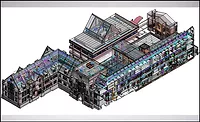
Engineering Renovations: Revitalizing the University of Minnesota's 90-Year-Old Pioneer Hall
Designers overcame numerous challenges to complete the $104.5 million Pioneer Hall expansion and renovation project in time for the start of the fall 2019 semester.
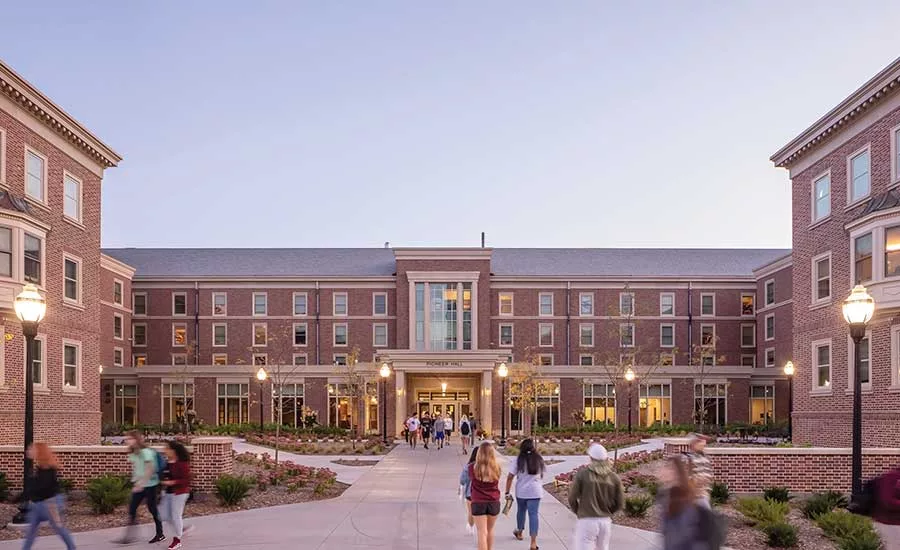
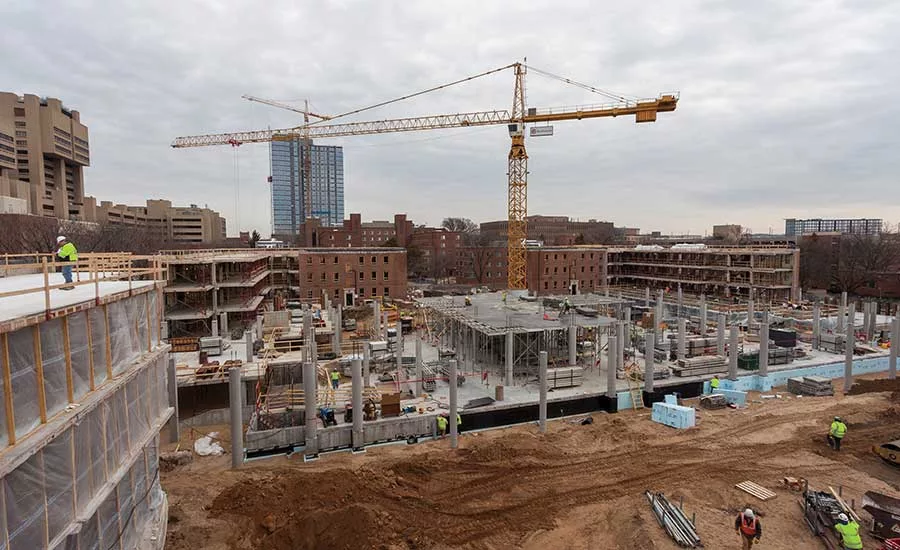
FIGURE 1. Pioneer Hall’s central connecting building sections and large sections of the building’s interior were demolished. Construction of the new, wider center wing is visible in the center of this photo.
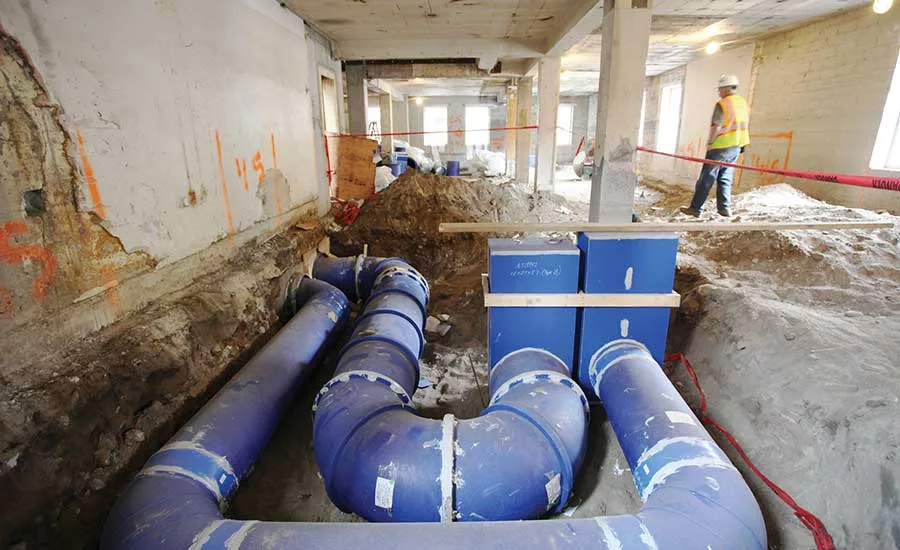
FIGURE 2. New mechanical systems were installed below grade. The high-density polyethylene pipe shown in this photo was installed alongside existing footings to connect air-handling units in the new mechanical room to vertical duct chases.
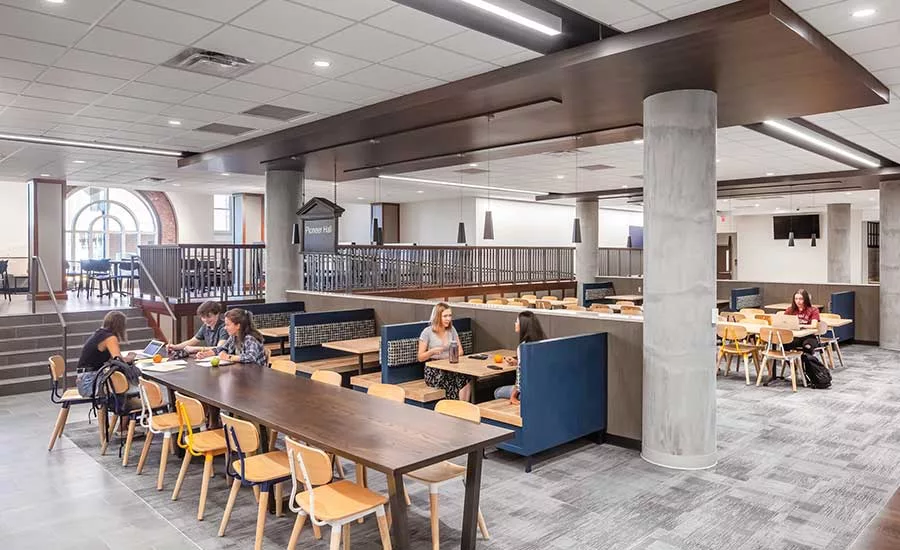
FIGURE 3. Pioneer Hall’s new dining hall is shown here. This view is toward a renovated section of the building, which includes the half-round window.

FIGURE 4. Pioneer Hall’s new entry area includes features that were salvaged from the old building. These include the original paneling and light fixtures, student mailboxes, and the Pioneer Hall sign, which is visible behind the desk.
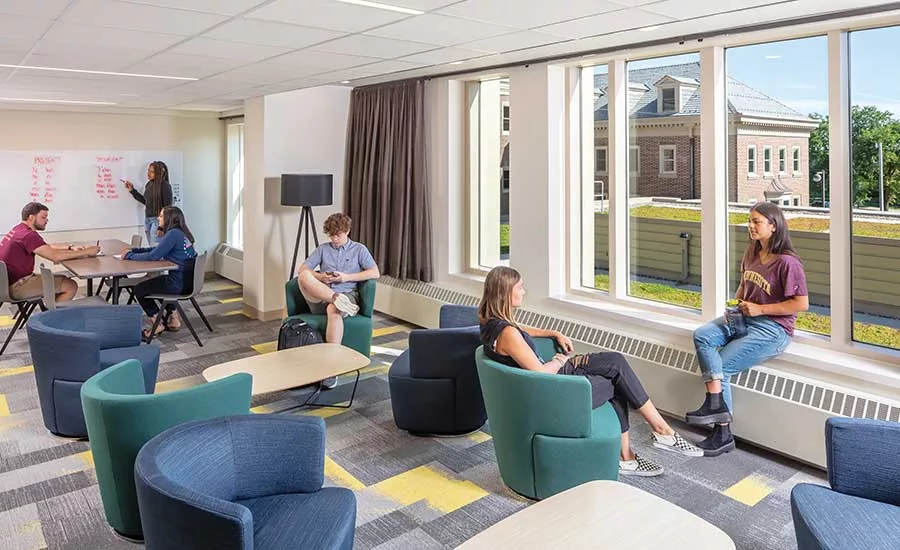
FIGURE 5. New student common areas in Pioneer Hall’s renovated west wing have a view of the green roof located on the building’s new center wing.
Pioneer Hall, one of four residence halls located within the University of Minnesota’s Superblock residential district, is prominently situated on the east bank of the Mississippi River on the university’s Twin Cities campus in Minneapolis. A much-needed expansion and renovation of the 90-year-old building was completed in time for classes last fall.
For decades, Pioneer Hall represented early efforts by the university to embrace the academic, social, and developmental significance of the first-year university housing experience. The university’s decision to preserve much of Pioneer Hall’s unique Georgian Revival-style exterior posed a design challenge. The residence hall’s limited floor-to-ceiling heights restricted the space for new mechanical and ventilation systems, incomplete historical drawings left designers guessing on how much reinforcement was in the original structure, and removal of 60% of the original building changed the way the structure behaved under loading.
Innovative engineering solutions, careful design coordination, and sustainable development practices all contributed to the preservation of Pioneer Hall’s sense of place in the university’s history while creating a modern student community that embraces the important role of social engagement in academic success and student retention.
Built in the Georgian Revival style, Pioneer Hall’s red brick exterior, slate roofs, central cupolas, terrazzo staircases, and doorway stone surrounds exhibited a high level of historic integrity. A decision by the board of regents in 2016 to preserve a significant amount of Pioneer Hall’s exterior but demolish much of its interior required that the building’s rebirth pay tribute to its significant place in the university’s history.
TKDA was selected to lead the design of the Pioneer Hall expansion and renovation project as the architectural firm-of-record and structural, mechanical, and electrical engineers. KWK Architects of St. Louis served as design architect on the project.
The decision to preserve Pioneer Hall’s historic presence required matching the building’s existing 9-foot floor-to-floor heights. This restricted the room available for new mechanical, electrical, plumbing, and fire protection (MEPFP) systems traditionally installed in ceiling spaces. A different approach and careful design coordination were required to meet or exceed MEPFP building codes. The building and its 39-inch hallways also did not meet ADA accessibility requirements.
The design team worked early on with stakeholders and the construction manager to investigate dozens of options involving various levels of demolition and new construction. A concept emerged that struck a balance between renovation and new construction.
The predesign study found that simply correcting noncompliant corridor widths and modifying room layouts within the existing narrow, C-shaped wings would result in a loss of almost half of the beds. A more creative solution was needed.
To accommodate the new housing and dining program, parts of the structure were demolished, while the character-defining portions of the residence hall fronting on Fulton, Harvard, Essex, and Walnut streets — constituting 40% of the upper floor areas — were preserved. Those floors were expanded toward the interior courtyards and new residential communities were built on each side of the widened corridors. Both east-west connecting wings — the spine of each “C” — were demolished and replaced with a single, wider center wing to match the building’s historic exterior. Renovations below grade made better use of space and added additional housing capacity to the five-story structure.
There were many unknowns as design began: Historical documents were often incomplete or incorrect. Extensive field testing and analysis, which could not begin until the building was vacated, were necessary to understand the existing reinforcing and load capabilities of the structure. Concrete compression tests, cores, chipping, and ground-penetrating radar all played a role. Approximately 60% of the original building was removed, including the wood-framed slate roof; every window, stairway, and partition; and all ductwork, piping, and electrical wiring.
Removal of large sections of the building changed the loading dynamics; loads had to be analyzed under the demolition scenario. A significant amount of temporary shoring was required to support existing pan-and-joist floor bays; those loads were later assumed by the new post-tensioned structure. Post-tensioned concrete slab floors required complex detailing to eliminate load transfer to the existing structure during the movement and creep that occurs during the post-tensioning process. Placement of new interior columns could not impede the use of space, and constant coordination was needed to avoid conflicts between new structural components and new MEPFP systems.
One of the biggest challenges involved weaving new mechanical systems into the original building framework. The typical approach was precluded by existing 7-foot-6-inch clearances to the bottom of the existing concrete beams that were integrally cast into the building’s floor slab, as many ran right through the center of residents’ rooms. To minimize the impact to the living spaces, the solution involved individually designed vertical duct chases from forced-air systems constructed below the slab-on-grade. The duct chases had to be spaced every 60 feet to meet the larger fresh-air requirements of today’s ventilation codes, while ceiling gaps could not accommodate anything larger than a 5-inch supply air duct. An iterative analysis was necessary to model and fine-tune this branching ventilation system. Careful coordination between mechanical and structural designers was required to locate each vertical duct chase and reinforce the impacted structural members.
BlueDuct high-density polyethylene (HDPE) pipe used in direct-burial below-slab forced-air systems was installed alongside the existing building footings to connect air-handling units in the new mechanical room, 16 feet below grade, to the vertical duct chases. Field modifications to some original footings were required, as they were higher than shown on as-builts and conflicted with new floor elevations. Other footings required underpinning to accommodate new buried ductwork and meet current building codes.
On-the-fly field decisions by designers were made possible through the use of iPad technology. Site markups made in this way eliminated time lags, streamlined the exchange of information, and made it possible to compress the project schedule.
The emphasis on energy recovery in the new Pioneer Hall has both economic and sustainable design implications because much of the building’s original heating-only piping and ductwork was not insulated. The building heating system converts 120-pound high-pressure steam supplied from the university’s power plant and deep tunnel distribution to 30-pound steam to serve the kitchen steam kettles and 10-pound steam for building heating purposes. Air-handling units equipped with an enthalpy total energy heat recovery wheel actively recover the heat in stale exhaust air and use it to preheat cold air, which improves system efficiencies. An air-to-water heat recovery system captures waste heat generated in the district steam tunnels, which is used to preheat incoming domestic hot water. Variable-speed ECM motors were used on all small heating and cooling fan coil units serving the dormitory rooms; large motors are premium efficiency-type motors, resulting in low energy use and significant electricity savings. Kitchen grease hoods equipped with heat and smoke sensors signal variable-speed exhaust fans to adjust exhaust air to respond to cooking operations.
The dining hall’s new green roof, visible to students, is vegetated with native plants that help filter rainwater. As part of a coordinated districtwide solution to stormwater management, runoff is captured in large buried retention tanks and diverted to university district cooling tower chillers for makeup water.
Insulated architectural precast concrete wall panels made it possible to accommodate a custom look to replicate design elements used more than 90 years ago. Unlike the building cladding used back then, however, the wall panels minimized mortar joints. This increased the building’s thermal capabilities and provided continuous insulation with an effective R-value of R-17.5. The use of post-tensioned concrete structure and insulated precast wall panels allowed construction to continue through the winter.
The elegant window detailing found in the original structure was cost-effectively interpreted in the new building exterior through reusable 3-D-printed window frame molds fabricated from carbon-fiber-reinforced ABS polymer. 3-D laser scanning technology was employed to develop a model of smart data points of the existing structure to establish accurate field conditions at the joints where the new building met the old.
Eighteen residential communities consisting of 31-45 beds were constructed along with apartments for a residence director and assistant residence director. Typically, each community has a community advisor unit, community lounge, and study room, while a larger floor lounge with a kitchenette serves several communities on the same level. Student living spaces include individually controlled intelligent thermostats with occupancy sensors. Accessible community restrooms serve up to 12 students. Accessible living units are provided, some with their own private restroom and SureHands lifts, which help raise an individual in a wheelchair into their bed or shower. Elevators now provide access to all floors, and all building entrances are accessible.
The newly constructed 850-seat dining area, located at street level beneath the new east-west center wing, extends out into the southern courtyard space defined by the existing south wings. Portions of the dining area can be closed for limited use during periods of low demand, and the dining facility, which is open to the public, is accompanied on the ground floor by building social spaces, a residence hall office, classrooms, and multipurpose spaces.
The $104.5 million Pioneer Hall expansion and renovation project successfully met or exceeded each of the priorities established by the board of regents. The expansion provided 63 more residence hall beds (from 693 on four floors to 756 on five floors) to meet the growing need for on-campus housing while preserving much of the historical landmark’s exterior. The new dining center can accommodate all 2,900 Superblock residents as well as the general public and employees of the nearby growing medical center. Lastly, the project met the budget and was completed by construction manager at risk McGough Construction Co. Inc. a month early, in time to receive incoming freshmen for the fall 2019 semester despite an aggressive construction schedule.
The project was recognized with a Grand Award in January 2020 by the American Council of Engineering Companies-Minnesota for its ingenuity, high level of accomplishment, and value to the community.
Looking for a reprint of this article?
From high-res PDFs to custom plaques, order your copy today!