Engineering the Future of Brain Health at the University of South Carolina
A new center combining leading-edge brain health care and research at the University of South Carolina, from the P.E.'s perspective
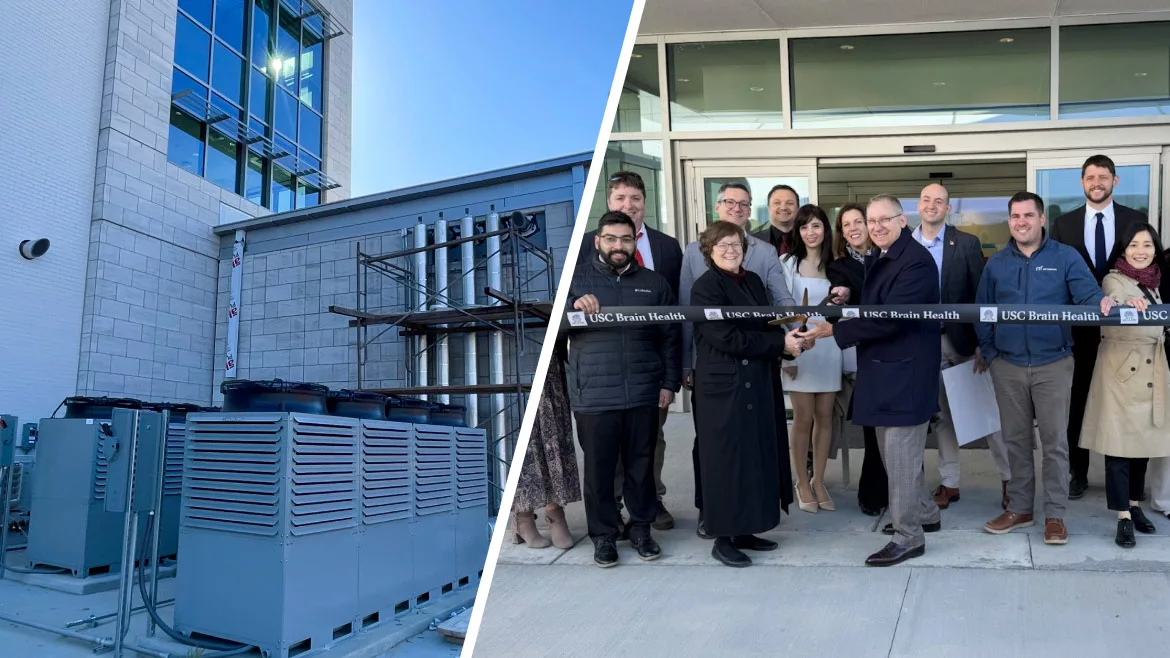
MECHANICALS: Left: Some of the outdoor mechanicals of the building, including VRF units. Right: Ribbon cutting ceremony for the USC Brain Health Center.
The University of South Carolina (USC) recently unveiled its new Brain Health Center, a 65,000-square-foot facility that allows patients with cognitive conditions such as Alzheimer’s disease and related dementias to more easily access specialized care and diagnostic support. The center, which is part of USC’s Health Sciences Campus in downtown Columbia, houses clinical services, advanced imaging, infusion therapy, rehabilitation, and research. This merging of services was executed with the goal of improving treatment options and outcomes through opportunities for patients to engage in clinical trials and studies.
A facility conducting leading-edge research and treatment demands reliable MEP systems. With that in mind, RMF Engineering partnered with Quackenbush Architects + Planners and Perkins&Will, as well as general contractor Hood Construction Company, to establish an expansive power supply and dependable safety systems. To meet the facility’s complex needs, RMF provided full MEP and fire protection design, supporting its ability to provide advanced patient care and treatment for years to come.
Project Synopsis
Designed with patient comfort and clinical excellence in mind, the Brain Health Center brings together cutting-edge technology, advanced research capabilities, and dedicated care spaces under one roof. The outpatient facility includes 16 exam, testing, and treatment rooms, an eight-bay infusion suite, and areas purpose-built for physical, occupational, and speech therapy.
The center anchors USC's statewide Brain Health Network—a system of brain health clinics and a future neurological hospital and rehabilitation center, also supported by RMF—by extending access to cognitive screenings, evaluations, and community support services for underserved regions of South Carolina. Beyond direct patient care, the facility strengthens USC's research mission, advancing both the treatment and understanding of brain-based disorders at regional and national levels.
A Care-Based MEP Plan
RMF's thoughtful approach to MEP design helped create a high-performance, sustainable facility supporting modern clinical, research, and imaging environments. To strengthen the resilience of the mechanical systems, redundancy was built into critical components throughout the facility, including air handling unit fans, building and data center chilled water pumps, and data center computer room air conditioning units. Should a component fail, this approach shifts replacement from an emergency response to a planned maintenance activity, reducing disruption and operational risk to the center as a whole.
The central air handling and chilled water systems were deliberately designed to be oversized to accommodate the building's full future fit-out, implementing a forward-thinking strategy that will significantly limit disruption to ongoing facility operations when that work occurs. Each MRI scanner was equipped with its own dedicated chiller and quench vent, carefully integrated into the building's infrastructure. The associated piping and ductwork were precisely sized and thoughtfully routed to an exterior mechanical yard, where a screen wall maintains a clean roofline above the MRI suite while also restricting access to authorized service personnel only. Placing this equipment on the rooftop also gave the architectural team the opportunity to integrate a cohesive screen wall that aligns seamlessly with the overall building façade.
Electrical Support for Technology Implementation
The facility is supported by advanced tools and technology, including South Carolina’s first 7-Tesla dedicated to patient care and 3-Tesla MRI scanners. The 7-Tesla system sets a new standard for brain imaging precision, making it possible to detect subtle abnormalities earlier and with greater confidence. For USC researchers pushing the boundaries of neurological science, it also provides the clarity and detail needed to support their pioneering work.
The data center spans approximately 1,600 square feet, including an infrastructure and server room, a staff room for monitoring network operations, and an area for administration and equipment maintenance. A backup generator was installed to support the data center space for IT equipment and the associated cooling. For IT needs specific to the Floyd School of Medicine, the data center supports the ever-increasing network and data needs for healthcare. The project serves as a precursor for bringing the main Health Sciences Campus online.
Fire Protection
The fire protection design also relied on a resilience-based approach to planning and implementation. A new combination system, which pairs manual wet standpipes with automatic wet sprinklers, provides comprehensive coverage throughout the building. In the MRI suite and data center, where equipment costs and operational continuity are most critical, double interlock pre-action sprinkler systems add an additional layer of protection. To streamline ongoing maintenance and testing, the pre-action equipment was consolidated in the incoming water service room alongside the fire protection backflow preventer.
The USC Brain Health Center is a testament to what intentional, forward-thinking engineering can achieve in a complex healthcare environment. By designing with resilience, flexibility, and long-term performance at the forefront, RMF Engineering helped bring a facility to life that is as equipped for the future as it is for the patients it serves today.
Looking for a reprint of this article?
From high-res PDFs to custom plaques, order your copy today!