LSU Engineering Team Uses Virtual Technology to Study Thermal Effects on Building Occupants
BATON ROUGE, La. — According to a recent study by the U.S. Environmental Protection Agency (EPA), people spend more than 90% of their time indoors and a significant amount of energy is used to keep building occupants comfortable and mentally and physically healthy.
As a result, it’s important for the design and engineering community to better understand, analyze, and even predict human building interactions for structures still in the design phase. With this in mind, a team led by LSU construction management professor Yimin Zhu is using immersive virtual environments (IVEs) to measure individuals’ thermal states — i.e., sensation, comfort and acceptability — in an effort to reduce performance gaps in buildings between predicted and actual energy performance.
“Many researchers have pointed out the lack of capabilities to observe human building interactions as one of the many sources contributing to the performance gap of buildings, i.e., the difference between the design performance and the actual performance,” Zhu said. “Immersive virtual environments as a proxy to reality present an interesting opportunity. While the technology is increasingly being used in design and engineering, such as in design validation, the potential of using it for understanding thermally driven behaviors is not known.
“This is because the technology itself cannot effectively provide thermal stimuli,” Zhu continued. “Therefore, by integrating IVE with an external heating/cooling source, we hope to develop a reliable experiment and data collection method for designers and engineers.”
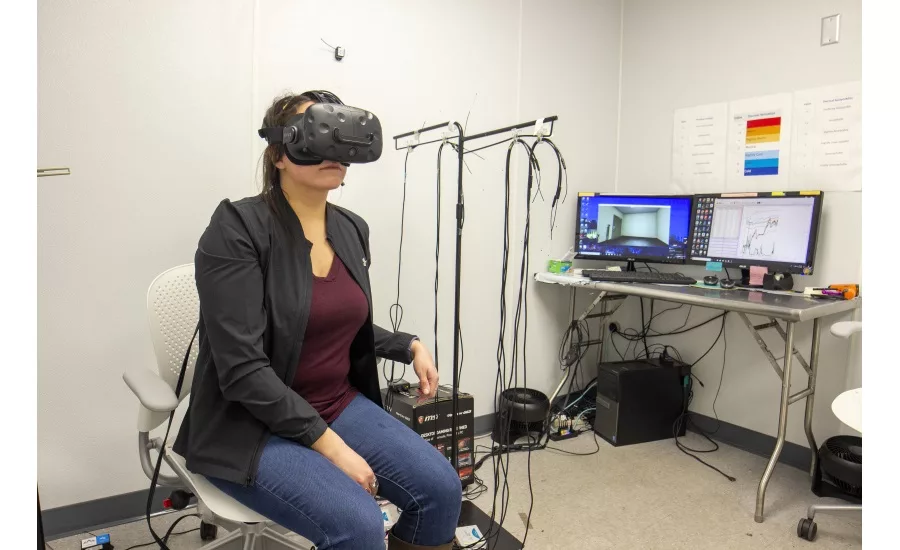
The research, made possible by a $300,000 grant from the National Science Foundation and support from the Construction Industry Advisory Council, works like this: In the engineering lab annex on LSU’s campus is a facility divided into three spaces — a climate chamber, an office area, and a mechanical/storage area. Tests are conducted in the climate chamber, a specially equipped space measuring 12 feet long, 12 feet wide, and 9 feet tall. Inside the office area, tests are monitored, data analysis is performed, and participants can rest and acclimate before the experiments.
An HVAC system controls the temperature, humidity, and airflow of the space. Experiments are conducted by setting the temperature to 65°F, then 75°, and, finally, 85°. Relative humidity is set to 50%-55%. Standalone sensors monitor participants’ physiological responses during the experiments. Testing is done twice, once in an in-situ setting and then again with the participant wearing a virtual reality goggle, which allows him or her to see a VR model of the climate chamber.
“The initial analysis suggests that the behavioral intention of participants is independent of the experiment settings,” Zhu said. “In other words, just because they are in virtual reality experiments does not mean participants’ intentions have a specific pattern. As a matter of fact, we observe their intention differences between the two experimental settings, but there isn’t sufficient evidence to solely contribute them to the virtual reality technology. We will further explore these issues when more data are collected and analyzed.”
Though it’s early in the process — there is another year left of experimentation — Zhu is encouraged by the role IVE technology has played in the experiments.
“Overall, the potential of IVE technology to support design and engineering is promising,” Zhu said. “With a better control of experiment environments, like using a climate chamber, it is possible to observe reliably occupants’ thermal sensations in IVE. At this stage, we don’t know yet if we can say the same for behavior intention. Until then, we will have a better idea how IVE can play a significant role.”
In the coming months, Zhu and the team will finalize the data collection and analysis. That information will then be shared with research and industry communities to further increase efficiency in building design and reduce the performance gap.
“I hope, based on the findings, we can have an enhanced experiment protocol; more effective analysis; and a group of like-minded students, researchers, and industry practitioners to further advance this line of research and applications,” Zhu said.
Zhu is joined on the project by Tracey Rizzuto, professor and associate director of the LSU School of Leadership and Human Resource Development; Neil Johannsen, assistant professor in the LSU School of Kinesiology; and Tianzhen Hong and Jared Langevin, scientists at the Lawrence Berkeley National Laboratory. In addition, Yong Tao, professor and interim chair of mechanical engineering at Cleveland State University; William Tolone, professor and associate dean of computing and informatics at the University of North Carolina-Charlotte; and Ming Sun, professor and associate dean of research at the Nottingham Trent University School of Architecture, Design, and the Built Environment, act as an advisory committee on the project. For more information, visit www.lsu.edu/eng.
This article originally appeared on Louisiana State University’s College of Engineering news website. View the original article here: https://www.lsu.edu/eng/news/2020/02/zhuthermaleffects.php
Looking for a reprint of this article?
From high-res PDFs to custom plaques, order your copy today!