LSU Mechanical Engineering Faculty Team Up With NASA to Advance Additively Manufactured Materials
Thanks to a NASA EPSCoR (Established Program to Stimulate Competitive Research) and Louisiana Board of Regents grant, LSU mechanical engineering professors Shengmin Guo and Michael Khonsari are working with NASA and LaSPACE to advance additively manufactured alloys to help reduce cost and lead times.
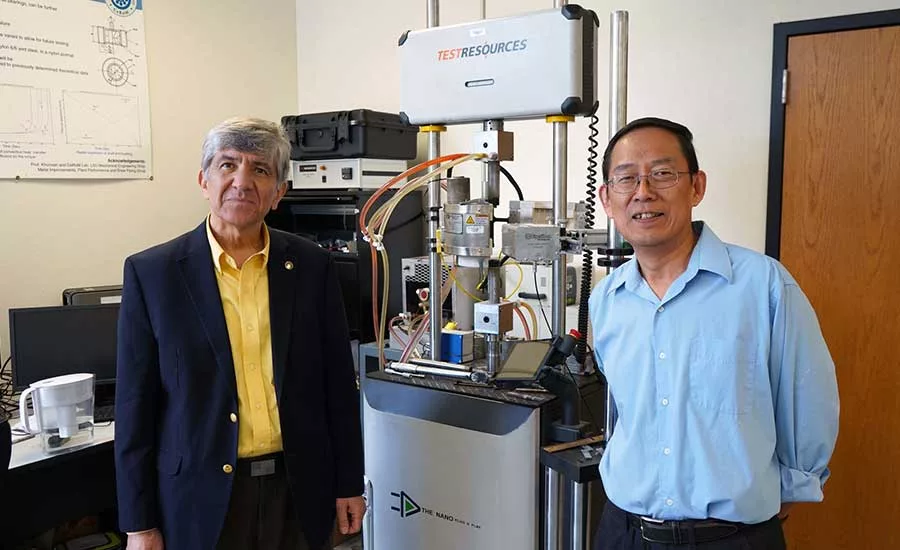
LSU department of mechanical and industrial engineering professors Shengmin Guo and Michael Khonsari are working with NASA - National Aeronautics and Space Administration and Louisiana Space Grant & NASA EPSCoR Programs to advance the use of additively manufactured alloys in producing needed parts, reducing cost and lead times.
Launch vehicles and propulsion systems are very complex and must survive extreme thermal, dynamic, pressure, and environmental loads. The materials and alloys used in these systems are often challenging to produce, costly, and have long lead times. Thanks to a NASA EPSCoR (Established Program to Stimulate Competitive Research) and Louisiana Board of Regents grant, LSU mechanical engineering professors Shengmin Guo and Michael Khonsari are working with NASA and LaSPACE to advance additively manufactured alloys to help reduce cost and lead times.
“Our goal through EPSCoR and other partnerships is to advance technologies, including novel alloys, for our missions and commercial spaceflight partners,” said Paul Gradl, NASA principal engineer at Marshall Space Flight Center in Huntsville, Alabama. “Part of our role is to understand the additive manufacturing processes better and provide accessible data so that NASA and industry can make better use of these processes and novel alloys.”
For the past 18 months, Guo and Khonsari have been experimenting with alloys used in liquid rocket engine components made by additive manufacturing (AM) methods, such as laser powder-bed fusion (L-PBF) and laser powder-directed energy deposition (LP-DED) methods. When NASA makes parts using additive manufacturing, the parts cost 50% less to produce than parts made with traditional manufacturing, and parts can also be produced two to 10 times faster. Traditional parts can take a year to make, whereas, the same part can be made using AM methods in a few weeks or, for the most complex parts, in a few months.
L-PBF metallic 3D parts are fabricated by sequentially and selectively melting thin powder layers according to CAD-directed laser scanning strategies. Multiple laser line scans form the desired 2D section shape, followed by multiple powder deposition/laser irradiation cycles that generate complex 3D metal/alloy parts. LP-DED allows for large AM parts to be fabricated with a deposition head attached to a robot based on a CAD-directed toolpath.
In this project, Guo, Khonsari, and their graduate students conducted thermal and mechanical property measurements on more than 30 AM alloys and processes and established protocols for sample preparation, thermal and mechanical property testing, material characterization, and data analysis. Supported by EPSCoR and NASA Marshall, this project will provide NASA and industry with detailed datasets regarding thermophysical properties of the metallic AM parts.
“We have a lot of complex parts that have internal features and channels that were traditionally made from multiple joining operations (welding and brazing) to fabricate a component,” Gradl said. “As additive manufacturing processes and metal alloys mature, we must have good understanding of the properties to design for these additive processes that include mechanical and thermophysical properties.”
According to Gradl, the thermophysical properties are a critical element of the design, and NASA required a substantial dataset for materials used in additive manufacturing processes, which is where the EPSCoR grant filled a gap. A key thermophysical property is thermal conductivity, particularly in high-temperature components, such as combustion chambers, where heat transfer is critical for the alloy being used.
“This project builds upon the successful results of multiple National Science Foundation grants, Louisiana Board of Regents grants, and LSU’s investments in material and advanced manufacturing research,” Guo said.
Apart from thermal property measurements, this team utilized the LSU Center for Rotating Machinery (CeRoM) equipment to perform mechanical testing and provide mechanical property measurements using the LSU Shared instrumentation Facility. CeRoM houses state-of-the-art fatigue-testing equipment, including rotating bending, fully reversed bending, torsion bending, and tension compression combined with torsion testing apparatuses.
“EPSCoR is excited to be associated with this research,” said Jeppie Compton, NASA EPSCoR project manager. “What is lab research today will one day be normal business, and with this database of properties that the team did methodical studies on, NASA and our industry partners could have a huge advantage for decades to come.”
Guo’s AM alloy thermophysical property work will also be featured in the appendix of a textbook led by NASA titled “Metal Additive Manufacturing for Propulsion Applications.” This book will be published by American Institute of Aeronautics and Astronautics (AIAA) under the Progress in Astronautics and Aeronautics series. For more information, visit http://www.lsu.edu/eng.
Looking for a reprint of this article?
From high-res PDFs to custom plaques, order your copy today!