Killing Airborne Germs with Ultraviolet Germicidal Irradiation
As the threat of measles and other infectious diseases continue to make headlines, more and more building and facility managers are searching for ways to reduce the threat from contagious airborne pathogens.
Using ultraviolet germicidal irradiation (UVGI) for disinfection is not new. In 1877, researchers in the journal Nature described how sunlight prohibited the growth of microorganisms. Since the 1940s, many hospitals have relied upon germicidal ultraviolet-C (UV-C) energy to control airborne infectious diseases, but use waned with the arrival and proliferation of antibiotics. In the 1990s, demand for the technology returned following a resurgence of drug-resistant infectious microorganisms; as germicidal UV-C technology kills airborne pathogens without increasing their antibiotic resistance. In other words, there is no way for microbes to develop a resistance to germicidal UV-C, and there are no harmful side effects as a result of its use. It’s important to note that science has not found any microorganism that can withstand the destructive effects of the UV-C 254-nm germicidal wavelength, including superbugs and other antibiotic resistant germs.
ASHRAE, too, has recognized that the UV-C wavelength inactivates virtually all microorganisms living on HVACR surfaces with a kill ratio of 90% or higher, depending on UV-C intensity and length of exposure.
Commercial IAQ problems vary from application to application, but they often stem from a poorly maintained HVAC system whose organic-rich environment is an ideal breeding ground for microbial buildup on surfaces and in the airstreams they condition. Thus, this is one of the first areas a contractor should check when isolating an IAQ problem.
How HVAC Contractors Can Help
While the use of UV-C to irradiate cooling coils has become more common, HVAC contractors need to educate and remind facility managers and building owners about the fact that ultraviolet germicidal irradiation is an established means of killing airborne pathogens and mitigating the spread of infectious diseases. Some commercial building managers now look at UV-C’s ability to deliver better indoor air quality as a benefit they can tout to their tenants and prospective tenants.
As examples, upper-air UV units cost as little as $3-$3.50 per square foot of treated space. Air-stream disinfection systems range from 60-80 cents per cfm and HVAC surface disinfection systems are approximately 10-15 cents per cfm.
Keep in mind that UV-C has a detrimental effect on organic (e.g., pathogens) and nonorganic (e.g., plastics, etc.) material. Prior to mounting a UV-C fixture, contractors should inspect the installation location to ensure that those surfaces that will be exposed to UV-C and are susceptible are protected when possible. In residential settings, many of the filters used are synthetic and are very susceptible to UV-C’s destructive energy, therefore UV-C fixtures should not be installed in a location where they will irradiate synthetic filters. More typically, UV-C fixtures are installed downstream of the cooling coil (e.g., the leaving air side) to irradiate the cooling coil. Additionally, if wires are present where the UV-C energy is, they should be protected by applying metal tape or even aluminum foil.
The adoption of UV-C technology will grow exponentially as facility managers look to improve efficiency and address IAQ issues, such as the rise of antibiotic-resistant infections in hospitals and schools and new health scares, like the recent Legionella outbreak. UV technology is one of the most reliable and efficient means of keeping indoor air clean and germ-free. Add to this the savings that can be realized with UV-C’s ability to clean and maintain cooling coil energy efficiency, and we would expect UV applications to significantly increase in the coming years.
Three Methods of Applying UV-C Energy
There are three primary means of applying UV-C systems against infectious agents: upper-air, HVAC airstream disinfection, and surface irradiation. Upper air/room systems are installed in classrooms, cafeterias, gymnasiums, locker rooms, childcare centers — anywhere infectious agents may exist. Coil-irradiation and airstream-disinfection systems are installed within HVAC air-handling units and duct runs. Some applications combine upper-air UV-C units to kill airborne microorganisms along with UV-C lamps installed within HVAC systems to provide supplemental airstream kill ratios and on all plenum surfaces.
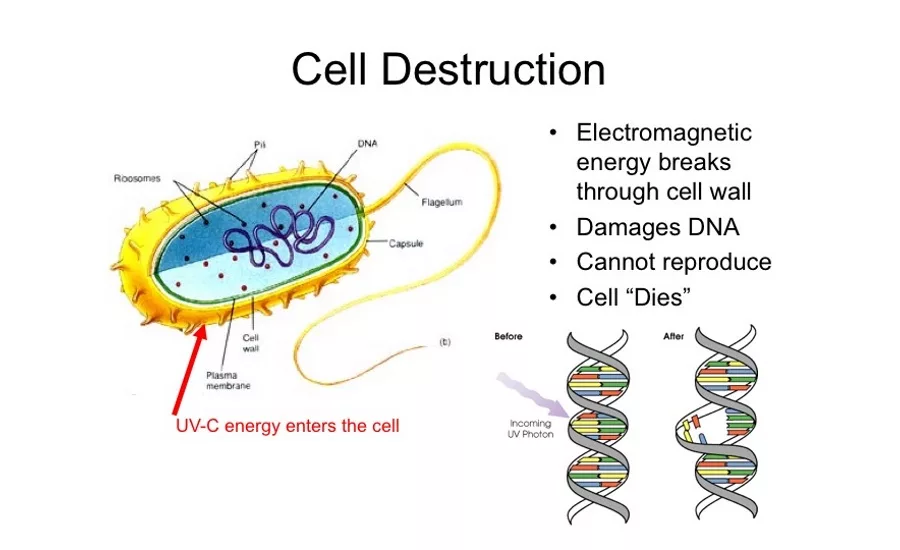
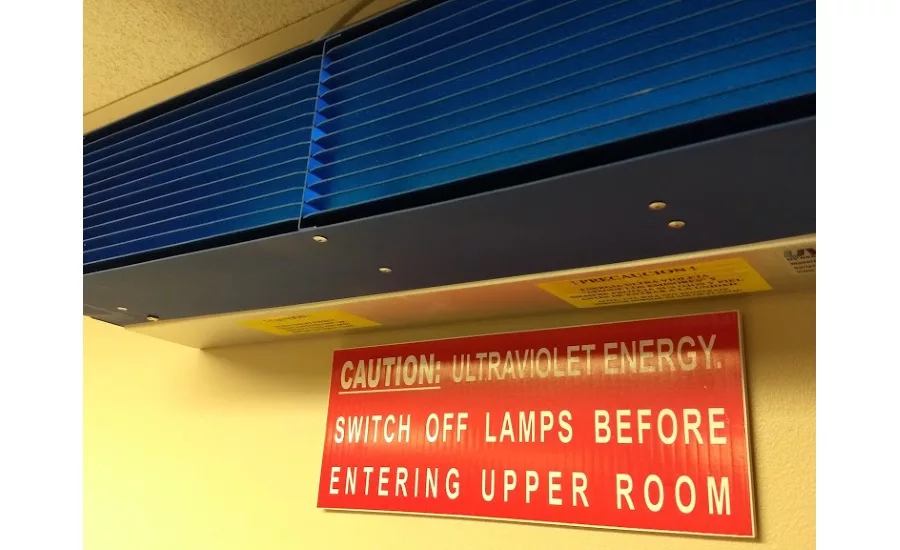
For the purpose of this article, we’ll focus on upper air UV-C systems designed to kill airborne infectious agents as they rise into the upper region of most any space. Typically installed on a wall at a height above seven-feet, the UV light fixture employs louvers to direct the radiation upward and outward to create an intense zone of UV-C in the upper air while minimizing the dosage in the lower (occupied) portion of the room or area. As convection or mechanical air currents lift communicable airborne agents into the upper air, they are exposed to the germicidal UV-C wavelength, which breaks the bacteria or virus DNA chain rendering it incapable of reproducing.
Ultraviolet Germicidal Irradiation - Discovery
The current scare over the Measles virus, one of the most contagious diseases known to man, is a good case-in-point. Nearly a century ago, Harvard University sanitary engineer, William F. Wells, discovered that germicidal ultraviolet energy killed airborne microorganisms, including Measles.
In the 1940s, Wells installed UV-C in suburban Philadelphia day schools to combat the spread of measles and compared infection rates. The schools without germicidal UV-C experienced a 53.6% infection rate, while the schools with the germicidal wavelength saw just 13.3%.
Around the same time, in 1936, Dr. Deryl Hart experimented with germicidal UV-C to disinfect an operating room at Duke University Hospital. He reported an 11.38% reduction in the rate of postoperative infection rates. Throughout the next few decades, UV-C was applied in schools and hospitals across the country, proving its ability to inactivate microorganisms and bacteria.
Compared to germicidal fixtures used in these studies, newer fixtures are available today that provide greater UV-C output and coverage, are less costly, use less power, and are less expensive.
Ultraviolet Germicidal Irradiation – How it Works
UV light comprises a segment of the electromagnetic spectrum between 400-100 nm, corresponding to photon energies from 3-124 eV. The ultraviolet segment has four sections, labeled UV-A (400-315 nm), UV-B (315-280 nm), very high energy and destructive UV-C (280-200 nm), and vacuum UV.
We all are familiar with the deleterious effects of UV transmitted by sunlight in the UV-A and UV-B wavelengths, giving rise to UV inhibitors or blocking agents, which are found in glasses and lotions. We are also familiar with products engineered to withstand the effects of UV radiation, such as plastics, paints, and rubbers.
However, unlike UV-A and B, the UV-C wavelength has more than twice the electron volt energy (eV) as UV-A, and it is well absorbed (not reflected) by organic substances, adding to its destructiveness. Frequently used to mitigate the risk of nosocomial infections, the germicidal 254-nm wavelength “C” band (UV-C) is particularly effective at destroying airborne viruses, bacteria, and mold spores.
UV-C’s germicidal effects are well proven. It owes these effects to the biocidal features of ionizing radiation, that is, UV-C does far more damage to molecules in biological systems than can temperature alone. Sunburn, compared to the sensation of warmth, is one example of that damage. Sunburn is caused by the sun striking living cells in the epidermis and killing them; the resulting redness demonstrates the increased capillary action and blood flow enabling the removal of the dead cells.
Ionization drives UV-C’s power to alter chemical bonds. It carries enough energy to excite doubly bonded molecules into a permanent chemical rearrangement, causing lasting damage to DNA, ultimately killing the cell.
UV-C exposure and the resulting dosage is the quantity of germicidal energy absorbed over a specific period of time. A 2013 study commissioned by ASHRAE and the Air Conditioning, Heating, and Refrigeration Institute (AHRI) found that even the most sophisticated organic compounds suffer from exposure to small dosages of UV-C energy, rendering microbial replication impossible.
In fact, the U.S. Centers for Disease Control and Prevention Healthcare Infection Control Practices Advisory Committee finds that ultraviolet energy helps to control disease transmission: “As a supplemental air-cleaning measure, UVGI is effective in reducing the transmission of airborne bacterial and viral infections in hospitals, military housing, and classrooms…”
Upper-Air/Room Germicidal Technology
The primary objective of upper-air UV-C placement is to interrupt the transmission of airborne infectious diseases where people congregate, especially in high-occupancy settings, such as schools, childcare centers, airports, cafeterias, homeless shelters, and emergency rooms, where unsuspected infectious persons may be present.
All of these spaces can be effectively and affordably treated with germicidal UV-C. Airborne droplets containing infectious agents can remain in a well-ventilated room for as long as six minutes. Operating 24 hours a day, wall-mounted upper-air systems inactivate exposed microbes in under a second, and these units have been shown to be effective against airborne viruses and bacteria, including chickenpox, measles, mumps, varicella, TB and cold viruses.
Conclusion
Although germicidal UV-C systems have been used for nearly 80 years, their application in infection control settings has waxed and waned. Given the growing desire to prevent the transmission of infectious diseases in facilities ranging from schools to hospitals to international airports, facility professionals may want to examine currently available germicidal UV-C technologies that address airborne infectious agents. In particular, upper-room UV-C systems and UV-C systems that irradiate interior surfaces of HVAC air-handling units, both of which operate continuously, can greatly reduce concentrations of pathogens in a highly reliable and cost-effective fashion.
Looking for a reprint of this article?
From high-res PDFs to custom plaques, order your copy today!


