search
Ask ACHR NEWS AI
cart
facebook twitter instagram linkedin youtube
  • Sign In
  • Subscribe
  • Sign Out
  • My Account
  • NEWS
  • TECHNOLOGY
    • Heating & Boilers
    • Cooling & Chillers
    • Pumps & Flow Controls
  • SECTORS
    • Commercial
    • Health Care
    • Data Center
    • Educational Facilities
  • DESIGN | CONSTRUCTION
  • OTHER TOPICS
    • High-Performance Buildings & Automation
    • Ventilation and IAQ
    • Commissioning
    • HVAC Retrofits
  • TODAY’S BOILER
    • Today’s Boiler Archives
    • Today’s Boiler Digital Edition
  • MORE
    • Case Studies
    • Podcasts
    • Videos
    • Directory
    • Webinars
    • ES NEWS Store
    • White Papers
  • SIGN UP
  • Back to The NEWS
Engineered Systems NEWSHVAC Engineering TechnologyHVAC Engineering SectorsToday's BoilerHeating & BoilersPumps & Flow ControlsCommercial HVAC

Today's Boiler

Six Boiler Combustion Rumble Solutions

When the primary source of rumble and vibrations is traced back to the combustion process, effective measures can be taken to satisfactorily reduce or eliminate the objectionable noise and vibrations.
By Mike W Valentino
Six Boiler Combustion Rumble Solutions

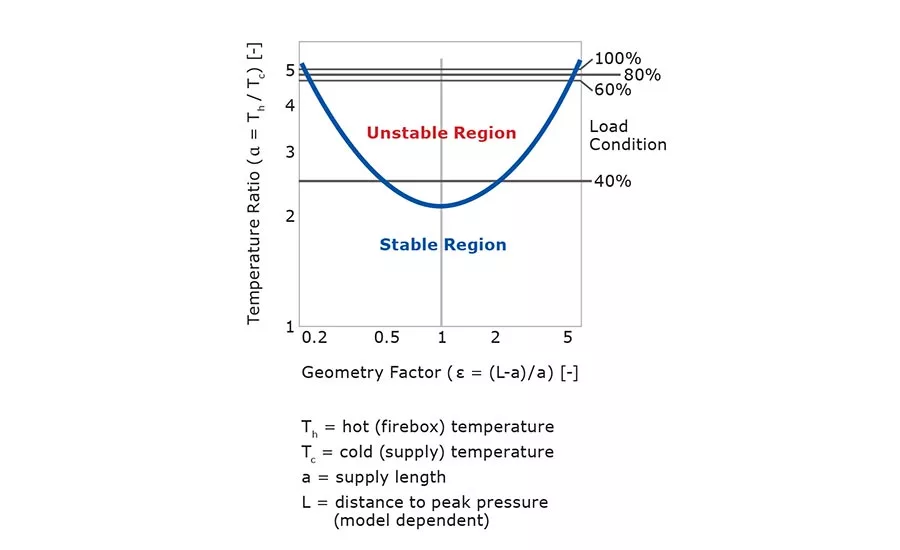
Figure 1. A thermoacoustic vibration stability curve [Eisinger and Sullivan (2008)] with typical load isotherms

November 7, 2019

If you’ve been around boiler rooms, you’ve undoubtedly run across the phenomena of combustion-related noise and vibrations. Often referred to as combustion “rumble,” this phenomenon produces vibrations and sound pressure waves that can range from a low-frequency rumbling sound to a high-pitched screech or howl. In some instances, these pulsations can be so severe, as to:

Six Boiler Combustion Rumble Solutions:

  • What is combustion noise? Where does it come from?
  • Contributions of the combustion process
  • Boiler stacks and breeching contributions
  • The importance of draft control
  • Importance of burner refractory
    front plate design
  • Mitigating combustionrelated
    vibrations and rumble
  • Conclusions

  • Present undesirable sound levels for occupants, both nearby and at a distance;

  • Shake loose electrical connections and terminations, including important safety devices;

  • Loosen or break mechanical fittings and connections;

  • Cause structural damage to property and equipment; and

  • Cause personal injury, such as from falling objects.

Engineers, installing contractors, owners and operators, technicians, and equipment manufacturers alike have struggled with the identification, prevention, and solutions to combustion noise-related issues for years.

And while there is no magic bullet for addressing all potential sources of combustion rumble, a better understanding of the issue and its underlying causes is paramount in developing strategies for mitigating combustion-related noise and vibrations.


What is combustion noise? Where does it come from?

Combustion noise and associated vibrations begin at the burner. When the burner is not firing, there is no combustion noise. This seems logical, but, that’s not to say the problem of noise or rumble is solely the fault or responsibility of the burner. In fact, objectionable noise or rumble is often the result of interactions between several sources:

  • The combustion process itself coupled with acoustical characteristics of the boiler, stack, and breeching designs;
  • Burner and boiler design/geometry;
  • Fuel-air mixing characteristics;
  • Flue gas recirculation (FGR);
  • Fuel gas pressure regulation;
  • Widely varying combustion air temperatures;
  • Draft control;
  • Flue gas turbulence in stacking and breeching, providing an amplifying feedback mechanism that can affect the combustion process itself; and
  • Others.


Contributions of the combustion process

Substantial empirical and theoretical research has been conducted in combustion noise and vibrations over the last 20 years — most notably by F.L. Eisinger and R.E. Sullivan in their 2002 and 2008 publications on “thermoacoustic” oscillations in boilers and furnaces. In 2017, Babcock & Wilcox Co., in collaboration with the Oak Ridge National Laboratory (ORNL) in Knoxville, Tennessee, presented a technical paper to the American Flame Research Committee on the subject.

Here’s a summary of their work and findings, including the work of others dating as far back as the 18th century:

  1. Thermoacoustic vibrations, or rumble, occurs in combustion furnaces and boilers as a result of the coupling and phase synchronization between the rate of heat input and rate of gas expansion and compression.

  2. Large temperature differentials between the burner inlet air temperature and hot combustion gases can prompt phase synchronization. The forces that normally dissipate the pressure waves are overwhelmed, and an amplifying feedback loop is created.

  3. Other key factors leading to thermoacoustic vibrations include boiler furnace geometry and thermophysical properties of the hot gas zones. These factors can provide the necessary conditions for development of standing acoustic (pressure) waves in the boiler furnace, which can be excited by heat energy input.

  4. Rumble tends to appear most often at the intrinsic “system” resonant frequency and harmonic multiples of that frequency. Thermoacoustic vibrations always require the presence of two key features: a large temperature gradient and a gas-filled cavity capable of supporting Helmholtz resonances.

A discussion on Helmholtz Resonance is left to the reader, but the work of Eisinger and Sullivan show that a large temperature difference between the cooler burner inlet air and the hotter combustion gases can promote phase synchronization in boilers.

Six Boiler Combustion Rumble Solutions

Figure 1. A thermoacoustic vibration stability curve [Eisinger and Sullivan (2008)] with typical load isotherms.

There are also geometrical considerations, such as burner cavity and the furnace’s design dimensions. As noted in their work, geometrical considerations provide the necessary spatial domains and boundary conditions for the development of standing acoustic waves. Fuel heat inputs can “excite” these standing pressure waves and provide an amplifying feedback loop.

Eisinger and Sullivan also developed a graph that shows the operating and design regions where phase synchronization and instability (leading to vibrations) are likely to occur (Figure 1). Dimensionless parameters representing key geometric and temperature factors are used to determine whether any given system falls into the stable (non-vibrating) or unstable (vibrating) regions. Typical load isotherms are plotted relative to these regions for a wide range of system geometries. Figure 1 indicates that thermoacoustic instability tends to increase with the load for a given geometric configuration.

As noted in the Babcock & Wilcox - ORNL technical paper, and evidenced by this author and many field personnel, the onset of combustion rumble frequently begins at part load (between 30%-40% of rated capacity) in the presence of operational transients, such as fuel-lean and fuel-rich conditions.


Boiler stacks and breeching contributions

Boiler stacks and breeching design, construction, and installation play a significant role in developing flow turbulence with the potential for the transmission of sound wave pulsations back to the boiler and burner, thereby accentuating vibration and rumble.

A stack and breeching configuration

Figure 2. A stack and breeching configuration.

NFPA-85, 4.7.8.3, specifically addresses the design of stacks and breeching: “The flue gas ducts shall be designed so that they do not contribute to combustion chamber pulsations.” Acute flow directional changes should be avoided, such as the use of Bull Nose T’s, sharp angle mitered joints, etc. It’s best to use smooth transitions, such as long radius elbows or multiple mitered joints, when forming a turn of gases.

When tying stack(s) into common breeching, good practice dictates stack connections to the breeching be at an angle of 45 degrees or less. Ninety-degree connections should always be avoided (Figure 2). Multiple boiler stack connections to a common stack or breeching should be staggered and never installed in an opposing fashion. Additionally, cylindrical ductwork is preferable to rectangular ductwork, thus avoiding large flat surfaces where vibration displacements can resonate and accentuate.

With multiple boilers on common breeching, the breeching should be “stepped up” in diameter along the direction of flow with smooth transitions to accommodate increased flue gas flow rates with low turbulence. The use of barometric dampers in boiler stacks or breeching can be effective, however, only under negative draft conditions. ABMA publishes a “Packaged Boiler Engineering Manual” that provides guidelines for boiler stacks and breeching designs.


The importance of draft control

The purpose of the boiler stack and breeching (for multiple boilers) is to provide the draft required by the boiler and burner manufacturer to evacuate flue gases to the point of a safe discharge. Typically, this draft requirement is around 0.05-0.5 inches water column of negative or positive draft.

With installations requiring tall stacks — multiple boilers connected to a common stack or breeching — it’s not always possible to account and control for the multitude of variables affecting draft without the use of draft control. And while the inclusion of barometric dampers can adequately relieve rumble conditions, these dampers can only be used in negative draft applications.

Variables affecting draft and thereby requiring draft control systems include firing rate, burner turndown, the need for FGR in emissions reduction, boiler staging schemes in multi-boiler installations, and more. When it comes to the firing rate, there is an inherent lag period between the burner’s firing rate changes and the draft damper’s response. Therefore, PID control schemes are now commonly employed, incorporating “feed-forward” input to the controller. Rather than simply responding to changes in draft conditions after changes in firing rate have occurred, feed-forward input allows the draft controller to monitor the burner’s firing rate. Accordingly, the control moves the stack damper to predetermined positions with the firing rate, which is determined at commissioning. When firing rate changes begin to level out, the PID controller takes over to trim the draft control damper and hold the draft set point for that particular firing rate.


Importance of burner refractory front plate design

A critical design consideration of boiler and burner packages is the refractory front plate, often referred to as the “burner dry oven, quarl, or throat section.” A typical refractory front plate is shown in Figure 3.

A typical refractory front plate

Figure 3. A typical refractory front plate.

Irrespective as to whether the burner is an integral part of the boiler package (manufactured by the boiler manufacturer) or supplied by a third-party burner company, the best situation is for the boiler package to be prequalified at the factory with the proper front plate design prior to shipment. In cases where the burner is supplied by a third-party manufacturer, specific dimensions of the front plate are usually provided to the boiler company or installing contractor. The design of this refractory is critical in that both combustion/flame qualities and acoustical response of the boiler-burner package must be considered.

With some firetube boiler and low-pressure-drop burner combinations, surrounding the refractory front plate with a soft, high-temperature insulating blanket can substantially dampen standing and reflected waves travelling inside the furnace.

Mitigating combustion-related vibrations and rumble

Whether the boiler room is new construction, part of a plant expansion, or a retrofit of existing boiler-burner equipment, the startup technician needs to deal with what’s at hand. At the point of commissioning, stacking and breeching may not be easily (or economically) modified to alleviate combustion noise and vibration.

However, when the primary source of rumble and vibrations is traced back to the combustion process, effective measures can be taken to satisfactorily reduce or eliminate the objectionable noise and vibrations.

Here are some possible steps that may be taken in this effort, in no particular order.

Solution 1: Adjusting Fuel-Air-FGR Ratios — In some instances, fuel-air ratio changes can be made near the onset of rumble to eliminate or alleviate noise and vibration problems. If a variable frequency drive (VFD) is employed on the combustion air fan, the VFD speed-to-firing rate profile can be modified. Low-fire VFD speeds are frequently set too low in the interest of turndown guarantees or promises of lower energy usage. Increasing the VFD speed at or near the onset of rumble while utilizing the combustion air damper to trim combustion airflow can sometimes mitigate rumble and vibrations as well.

Low-NOX systems employing FGR can contribute to rumble, particularly on a cold boiler start. Many burner controls employ a “hold” on FGR flow until the boiler warms up to a specified temperature. While compliance with permitted NOX levels is necessary, operating NOX  levels should not be too aggressive with respect to permitted values. In addition, many parallel positioning control systems allow the burner to pass through troublesome points in the firing rate curve.

While these potential solutions do not always work or are not always available to a technician, they are certainly worth investigating.

Solution 2: Repositioning Flame Stabilizer/Diffuser — Another simple method for a technician to alleviate rumble is to reposition the flame stabilizer or diffuser assembly forward or rear-ward inside the burner drawer. In fact, this is often one of the simplest procedures to perform that can yield very positive results.

It’s always recommended that any alterations made to a burner or boiler are first communicated with the boiler and burner manufacturer for guidance and approval. Additionally, burner and boiler modifications should only be performed by qualified and experienced personnel.

Solution 3: Applying Back-Pressure — A common trick used by field service and commissioning technicians is to apply back pressure to a boiler to reduce flame front oscillation that can drive combustion rumble. Many boilers are fitted with manual stack dampers that can be positioned and locked in place. Assuming that the burner has sufficient fan capacity (margin), applying a small amount of additional pressure back onto the boiler and burner package may yield positive results. In some applications, the insertion of an orifice ring in the stack has produced a similar dampening effect.

Gas spud symmetry

Figure 4. Gas spud symmetry.

Solution 4: Disrupting Burner Symmetry and Flame Stretching — Engineers and technicians appreciate symmetry, such as with gas orifice and gas spud arrangements on a burner, but sometimes a particular boiler application or its integration with site conditions does not. In these cases, symmetry is not your friend. Therefore, a disruption in that symmetry can produce excellent results and reduce or eliminate a rumble issue.

Changing to an asymmetrical gas spud or orifice pattern is one very effective technique to attenuating noise. For example, breaking up repeating spud patterns to a non-repeating pattern may be in order. Figure 4 shows a symmetrical gas spud pattern of a burner head. Altering this pattern in a rumbling boiler may produce positive results. This modification may entail blocking spuds (or orifices) in one, two, or three locations or changing spud lengths asymmetrically. This is typically a trial and error process.

Stretching the flame further down the furnace, sometimes referred to as relaxing the flame, can be very effective in reducing rumble. This method also involves modifications to the burner combustion head and could include elimination of longer spuds, repositioning the diffuser, gas and air mixing changes, the use of 90-degree longitudinal gas injectors for some or all of the fuel gas, and more.

It is noted that blocking gas ports and spuds will require higher main gas regulator output pressure to achieve rate. And, in employing these potential measures, care must be taken in preserving pilot, main gas light off, and flame scanning integrity and safety. Additionally, other combustion characteristics, such as low-CO emissions, must be observed and maintained.

Solution 5: Gas Pressure Regulation — Combustion pulsations can start at the main gas pressure regulator and be a symptom of regulator problems. A pressure gage in the main gas line downstream of the main gas pressure regulator can be an indication of such a problem; however, caution is advised in drawing conclusions too quickly from this origination elsewhere, such as feedback from stack, breeching, or the furnace.

Often, changing main gas pressure regulators to a new or alternate make of regulator may resolve or significantly mitigate rumble. It should also be noted that some pressure regulators do not accommodate a wide range of flow rates. Care must be taken in regulator selection for high turndown burners. Many inexpensive regulators will not respond satisfactorily to very low gas flow rates while still capable of regulating regulator outlet pressures.

Solution 6: Changing Furnace Acoustical Properties — One of the most effective ways to reduce or eliminate combustion-driven rumble is to change the boiler’s acoustics properties. In firetube boilers, for example, there are typically one to three additional tube bank passes to the first furnace pass. Between passes and in the tube bank turnaround areas, there is generally space where a “baffle” or flow deflector can be installed. Care must be taken to secure the baffle to areas that are not subject to ASME code requirements, such as welding onto the boiler tube sheet(s); however, there is evidence that shows that the strategic placement of a single baffle or deflector in one of these turnaround areas have effectively attenuated the rumble.

Another method is to sub-divide the furnace through placement of a partial barrier made of firebrick, roughly 30%-50% of the distance along the furnace. Many facility owners and managers frown on this practice and treatment to their boilers, which is understandable. Often, this option is left in the last resort drawer of solutions. But again, there is evidence that this method of mitigating rumble can be very effective.


Conclusions

Objectionable combustion rumble and vibrations stem from a complex set of conditions, including fuels fired, stoichiometry, operating and environmental factors, boiler and burner geometry and construction, stack and breeching design, draft conditions and control, and a host of other variables. Often, these considerations are intertwined and codependent.

Technical publications, national codes and standards, and experienced personnel, including equipment manufacturers and acoustics engineers/consultants, are available to plant owners and installing contractors to best select combustion equipment and construct the boiler room, thereby minimizing the risk of objectionable noise and vibrations.

However, being a very complex set of phenomena not always presented until the commissioning phase of the project, problems associated with rumble and vibrations are often addressed in the field. A few methods utilized by field service technicians and engineers have been cited in this article. Some methods are more applicable than others, some are dependent on the noise sources, and some rely on trial and error.

As with all activity involving boilers, burners, and controls, only qualified and authorized personnel should attempt to resolve these issues with safety remaining the No. 1 objective.


References

  • Thomas J. Flynn, Timothy A. Fuller, and Suzana Rufener , The Babcock & Wilcox Company and Charles E.A. Finney and C. Stuart Daw, Oak Ridge National Laboratory, Knoxville, TN USA, Thermoacoustic Vibrations in Industrial Furnaces and Boilers, American Flame Research Committee (AFRC) 2017
  • Thomas J. Flynn, Timothy A. Fuller, and Suzana Rufener , The Babcock & Wilcox Company and Charles E.A. Finney and C. Stuart Daw, Oak Ridge National Laboratory, Knoxville, TN USA, Characteristics of ‘rumble’ in industrial furnaces and boilers, 2018 Spring Technical Meeting

Central States Section of The Combustion Institute May 20–22, 2018, Minneapolis, Minnesota

  • Peter K. Baade, Fayetteville, New York, Michael J. Tomarchio, Rochester, New York, Tricks and Tools for Solving Abnormal Combustion Noise Problems, Sound and Vibration, July 2008
  • Peter K. Baade, Consultant, Fayetteville, New York, How to Solve Abnormal Combustion Noise Problems
  • Tompkins, G., and Kolbus, J., Boiler Installation Guide – Addressing Common Issues Impacting Safety & Performance of Boilers, June 2018, American Boiler Manufacturers Association (ABMA)

Back To Top

Share This Story

Looking for a reprint of this article?
From high-res PDFs to custom plaques, order your copy today!


Mike W. Valentino is president of Boiler Room Consulting LLC and a consultant for ABMA.

Recommended Content

JOIN TODAY
To unlock your recommendations.

Already have an account? Sign In

  • HVAC-enrollment

    The Trades Are Back: HVACR Programs See Nearly 30% Enrollment Spike

    A new wave of future technicians is entering the pipeline.  
    Training and Education
    By: Matt Jachman
  • 2025 Top 40 Under 40

    2025 Top 40 Under 40 HVACR Professionals List

    The 11th annual Top 40 Under 40 list highlights those...
    HVAC Commercial Market
    By: Hannah Belloli-Oster
  • LG Ductless Mini-Split Systems

    The 9 Types of Heat Pumps

    As the U.S. moves toward electrification, heat pumps are...
    Air Source Heat Pumps
    By: Joanna R. Turpin

More Videos

Today's Boiler

Spring 2026 Issue

Today's Boiler - Spring 2026 Cover

Read More from Today's Boiler

Case in Point Logo

Smarter Hydronic Design for Data Centers - Free Webinar - January 22, 2026

Related Articles

  • Nationwide Boiler Combustion Controls

    Nationwide Boiler: Combustion Controls

    See More
  • Lochinvar CREST Hellcat

    CREST Condensing Boiler with Hellcat Combustion Technology – Lochinvar

    See More
  • RBI: Sealed Combustion Boiler

    See More

Related Products

See More Products
  • Lessons Learned in a Boiler Room: A common sense approach to servicing and installing commercial boilers

  • 9781482253894.jpg

    Boiler Operator's Handbook, Second Edition

  • The ACHR NEWS - September 08, 2025

    ACHR NEWS September 8, 2025, Issue

See More Products

Events

View AllSubmit An Event
  • October 8, 2025

    Heat Rejection Solutions: Leverage Data to Optimize Design

    On Demand This webinar will present real performance data for evaporative cooling towers, closed circuit coolers, hybrids, dry, and adiabatic coolers, clarifying tradeoffs and utility impacts.
  • November 6, 2025

    Next-Gen Data Center Cooling: HVAC Innovation and Real-World Solutions

    On Demand As AI workloads and high-density computing push traditional cooling methods to their limits, the data center industry is accelerating the adoption of next-generation HVAC technologies.
View AllSubmit An Event

Related Directories

  • California Boiler Inc.

    For fast results and 24/7 Sales & Service, call (800) 775-2645. As a California State Licensed Contractor, California Boiler's comprehensive service approach delivers complete service throughout the life cycle of your equipment from initial planning, installation, and fabrication through ongoing training, support and maintenance. Service technicians are on call 24 hours a day.
  • American Boiler Manufacturers Assn. (ABMA)

    The national nonprofit trade association of commercial, institutional, industrial and power-generating boiler and combustion equipment manufacturers, manufacturers of environmental systems and controls and instrumentation equipment, boiler operators, product/service suppliers, and the boiler/burner aftermarket.
×

Sign Up. Stay Informed.

The #1 trusted source for the HVACR industry since 1926

SUBSCRIBE
  • RESOURCES
    • Advertise
    • Contact Us
    • Advisory Board
    • Classifieds
    • Submit a Letter
    • Directories
    • Store
  • ACCOUNT CENTER
    • Create an Account
    • Start a Subscription
    • Manage My Account
    • Sign Up for Newsletters
    • Visit Customer Service
    • Update Preferences
  • SERVICES
    • Marketing Services
    • Reprints
    • Market Research
    • List Rental
    • Survey/Respondent Access
  • STAY CONNECTED
    • LinkedIn
    • Facebook
    • Instagram
    • YouTube
    • X (Twitter)
  • PRIVACY
    • PRIVACY POLICY
    • TERMS & CONDITIONS
    • DO NOT SELL MY PERSONAL INFORMATION
    • PRIVACY REQUEST
    • ACCESSIBILITY

Copyright ©2026. All Rights Reserved BNP Media, Inc. and BNP Media II, LLC.

Design, CMS, Hosting & Web Development :: ePublishing