Trend Analysis for Effectiveness and Efficiency — Part 3
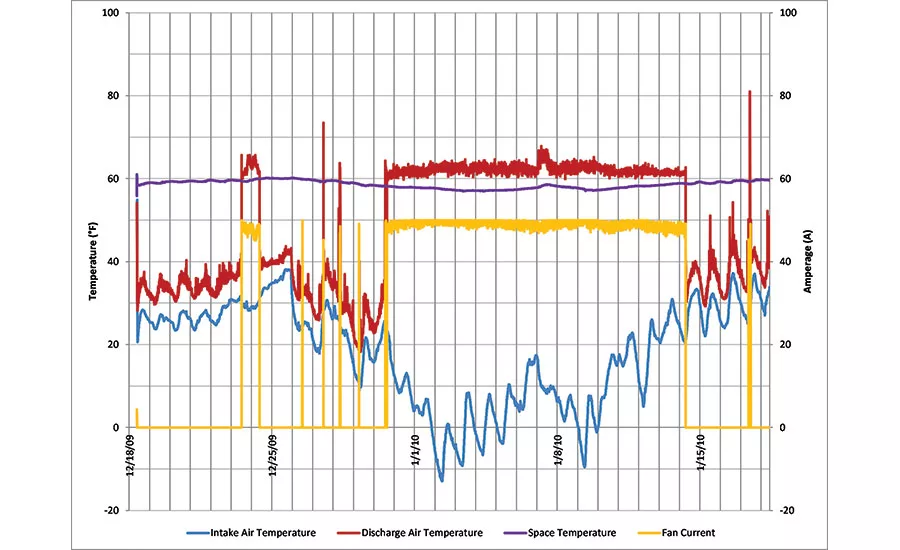
FIGURE 1
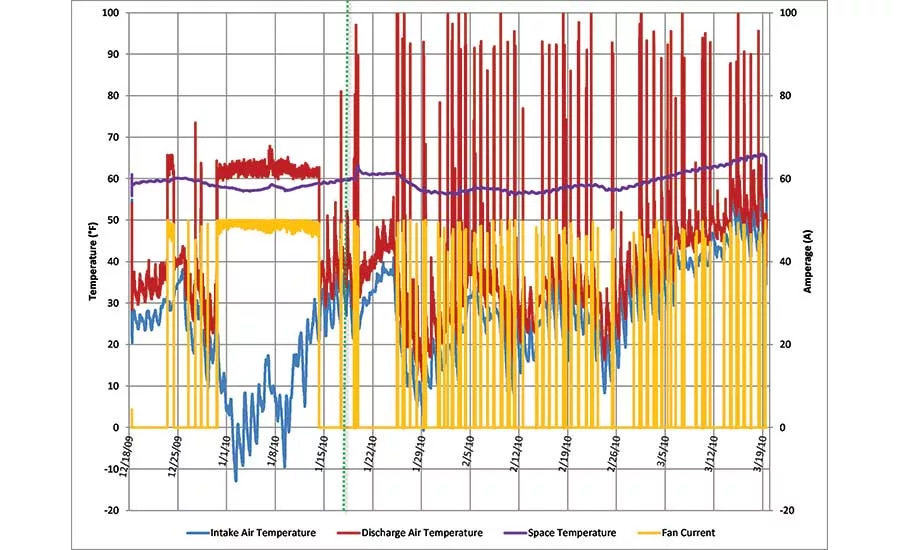
FIGURE 2
This is my third column presenting a real-life example of how trend analysis, if done thoughtfully, can uncover wasted energy even when the system appears to be functioning well. In this month’s case study, the building owner suspected a problem due to extremely high winter natural gas costs.
This was a multistory building in the upper Midwest with underground parking and district steam for space heating. When faced with excessively high winter natural gas costs, the usual suspect – the heating boiler system – was not in the lineup of potential culprits. In fact, the only natural gas load expected to have increased consumption during cold weather was the parking garage’s gas-fired ventilation.
The garage HVAC system consisted of a 100% makeup air unit (MAU) with modulating gas furnace interlocked with an exhaust fan at the other end of the garage. The MAU was the only source of heat for the garage. The local controls included a space thermostat, discharge air temperature thermostat, and carbon monoxide (CO) system with sensors distributed throughout the garage.
In mid-December, we placed portable temperature data loggers in the MAU intake louver (i.e., outside air), in the MAU discharge duct, and at the space thermostat. Another data logger measured the MAU fan motor electrical current draw. We left those loggers in place until we had some extremely cold (sub-zero) outdoor temperatures about a month later.
Figure 1 is a trend of the data collected over those four weeks. If all we cared about was maintaining the garage space temperature (purple) at its apparent 60°F set point, we would have concluded that the system was performing just fine. However, the other trended points provided insights into why the system was using so much natural gas.
The yellow trend indicates when the MAU fan was on (40+ amps = on, <0 amps = off). When the outside air temperature (blue) was above 10°, the fan turned on when the CO system called for it to start, ran for a short period of time, and then turned off. This is how a garage ventilation system is expected to operate.
When the outside air temperature dropped below 10°, the fan turned on when called to do so by the CO system and stayed on continuously until the outside air temperature rose above 20° again (about two weeks). Why did it heat and introduce 100% outside air to the garage for such a long time? The answer is in the red discharge air temperature trend.
Regardless of how cold it was outside, the MAU discharge air temperature was consistently between 60°-65°. We interpreted this to mean that the MAU furnace was modulating to just barely maintain the set point space temperature of 60°, and it did not turn off until the space temperature rose high enough to satisfy that thermostat. Even after the CO concentration dropped below its maximum set point, the MAU remained on because the space thermostat was calling for heat.
In order to avoid heating the garage any longer than necessary with 100% outside air, the owner changed the MAU controller to maintain a set point discharge air temperature of 100° instead of modulating to maintain the space thermostat set point. This meant that when the MAU started upon a command from the CO system, it resulted in a very short-term increase in the space temperature, thus taking the space thermostat out of play and allowing the CO system to command the MAU to stop as soon as the CO concentration dropped below its set point.
We collected data for two more months. Figure 2 is the full three months of data comparing operation before (left of the dotted green vertical line) and after (right of the green line) the controls modification. It illustrates the desired garage ventilation performance of intermittent, very short-term operation of the ventilation system and minimal gas consumption for heating. This saved more than $8,500 per year in natural gas savings.
Check out Trend analysis is a valuable commissioning tool and A deeper dive into trend analysis.
Looking for a reprint of this article?
From high-res PDFs to custom plaques, order your copy today!