The Relevance of Deep Retrofits: Leaders from NYC, DC, and Pittsburgh Speak Up

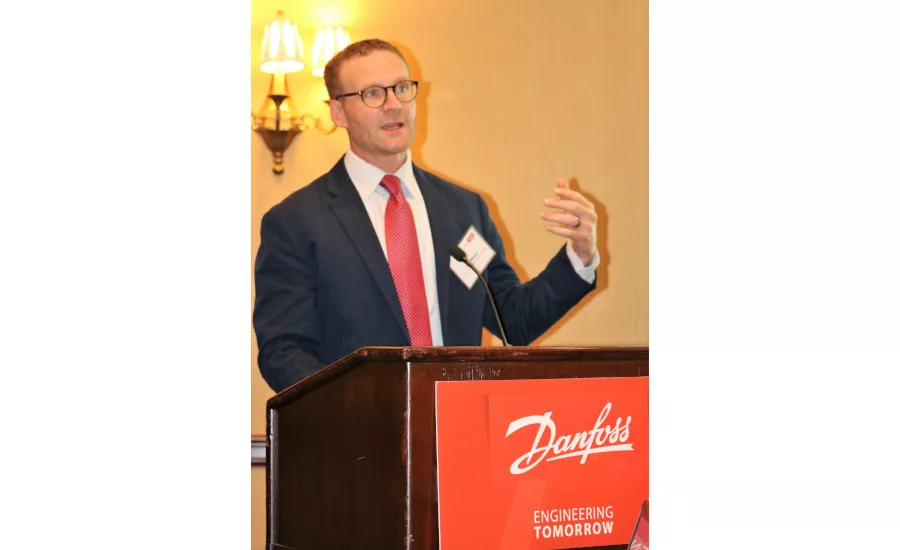
Eric Wilson, Deputy Director for Land Use and Buildings at the NYC Mayor’s Office of Resiliency, said climate change — specifically in the form of sea level rise and temperature change — is the Big Apple’s primary threat.
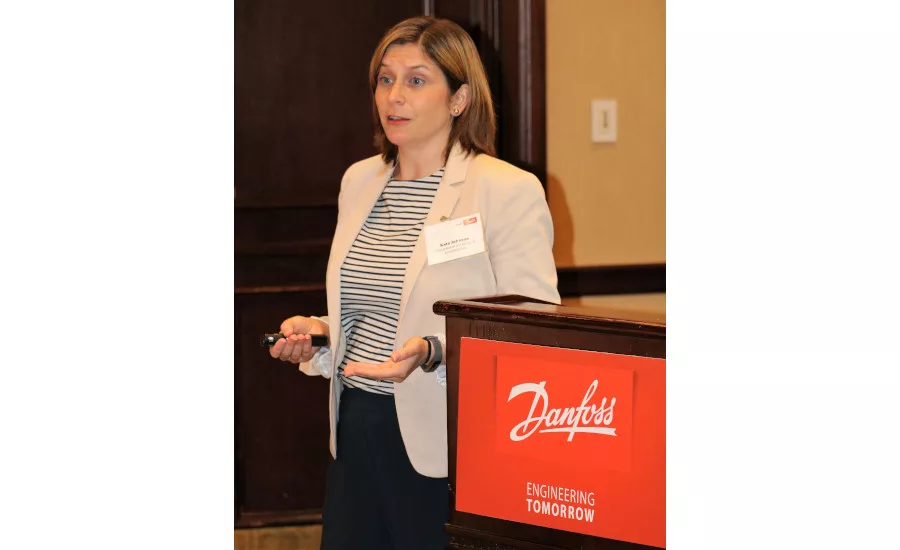
Kate Johnson, Chief of the Green Building and Climate Branch, Washington, D.C., Department of Energy and Environment, said Washington, D.C., intends to cut its municipality’s greenhouse gas emissions by 50%, energy use by 50%, and increase the use of renewable energy by 50% by 2032.
WASHINGTON — America’s built environment is antiquated.
According to the Commercial Buildings Energy Consumption Survey (CBECS), there were 5.6 million commercial buildings in the U.S. in 2012, comprising 87 billion square feet of floor space. Per SMR Research Corp., the average age of those 5.6 million buildings is 49.83 years old.
While America is constructing new buildings, it’s doing so at a snail’s pace, as the CBECS study reveals that only 400,000 new buildings have been completed nationwide between 2003 and 2012.
Thought leaders and practitioners from across the built environment recently held a roundtable discussion focusing on America’s aging infrastructure during Danfoss’s 33rd EnVisioneering Symposium, titled “Deep Retrofits: Resilience, Efficiency, and the Path to Sustainability,” June 4 in Washington, D.C.
Municipal management
The federal government continues to waver on major climate issues, including withdrawing American support from the Paris Agreement and, more recently, unveiling plans to rewrite former President Barack Obama’s Clean Power Plan. In the wake of these decisions, more and more city leaders are taking matters into their own hands by making firm commitments to cut carbon emissions and provide resilient infrastructure through transparency, building labeling, and benchmarking.
Three cities in particular — Washington, D.C., New York City, and Pittsburgh — are leading the way through their municipal efficiency, sustainability, and resiliency policies. Individuals representing each of these locales provided insight on their policies and explained the reasoning behind their efforts during the Danfoss event.
Washington, D.C.
Kate Johnson, chief of the Green Building and Climate Branch, Washington, D.C., Department of Energy and Environment, said the district unveiled its Sustainable D.C. initiative five years ago. By 2032, the initiative intends to cut the municipality’s greenhouse gas emissions by 50%, energy use by 50%, and increase the use of renewable energy by 50%.
“This is a comprehensive plan that defines how D.C. is going to be the healthiest, greenest, most livable municipality in the country,” she said.
According to Johnson, Sustainable D.C. is a broad sustainability plan that touches on much more than climate and energy.
“It covers everything from health and equity to nature, water, and lots of other things,” she said. “The goals within Sustainable D.C. are driving our work around climate change.”
In addition to Sustainable D.C., Mayor Muriel Bowser has ambitiously committed to making D.C. both carbon neutral and climate resilient by 2050.
“About three quarters of the district's greenhouse gas emissions today come from buildings,” she said. “We recognize that new buildings are only going to get us so far. Even though our rate of new construction is high, we're only building so many new buildings. Therefore, we have to rely on transforming our existing buildings, and we expect existing buildings to contribute to about 20% of those emissions reductions.”
New York City
When it comes to new construction, New York City is a very busy city.
Eric Wilson, deputy director for land use and buildings at the NYC Mayor’s Office of Resiliency, said the city issued over 91,000 new construction or major alteration building permits between 2013 and 2018.
“This incorporates 316 million square feet of new floor area and 445,000 new residential units across all boroughs of the city,” he said.
These new additions add to NYC’s impressive inventory of infrastructure.
“In 2015, we had about 5.4 billion square feet in building floor space,” he said. “Between now and 2050, we expect about 7% of these buildings to be demolished and 70,000 new buildings to replace those that are demolished. We expect NYC to have about 1.3 million buildings in total by 2050.”
While NYC’s infrastructure faces numerous threats, Wilson referenced climate change — specifically in the form of sea level rise and temperature change — as the Big Apple’s primary threat.
“We're a waterfront city, which is something you may not realize when you're standing in the middle of Manhattan,” he said. “We have 520 miles of coastline — more than Miami, Boston, San Francisco, and Los Angeles combined. This was especially apparent in October 2012, when we were hit by Hurricane Sandy, which was New York City's biggest natural disaster to date. Climate change is an economic and human threat to the city — one that we're laser focused on now.”
Through an academic partnership with the New York City Panel on Climate Change, city leaders expect coastal storms to become 50% more intense over the next 30 years.
“This could create a storm surge in our 100-year flood plain as well as intense winds,” Wilson said. “Sea level rise is a major factor with an increase of about 30 inches expected by the 2050s, which would impact about 2.5 million people in our low lying coastal areas.”
To become more resilient to these hazards, city leaders recognize they must focus on transforming the city’s existing building stock. The city is hoping to solve these challenges, and more, by fostering resilience retrofits to deal with flood risks and heat waves through a combination of regulatory changes and support programs, and by achieving carbon neutrality by the year 2050.
“All buildings in New York City that are over 25,000 square feet must report their energy and water usage every year, and it's uploaded into a publicly accessible website,” he said. “By doing so, we get an annual snapshot of how buildings are performing and where we are on the path to achieving our goals.”
The New York State Energy Research and Development Authority (NYSERDA)’s RetrofitNY program is another tool the city is using to help revive its existing building stock. The goal of the program is to perform retrofits with occupants in place.
“In partnership with Retrofit NY, we’re looking at a building’s siting, its envelope, its HVAC systems, and, in some cases, its on-site energy generation,” Wilson said. “New York State is the first state to consider a program like this, which includes three pilot projects for multifamily buildings in different parts of the city. By retrofitting our existing building stock to respond to flood risks and increased precipitation and minimizing the energy needed to maintain interior habitability, we can ensure the wellbeing of our citizens against the current and increasing climate stressors we face. At the same time we will be reducing our carbon footprint and thus reducing the impacts of climate change.”
Finally, city leaders recently enacted the Climate Mobilization Act, which mandates that all buildings above a certain floor area will gradually ratchet down greenhouse gas emissions, Wilson said.
“We have a formula that we put into place that’s based on different building uses,” he said. “Building energy usage and greenhouse gas emissions will be monitored through the city’s already established benchmarking program. Progressively, these new regulations will require a notch down in a building owner’s greenhouse gas emissions budget. If a building exceeds those targets, there will be a fine applied to that building based upon the metric tons of carbon in excess of its budget. The Climate Mobilization Act will also require all new buildings and major renovation projects to utilize either green roofs or solar panels.”
Wilson indicated that the Climate Mobilization Act is only a first step (albeit a very important one) on the road to prospective mandatory building retrofits given the need to retrofit buildings for climate vulnerabilities as well.
Pittsburgh
Depending on where you get your statistics, Pittsburgh has either the second or third oldest housing stock in the country, said Majestic Lane, deputy chief of staff, office of the Mayor, Pittsburgh.
“Deep retrofits offer the city both a huge opportunity and challenge,” Lane said. “Our building stock impacts many things, including greenhouse gases and climate change. It’s all intertwined.”
In 2014, Mayor Bill Peduto unveiled his P4 initiative, which incorporates people, place, planet, and performance.
“We had to decide what to incentivize and what to penalize,” Lane said. “We had to make sure everything was connected, and we felt that buildings and energy really covered all four of the Ps. This effort wasn’t only the mayor’s philanthropy, it also involved the efforts of corporate citizens and other stakeholders as well who were really supportive of this initiative.”
One major issue plaguing Pittsburgh is poverty, said Lane.
“We have the sixth-highest energy burden for residents in any city in America,” he said. “And for minority residents, we have the second-largest energy burden. So, what we’re finding is that not only are houses too expensive, but when you add energy costs in as well, people are unable to afford homes in our city.”
As a result, more and more people are moving from their inner-city homes and further into the suburbs, which increases the city’s transportation issues and, ultimately, its greenhouse gas emissions.
“We have to develop a solution to keep people in place, and we believe retrofitting can do just that,” he said. “Because the housing stock is so old, and because people have been disconnected for so long, what you find is they can't get the housing up to code to get a certificate for occupancy.”
In an effort to address the municipality’s energy/infrastructure issues, Pittsburgh has become part of the 100 Resilient Cities initiative. City leaders have also pledged to meet United Nations Sustainable Development Goals, making it one of only a handful of American cities to do so.
Additionally, the city, in conjunction with Siemens, is developing a City Performance Tool that will further examine the municipality’s carbon footprint.
“This regional benchmarking tool will allow professionals to look at each structure’s energy usage and have one-on-one conversations with owners of poorly performing buildings to talk about resources that can be utilized to actually get the buildings to be performing at a higher form,” Lane said. “We’re trying to incentivize behavior that benefits the buildings, the city, and the environment. If we can get people connected to our workforce development strategy, then we can really change what’s possible. The impact deep retrofits have on the environment is rewarding, and it’s indicative of the theme the city is building going forward.”
Roundtable discussion
Following Johnson, Wilson, and Lane’s presentations, the discussion shifted to the roundtable. Moderator Bob Cavey, partner, Praxis, said that true energy/climate transformation sounds like a real possibility today, while five years ago it was merely a dream. To kick off the discussion, he asked attendees what had changed over that short five-year span.
Johnson quickly responded that the planet is simply running out of time.
“Climate critics don’t have the luxury of biding their time,” she said. “The time for pilot programs and working things out has passed. We can’t walk anymore. It’s time to run. We should have been running all along.”
Tom Eisele, LEED AP, principal, Eisele Architects, said awareness of energy and climate issues has grown beyond a simple groundswell.
“The majority believes addressing these issues is crucial to the survival of our businesses and communities,” he said. “There has to be a stronger mindset shift that this is not just something that needs to be paid for. It’s a necessity, not a luxury. We’re well past the point of kicking the can down the road.”
Maureen Guttman, president, building codes assistance project, American Institute of Architects (AIA), said more work needs to be done, and it’s as simple and difficult as changing people’s minds.
“I’m excited for the work that’s occurring in New York City, Washington, and Pittsburgh, but I really worry about what’s going on across the rest of the country,” she said. “We have to do things differently, and that’s scary. It’s a cost and fear-of-change issue. New construction should be net-zero right now, and we’re so far from being able to do that across the country.”
John Galyen, president, Danfoss North America, deemed the work of New York City, Washington, D.C., and Pittsburgh “inspiring.”
“I’m inspired that cities are taking up the mantle,” he said. “They may not have figured out how to do it all quite yet, but it’s far from the times when we were held back by government discussions, utility incentive discussions, etc. I’ve long believed that the technology has always been there — that’s not what’s holding us back. I think this absolute and continued focus on first cost is wrong, and if you consider the total life cycle cost, this energy equation can be figured out. The fact that cities like Pittsburgh, D.C., and NYC are standing up, setting goals, and figuring out how to achieve them makes me believe that we’re actually making some progress here.”
For more information on the Danfoss EnVisioneering Symposium, visit www.danfoss.com.
Looking for a reprint of this article?
From high-res PDFs to custom plaques, order your copy today!


