Case in Point
School District's VRF/ERV Retrofit Receives High Marks
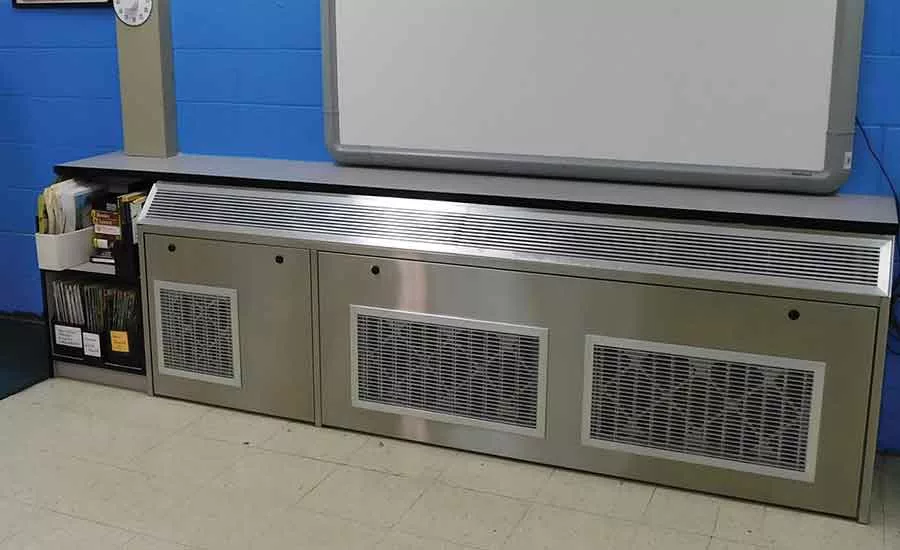
The Lebanon Special School District (LSSD) in Lebanon, Tennessee, has reduced its school maintenance costs, improved IAQ, and reduced noise levels with the installation of a VRF/ERV system.
The Lebanon Special School District (LSSD) in Lebanon, Tennessee, is one of the nation’s first school districts to retrofit conventional two-pipe classroom unit ventilators with combination VRF and ERV drop-in replacements.
LSSD’s Walter J. Baird Middle School recently performed a successful nine-classroom retrofit trial using SlimLine VRF/ERV unit ventilators manufactured by RevolutionAire. Each unit ventilator incorporates a combination of 3-ton VRF from Mitsubishi Electric and an enthalpy wheel for dehumidification. Consequently, the classrooms now comply with IAQ classroom codes under ASHRAE Standard 62.1.
The project was designed by Jonathan Yeager, P.E., of eSolutions in Knoxville, Tennessee, a manufacturer’s representative with design-build engineering capabilities, and Knoxville, Tennessee-based mechanical contractor Four Seasons Corp. The contractor also demolished the old units, converted the previous three-phase electric service to single-phase, and installed the replacement units in only eight days without any classroom activity disruption.
Besides IAQ improvement, the new units’ VRF and enthalpy technologies have cut energy operating costs by an estimated 30 percent versus the old systems, according to Jerry England, maintenance director, LSSD. The reduction helps the school far surpass minimum requirements of the ASHRAE 90.1-2017 energy standard. Furthermore, the original DX unit ventilators installed in the 1983-built wing addition had surpassed their useful life cycle and were racking up combined annual maintenance costs of approximately $7,000. The new units’ energy savings combined with eliminating past maintenance costs will deliver an estimated project payback of less than six years, according to England.
The original unit ventilators used hot water from one central boiler manufactured by Raypak that continues to supply hot water coils for the adjacent main building’s 1977-era packaged rooftop multi-zone design brands that include Trane, Carrier, Farmington, and AAON. Since the new unit ventilators also use VRF for heating, the school’s existing boilers now have additional capacity for any future heating needs.
LSSD decided against replacement with the same unit ventilator format of DX air conditioning and boiler-supplied, two-pipe heating system. The traditional design was cost-prohibitive because many states now require schools to upgrade to current ASHRAE Standard 62.1 outdoor air compliances during any type of major HVAC retrofits. Consequently, the nine-classroom wing had no ceiling accessibility for installing conditioned outdoor air ductwork to each classroom. Additionally, a DX replacement wouldn’t have solved a history of in-classroom compressor operational noise complaints by teachers.
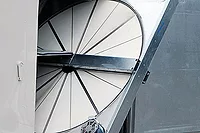
While the previous DX unit ventilators had manual outdoor air vents, the 3 tons of cooling weren’t capable of maintaining a comfortable classroom relative humidity below 70 percent on humid days. However, the 3-ton, 1,200-cfm replacement units introduced more outdoor air at the current ASHRAE Standard 62.1 rate of 15 cfm/student, but pre-treat latent and sensible humidity loads via onboard 21-inch-diameter aluminum enthalpy wheels before VRF cooling/heating. An in-classroom thermostat provides teachers an adjustable temperature range of 68°-74°F. Pinpoint temperatures are possible because VRF/ERV systems use VFDs to provide more energy-efficient partial-load cooling, whereas the previous DX system compressors were either off or on at 100 percent.
The new unit ventilators operate independently on their own respective classroom thermostats and are activated with either CO2, temperature, humidity sensors, or daily occupancy scheduling; however, England plans to eventually incorporate them into the school’s Metasys BMS manufactured by Johnson Controls Inc.
While relative humidity and temperature improvements are noticeable, teachers have commented positively on the HVAC noise reduction that’s conducive to more classroom productivity. The dB difference is up to 50 percent quieter because VRF technology condensers are located remotely outdoors.
“Teacher response to the noise reduction has been very positive,” said England.
The LSSD retrofit committee also considered the alternative of vertical indoor DX/boiler-supplied unit ventilators, which are less costly than VRF/ERV technology but 15-20 percent less energy efficient. A vertical format would require leaving the old units in place or removing them and cosmetically repairing carpeting, masonry, and walls at a cost of approximately $3,000 each. However, the 104-by-32-by-20-inch horizontal drop-in replacements fit the old unit ventilators’ space perfectly and eliminated cosmetic touch-ups.
The new ventilators also add more classroom storage because Revolutionaire factory-fitted them with laminate tops that connect to matching floor-standing bookshelves. Storage atop the old unit ventilators was prohibited because it blocked top-side air discharge. Conversely, the replacement models used a 45-degree-angled front grille for supply air, which leaves 16 inches of top space available for books and storage.
The new units require little routine maintenance other than MERV-8 filter change outs. The direct-drive fans with electronically commutated motors (ECMs) require minimal maintenance.
The one-year trial was successful, according to England, and LSSD plans other future school retrofits with VRF/ERV equipment to provide upgraded classroom environments that will enhance learning and deliver better energy savings to taxpayers.
Looking for a reprint of this article?
From high-res PDFs to custom plaques, order your copy today!