CASE IN POINT
Hybrid HVAC design earns high marks at KY school

|
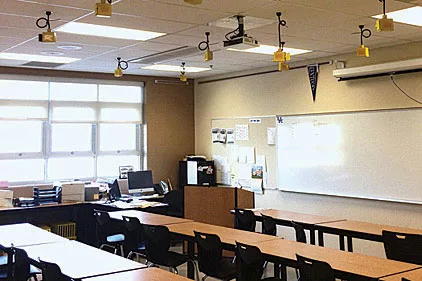
| A Kentucky high school used chilled beams as part of a hybrid HVAC design. The results were lower energy costs and improved IAQ. |
The new $60-million George Rogers Clark High School in Winchester, KY, is saving 35% each month in utility costs, thanks to its green design.
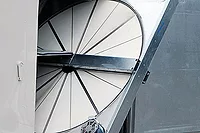
One reason for the increased efficiency is a hybrid HVAC design featuring a geothermal well field that supplies active chilled beams, dual wheel outdoor air dehumidification systems, and other technologies, according to Paul Christy, superintendent of Clark County Public Schools.
Christy, the county schools’ former director of operations, oversaw the 300,000-sq-ft high school’s HVAC design team that included Charles H. Wade, P.E., LEED AP with KTA Engineers; and Mark Saunier, B.S.E.E., LEED AP, CEM and president of Comfort & Process Solutions.
Originally specified as a conventional 200-ft, 80-well geothermal field with just GSHPs, Christy opted for enhancing the design by replacing the proposed 350 heat pumps with 542 active chilled beams and six Semco Pinnacle Series DOAS heat recovery systems. Christy’s decision was based on visiting a similar system at Furman University and reviewing a building energy simulation report prepared by Semco.
The report, which was completed by using the Carrier hourly analysis program in conjunction with Semco’s supplemental Pinnacle hourly energy analysis module, compared the estimated annual energy consumption of the high school’s three most-likely HVAC approaches:
- A DX-based outdoor air system, including a total energy recovery wheel and hot gas reheat capabilities preconditioning the outdoor air delivered directly to the classroom spaces served by individual GSHPs
- A DOAS incorporating both energy recovery and passive dehumidification wheels, served by a ground source heat pump to precondition outdoor air delivered directly to the classroom spaces served by individual GSHPs
- A DOAS and active chilled beams combination all served by a GSHP chiller to condition the media center and all classrooms.
Based on an electric rate of $.07/Kwh, the estimated annual HVAC energy cost for each of the three systems was 1) $73,490 ($.53/sq ft); 2) $56,670 ($.41/sq ft); and 3) $45,175 or ($.33/sq ft), respectively. Some of the greatest efficiency is attributed to a 50% air flow reduction that chilled beam technology offers versus conventional forced air distribution methods.
“The (GRCHS) mechanical system was installed for $19.50 per sq ft, which is the same or less than water source heat pumps or VRV ground source systems currently in Kentucky,” said Saunier.
The old school building from the 1960s had a four-pipe boiler/chiller system with fan coil units, and was averaging annual utility costs of approximately $194,040 ($.97/sq ft).
“In the first four months of operation, the new building’s preliminary utility bill figures were $41,800 less than our old building during the same period,” said Christy.
The savings comes primarily from better humidity control and subsequently higher set point temperatures with no trade-off of indoor air comfort. The system’s comparably lower 43°F dew point temperature allows for greatly reduced air volume due to the humidity control from dual-wheel dehumidifiers that control both latent and sensible humidity, according to Saunier, who helped convert the original design from conventional heat pumps to Christy’s requested chilled beam concept.
Other Clark County schools with conventional HVAC systems typically operate at 70°F amidst occasional “too warm” complaints in spring, summer, and fall. GRCH’s temperature complaints have been few due to better humidity control, even though set points average five degrees warmer at 75°F.
The IQHC chilled beams, which are supplied by a water-to-water GSHP by ClimaCool, have a 12-slot nozzle that is field-adjustable for areas with excessive solar gain or heat loss. The school’s service department is training the high school maintenance staff to adjust volume and up to a 45-degree angle directional airflow for hotspots with each chilled beam’s hand-operated levers for the greatest airflow flexibility efficiency.
The chilled beams never develop condensation because five rooftop DOAS units ranging from 3,700 to 14,500-cfm supply them with semi-neutral, super dry air. There is one 7,000-cfm DOAS that resides in a mechanical room. Some areas with high ceilings that aren’t ideal for chilled beams, such as the cafeteria and gym, use their own DOAS to distribute cooling and heating via the GSHP loop.
The DOAS units feature VFD, integrated GSHPs, and dew point discharge control that are all interfaced with the school’s building automation system by Delta Controls. The control system runs through each DOAS unit’s wintertime supply temperature control stages that use the enthalpy wheels’ heat recovery to minimize the onboard mechanical heat pump’s runtimes. The system also saves energy by maintaining humidity with a recirculation mode during unoccupied periods, which lessens ramp up time heating or cooling when the school opens each day.
Christy says the school saw a .53% student attendance increase in the first five months of operation in the 2013 fall semester versus the same period the previous year. He attributed this partially to the IAQ and humidity control.
The success of the project has led the school district’s design team to consider chilled beams and DOAS in an upcoming school retrofit.
“Because of space restrictions in a retrofit, we see chilled beams as space-saving and an air comfort solution,” said Christy.
Looking for a reprint of this article?
From high-res PDFs to custom plaques, order your copy today!