CASE IN POINT
Chilled beams, DOAS upgrade KY school's aging HVAC
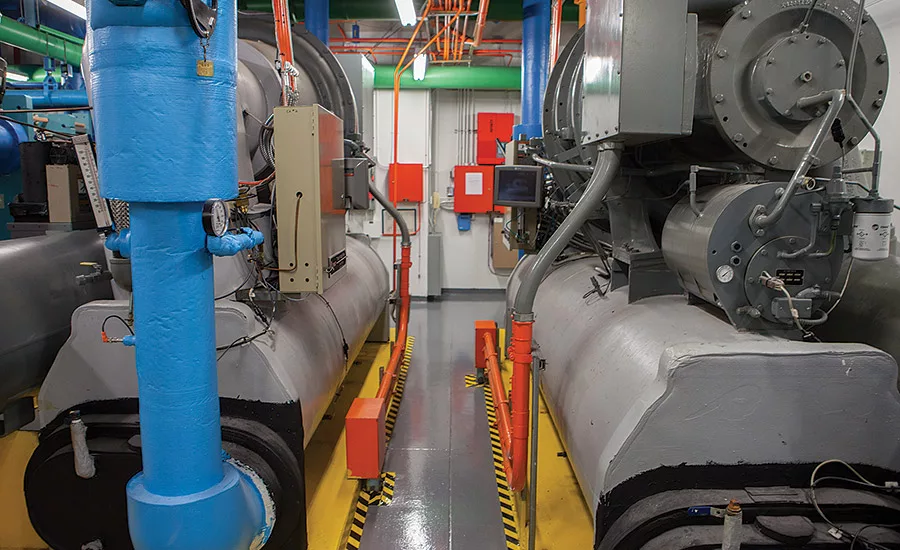
Touted as one of the first buildings to use plug-and-play controllable chilled beam pump modules, Robert D. Campbell Junior High is sav¬ing approximately $33,000 annually in energy costs.
Clark County Public Schools in Kentucky has gained notoriety for its sustainable school designs. Recently, the county has improved upon its chilled beam energy-saving model with the recent HVAC retrofit of a 43-year-old school building.
Robert D. Campbell Junior High School was retrofitted in 2015 from circa-1970s unit ventilators to chilled beams and DOAS, but with a new twist. Chilled beams and DOAS aren’t new, but Campbell is the world’s first known building to use smart, plug-and-play controllable chilled beam pump modules (CCBPM).
Using CCBPMs in Campbell’s two-phase HVAC retrofit saved the school district $147,000 in labor installation costs versus the primary alternative technology considered. The chilled beam/DOAS combination also saves $33,000 annually versus the school’s former unit ventilator system. The energy savings will lower capital dollars spent on the project by $500,000, which is guaranteed by a performance contract with the Lexington, KY, branch of Performance Services Inc. (PSI).
PSI’s CCBPM specification enabled the reuse of 100% of the existing two-pipe loop’s piping, the pumps, and the relatively new replacement chiller and boiler installed in the 1990s and 2003, respectively. Another advantage is that CCBPMs eliminate the need for heat exchangers.
A CCBPM, which includes a powered integrated direct digital controller (DDC), chilled and hot water connections, valves, variable-speed elec
tronically commutated (EC) motor pumps and smart sensors, is designed to be superior in temperature and humidity control to the original unit ventilator design, especially during season changes.
Designers said the plug-and-play CCBPMs eliminate the guesswork associated with chilled beam system specification, installation, balancing, and commissioning. As with most two-pipe designs, the many wildly fluctuating temperatures of spring and fall days resulted previously with uncomfortable indoor temperatures because of the extensively long periods required to switch from heating to cooling modes.
Conversely, Campbell’s design provides pinpoint tempered conditions within a one-degree tolerance, regardless of the season, because its control is based on outdoor dew point, not temperature, according to SEMCO LLC, which manufactured the project’s 46 NEUTON CCBPMs, 212 IQHC active chilled beams, and the Pinnacle 5,000-cfm DOAS units. If the OA dew point is less than or equal to 45°F, the space latent load is satisfied by DOAS ventilation air, which is distributed through each chilled beam and controlled via its respective CCBPM. When the dew point surpasses 45°F, the chiller is needed to maintain space conditions.
Donahue Mechanical, the project’s sheet metal and piping contractor, executed PSI’s design of reusing all hydronic trunk lines and the former unit ventilator taps for the first floor, but needed to extend the second floor unit ventilator taps to the ceiling for CCBPM and chilled beam connection. Most CCBPMs are mounted above each level’s classroom zone’s 18-in high T-bar drop ceilings and typically control four ceiling flush-mounted chilled beams ranging from 2-ft by 2-ft to 2-ft by 8-ft sizes. Each CCBPM was centrally positioned in each zone to limit chilled beam piping circuitry and allow its front panel to swing down through a removed 2-ft by 2-ft ceiling tile for easy access.
“Our project is best described as a three-loop system — the original pipe loop from the central plant, the take-off loop to-and-from each CCBPM, and the loop that connects a series of four to eight chilled beams to its respective CCBPM,” said Sprague.
The third loop is a “game-changer,” according to Sprague, because the CCBPM blends and re-circulates its return water within its zone to convert typical 42°F (cooling) and 140°F (heating) primary loop supply water temperatures to optimal 58°F (cooling) or 100°F (heating) chilled beam discharge temperatures, respectively. This prevents cooling mode condensation and heating season heat stratification. Campbell is a retrofit, but in new construction projects, a secondary pipe loop with its own dedicated chiller and boiler — which was previously required in chilled beam designs because of a primary loop’s extreme temperatures — are no longer necessary, because of the CCBPMs water tempering capabilities.
The facility uses a BMS by Delta Controls with front-end software by Tridium, which monitors the CCBPM via Ethernet with the BACnet protocol and sends outdoor temperature/humidity information. Sprague receives alarms and periodically reviews real-time and historical data from the BMS.
Cooling season condensation is prevented with the DOAS ducts that supply 6-in-round intakes on each chilled beam with conditioned, dehumidified air above dew point and satisfies outdoor air codes. The small 6-in-diameter air supply ducts easily fit into the restricted ceiling space, which was another impetus for using chilled beams versus other technologies requiring larger outdoor air ductwork.
The new high school’s attendance numbers climbed versus the school it replaced, which Christy partially attributes to the comfortable learning environment created by the HVAC. Likewise, the 7th- and 8th-grade students who came from two other schools are showing an attendance increase during Campbell’s first year, which Christy attributes partially to improved IAQ. ES
Looking for a reprint of this article?
From high-res PDFs to custom plaques, order your copy today!


