Predictive Maintenance and its Role in Improving Efficiency

Keeping fleet, machinery, and other assets working efficiently is a common challenge among equipment manufacturers; engineering, procurement, and construction (EPC) companies; and power and process plant owners and operators. All the more complicated is simultaneously reducing costs of maintenance and time-sensitive repairs. Aggressive time-to-market for industrial products and services make it even more critical to identify the cause of potential faults or failures before they have an opportunity to occur.
Emerging technologies, like the Internet of Things (IoT), big data analytics, and cloud data storage, are enabling more vehicles, industrial equipment, and assembly robots to send condition-based data to a centralized server, making fault detection easier, more practical, and more direct.
Identifying potential issues in a proactive manner allows companies to deploy their maintenance services more effectively and improve equipment up-time. The critical features that help to predict faults or failures are often buried in structured data, such as year of production, make, model, warranty details, as well as unstructured data, such as maintenance history and repair logs.
Artificial intelligence models can identify anomalous behavior, and the information derived from the equipment sensors can be turned into meaningful and actionable insights for proactive maintenance of assets, further preventing incidents that result in asset downtime or accidents. Commonly known as predictive maintenance, this added intelligence enables organizations to forecast when or if functional equipment will fail so that its maintenance and repair can be scheduled before the failure occurs.
The Market: North America Tops Market Share
Due to higher spending by companies looking to optimize operating costs and increase profitability, North America will continue to be the biggest market for predictive maintenance solutions. With an estimated market share of 31.67 percent, North America is expected to grow its predictive maintenance solutions at a compound annual growth rate (CAGR) of 24.5 percent, maintaining its lead from 2017 through 2022.
Predictive Maintenance Approach: Increasing Product Availability
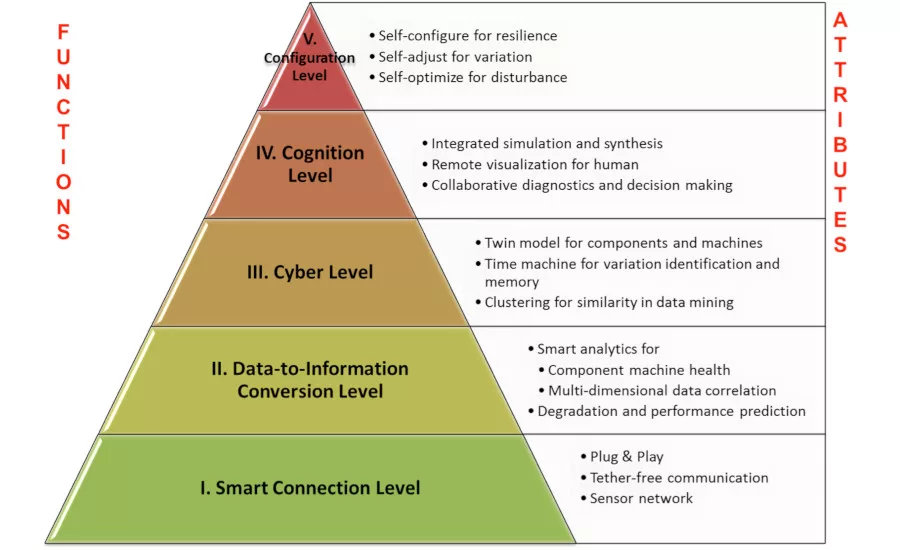
The underlying architecture of a preventive maintenance model is fairly uniform irrespective of its end applications. The analytics usually reside on a host of IT platforms, but these layers are systematically described as:
-
Data acquisition and storage (either on the cloud or at the edge);
-
Data transformation — conversion of raw data for machine learning models;
-
Condition monitoring — alerts based on asset operating limits;
-
Asset health evaluation — generating diagnostic records based on trend analysis if asset health has already started declining;
-
Prognostics — generating predictions of failure through machine learning models and estimating remaining life;
-
Decision support system — recommendations of best actions; and
-
Human interface layer — making all information accessible in an easy-to-understand format.
Failure prediction, fault diagnosis, failure-type classification, and recommendation of relevant maintenance actions are all a part of predictive maintenance methodology.
As industrial customers become increasingly aware of the growing maintenance costs and downtime caused by the unexpected machinery failures, predictive maintenance solutions are gaining even more traction. With the manufacturing, energy, and utilities verticals among the biggest demand drivers for predictive maintenance, it is even more critical for equipment manufacturers, EPCs, and owners/operators to adopt a predictive maintenance solution to maintain a competitive advantage.
The bigger players have already been using this methodology for more than a decade. Small- and medium-sized companies in the manufacturing sector also can reap its advantages by keeping repair costs low and meeting initial operational costs for new operations.
While it evidently offers more business benefits than corrective and preventative maintenance programs, predictive maintenance is also a step ahead of preventive maintenance. As maintenance work is scheduled at preset intervals, maintenance technicians are informed of the likelihood of parts and components failing during the next work cycle and can take action to minimize downtime.
Gain the Benefits of Predictive Maintenance
In addition to the advantages of controlling repair costs, avoiding warranty costs for failure recovery, reducing unplanned downtime, and eliminating the causes of failure, predictive maintenance employs nonintrusive testing techniques to evaluate and compute asset performance trends. Additional methods used can include thermodynamics, acoustics, vibration analysis, and infrared analysis, among others.
The continuous developments in big data, machine-to-machine communication, and cloud technology have created new possibilities for the investigation of information derived from industrial assets. Condition monitoring in real-time is viable thanks to inputs from sensors, actuators, and other control parameters. What stakeholders need is a bankable analytics and engineering service partner who can help them leverage data science not only to predict embryonic asset failures but also to eliminate them and take action in a timely manner.
Looking for a reprint of this article?
From high-res PDFs to custom plaques, order your copy today!