Ultraviolet Energy: An Important Addition to The Data Center Cooling Equation
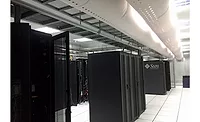
Extracting heat from server rooms/warehouses has only grown in importance with today’s high-performing, temperature-sensitive equipment and energy.
Yet, building owners, operators, and engineers must cope with lower or flat maintenance budgets, so keeping equipment energy efficient, sustainable, and operating at original design levels can be a challenge. Because cooling systems represent the most expensive parts of a data center facility to both construct and operate, even the smallest improvement in energy efficiency can translate to sizeable savings.
It is these very incremental efficiencies that offer an untapped savings opportunity for managers and operators of server rooms and warehouses.
Given the well-documented and often growing cooling demands by data centers, HVAC equipment must operate at its original design capacity. However, as air conditioning/refrigeration equipment ages, its ability to maintain temperatures and humidity levels decline. Most often, the culprit is reduced coil heat-transfer effectiveness or the ability of AHU cooling coils to remove heat from the air.
RESTORING COOLING CAPACITY
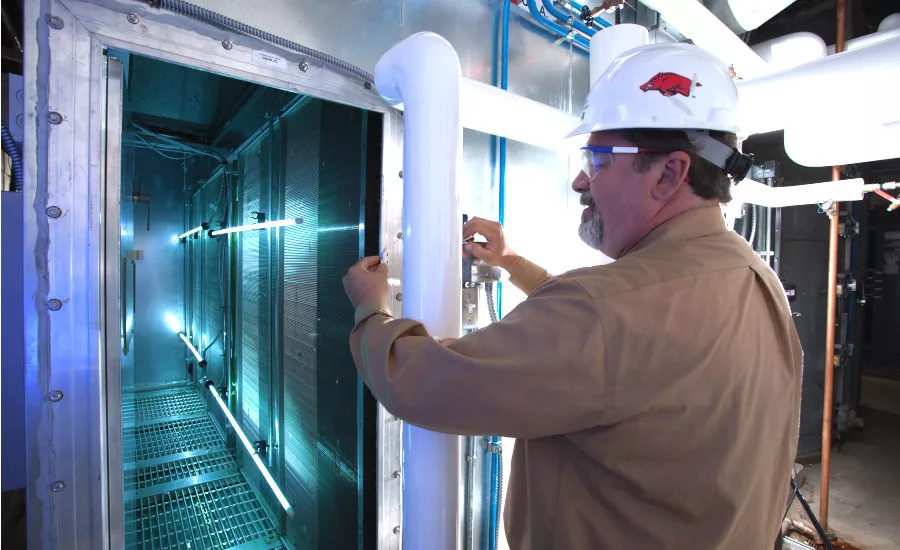
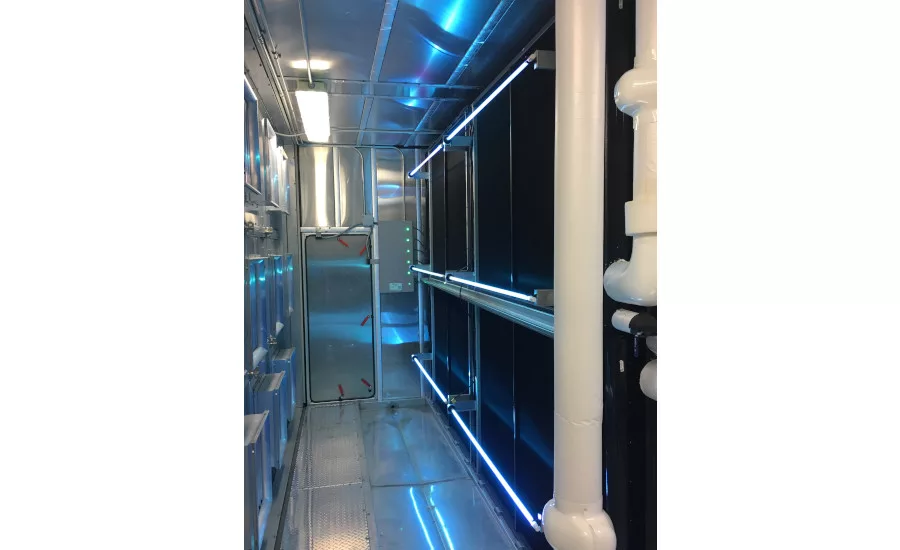
These inefficient heat-transfer rates derive primarily from the buildup of organic contaminants on, and through, the coil’s fin areas. Such buildups are eliminated through the use of ultraviolet germicidal irradiation or light in the UV-C wavelength (254 nm). UV-C works by disassociating molecular bonds, which in turn disinfects and disintegrates organic materials.
UV-C lighting systems are not an exotic, new technology. They have been used extensively since the mid-1990s to significantly improve HVAC airflow and heat-exchange efficiency, which can reduce energy use by up to 35 percent. UV-C by itself doesn’t save energy; rather, it restores cooling capacity and airflow to increase the potential for energy savings.
In new/OEM equipment, UV-C keeps cooling coil surfaces, drain pans, air filters, and ducts free from organic buildup for the purpose of maintaining “as-built” cooling capacity, airflow conditions, and IAQ. In retrofit applications, UV-C eradicates organic matter that has accumulated and grown over time and then prevents it from returning.
This trifecta of boosting capacity, saving energy, and lowering maintenance is driving more than nine of 10 energy UV-C installations today.
All of these system-enhancing efficiencies of UV-C technology are discussed in greater depth in the ASHRAE 2011 Handbook of HVAC Applications, chapter 60.8, which states: “UV-C can increase airflow and heat-transfer coefficient and reduce both fan and refrigeration system energy use. ”
In other words, UV-C helps to restore, and thereafter maintain, original cooling capacity.
SERVERS’ NEED FOR CONSTANT COOLING
Servers generally require an air flow volume of about 160 cubic feet per minute (cfm), while blade servers consume about 120 cfm of air between 66°F and 77°F per kilowatt.
In 2004, ASHRAE recommended a temperature upper limit of 77°F for data centers. In 2008, the association raised the upper limit to 80.6°F and this limit remained in the 2011 recommendations, which may provide some operators a hedge against lost cooling capacity.
Despite this industry benchmark, most data center operators believe that higher temperatures lead to equipment failures. Therefore, half of all data center managers strive toward the temperature goal of 71°-75°F; with more conservative colleagues (37 percent) aiming for the 65°-70° range.
Modifying return air ductwork to capture hot aisle air separately allows return air temperatures to increase, which provides for greater temperature differentials at the cooling coil. So long as coil heat-exchange efficiency is maintained to its original design specifications, this would allow the cooling coil to operate more efficiently. Liebert Corp. states that capturing hot aisle air in this manner can provide up to a 25 percent increase in equipment capacity and an increase of 30 percent in cooling system efficiency.
ROAD TO SUSTAINABLE COOLING
However, in regards to sustainability, these performance-based cooling systems should be of concern for the operator. The main reason relates to the preservation of system cooling coil heat-exchange efficiency or, more specifically, capacity. Data center cooling designs vary, but the common reality most face involves increasing heat loads and decreasing capacity from fouled coils, which challenges cooling demands overall.
In some of the designs, variable-speed chillers, pumps, and fans along with EC motors, etc. have allowed facilities to initially meet cooling loads in the most cost-effective way. Aiding this equipment are digital controls aimed toward saving energy in often over-designed cooling equipment.
Some users’ energy efficiency goals consist of achieving a rating as close to 1 as possible. This is thought to be accomplished by reducing the energy consumption of cooling equipment. This may be possible in a new facility but very difficult to obtain from older equipment. Also, the intelligent building equipment mentioned above could be masking ongoing losses in heat-exchange efficiency (capacity) such that the 15-plus percent surplus of original system capacity may have slowly eroded through lost coil heat-exchange efficiency and airflow from coil fouling alone, as seen below.
Energy savings from cooling equipment might not be possible, as minor increases in air-leaving wet bulb temperatures from a fouled coil can have dramatic effects on system capacity and thus energy use. For operators who have the instrumentation or access to outside test and balance services, air conditioning unit capacity can be demonstrated through simple measurements using the ASHRAE equation:
Btu = cfm x 4.5 x (h1 - h 2)
(where h1 - h 2 are wet bulb temperatures in Btu per degree)
A velocity traverse at the coil is used to establish cfm, and the coil upstream and downstream wet bulb temperatures (h1 - h 2) are used to populate the above algorithm.
Another important measurement is the pressure drop across the coil. Even a small amount of coil fouling will cause the coil’s pressure drop to increase, which will cause the system airflow to decrease or be digitally compensated for in fan speed (see below).
In the equation above, we calculate system airflow in cfm, which plays a major role in determining system capacity. In other words, coil fouling will reduce both the system’s heat removal capability and airflow.
The effects can be seen in this example: A new 20,000-cfm system with an air-entering wet bulb temperature of 64 and an air-leaving temperature of 53 would be: 20,000 x 4.5 x (h1 = 64 or 29.31 Btu – h2 = 53 or 22.02 Btu) = 656,100 Btu of cooling. If the current air-leaving wet bulb temperature is “only” 1° higher, it would look like this: 20,000 x 4.5 x (29.31 – 22.62) = 602,100, or a drop of (656100 – 602100) = 54,000 Btu in lost capacity or (54/12) = 4.5 tons of lost cooling capacity.
When a slight reduction in airflow is added in, it would look like this: 19,000 x 4.5 x (29.31 – 22.62) = 571,995, or a drop of (656100 – 571995) = 84,105 Btu in lost capacity or (84/12) = 7 ton of lost cooling capacity or a total reduction of 13 percent in capacity from some seemingly minor changes in performance. It’s not uncommon to find airflows reduced by 25 percent and air-leaving temperatures increased by 3°. Again, eroded surplus capacity might not be apparent, which warrants the taking of measurements to be sure. Potential energy savings may already be gone.
When capacity is lost (temperatures not being made), fan speed is often increased digitally, manually, or mechanically to help compensate for the loss; however, fan horsepower (energy use) increases to the “cube” of rpm:
HP2 RPM23
HP1 RPM1
This demonstrates that the simple fix of increasing the fan’s speed consumes more energy than most of us realize. It may temporarily satisfy capacity losses; however, when that isn’t the case, further modifications are usually performed.
In chilled water systems, the water’s temperature, which may also be automatically controlled, is lowered, increasing the temperature differential between the air and the coil surfaces, thereby increasing the heat transfer rate. Often, this is enough to return system capacity to when the coil was clean but at a noteworthy cost. The lowering of the water temperature requires a significant increase in energy use, and it’s often accompanied by pumping additional water volume. Increasing pump rpm has the same consequences as increasing fan rpm, a boost in horsepower to the cube of the increase. All of the above make a case for obtaining and keeping a coil perfectly clean, so that the original design advantages can be captured and maintained for the life of the system.
For DX systems, typically, run times are increased, and those DX machines equipped with variable drives could consume additional energy as fans speed up to compensate for the increased pressure drop across the coil. As temperature differentials across the evaporator coil lower, temperature differentials across the condenser coil will decrease as well, yielding an overall loss in cooling capacity. There may be other issues as well, such as head temperatures and pressures at the compressor. The key again is to obtain and keep the evaporator coil as clean as possible, which will restore the unit to near as-built capacity, and, therefore, potential energy savings.
In the future, both energy and water are going to cost more. Condensate from cooling equipment will be required to be collected and reused. When UV-C is used, drain pan water is disinfected and free of agglomerated organic material, meaning it can be easily reused, often without further treatment. When municipalities adopt green building codes, the focus will be on business’s consumption of water and will most likely include data centers.
Again, UV-C serves to restore the coil’s performance to regain system capacity. And, as system capacity increases, the energy that had been wasted to compensate for lost capacity is returned in the form of lower power consumption.
COIL CLEANING
Equipment manufacturers usually recommend coil cleaning twice a year and no less than annually to not only prevent mold growth and capacity loss but to keep contaminants from compacting deep within the coil. However, with staffs and budgets shrinking, time and money for in-house or contracted coil cleaning is becoming scarce. In fact, some building operators report they have not cleaned their AHUs coils in three or four years. If coil cleaning is not performed regularly, contaminant buildup deep inside internal surfaces can become so difficult to remove that expensive coil replacement becomes the only option. UV-C has been shown to clean even compacted contaminant from a coil.
COSTS AND PAYBACK
Users report that UV-C installations are very cost-effective. Most see paybacks in less than six months on energy use alone.
Many users report that their cost for an installed system featuring high-output lamps was about $0.10 per cfm (US). For a 10,000-cfm system, this amounts to an investment of about $1,000.
Field reports indicate that the first-cost of a UV-C system (initial investment) is approximately the same (or less) as a single, properly performed coil-cleaning procedure, especially when system shutdowns, off-hours work, associated overtime, and/or contractor labor costs are considered.
The operating cost for a system that is on year-round (24/7/365) is far less than 1 percent of the power to operate that air conditioning system. This amount is a noteworthy bargain in those systems that return 5 percent or more of their capacity.
UV-C light is an amazingly effective and affordable technology for keeping critical components of commercial HVAC systems clean and operating to “as-built” specifications. The benefits of UV-C energy can often sound a little too good to be true, but, with tens of thousands of installs and backing by ASHRAE, it becomes a benefit too good to miss out on.
Looking for a reprint of this article?
From high-res PDFs to custom plaques, order your copy today!