search
Ask ACHR NEWS AI
cart
facebook twitter instagram linkedin youtube
  • Sign In
  • Subscribe
  • Sign Out
  • My Account
  • NEWS
  • TECHNOLOGY
    • Heating & Boilers
    • Cooling & Chillers
    • Pumps & Flow Controls
  • SECTORS
    • Commercial
    • Health Care
    • Data Center
    • Educational Facilities
  • DESIGN | CONSTRUCTION
  • OTHER TOPICS
    • High-Performance Buildings & Automation
    • Ventilation and IAQ
    • Commissioning
    • HVAC Retrofits
  • TODAY’S BOILER
    • Today’s Boiler Archives
    • Today’s Boiler Digital Edition
  • MORE
    • Case Studies
    • Podcasts
    • Videos
    • Directory
    • Webinars
    • ES NEWS Store
    • White Papers
  • SIGN UP
  • Back to The NEWS
Engineered Systems NEWSHVAC Engineering SectorsCommercial HVAC

Observations Of A Physician In The Company Of HVAC Engineers

You must be doing something right.
By Stephanie Taylor, M.D., M. Arch, CIC
Observations Of A Physician In The Company Of HVAC Engineers

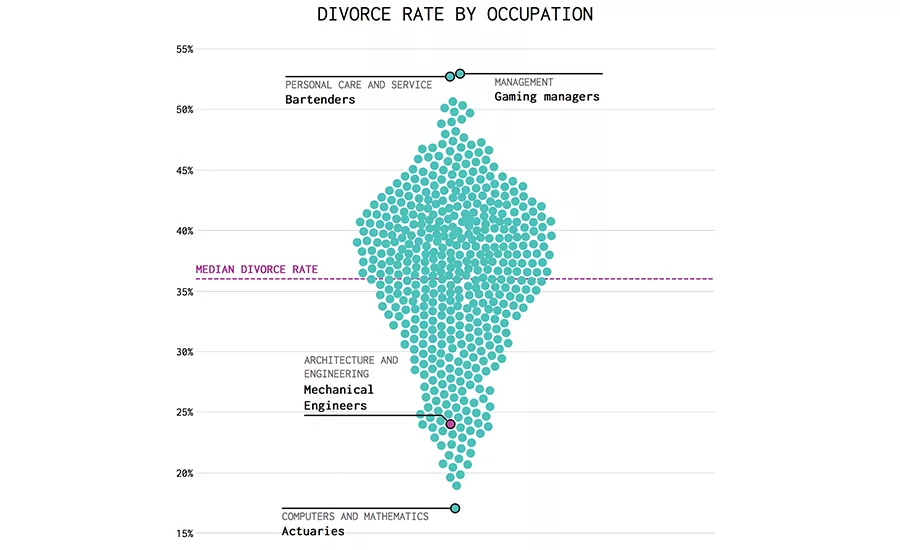
FIGURE 1. Divorce rate by occupation.

March 1, 2018

Over the past decade, I have spent many hours with engineers, specifically with mechanical engineers who deal with HVAC systems. From meetings with consulting firms to ASHRAE and ASHE conferences, I have noticed certain personality traits that seem to be more common in this group of my colleagues, as compared to other physicians or clinicians. I write about my hypotheses with some trepidation because you readers are the subject and the experts! Nevertheless, I will forge ahead, keeping in mind that all generalizations have exceptions.

The characteristics I have noticed, and admired, in HVAC engineers are the following. They (you) like practical jokes, seem unconstrained by self-consciousness (geeky is good), and have great manners. You are: very smart — yet humble, lots of fun to spend time with, somewhat shy, thoughtful, hard-working and extremely dedicated to your profession.

To determine if my observations are reflected by job satisfaction surveys or health data (I love data) on mortality, substance abuse, suicide, divorce, etc., I did some research on these trends by profession.


According to an American community survey on divorce in 2015, the marriages of mechanical engineers have a three to one chance of lasting, which is presumed to be a good thing. Actuaries, dental hygienists, and animal breeders have an even better chance of stable marriages, while bartenders, dancers, and gaming managers have the lowest probability of avoiding divorce.


The following is what I have uncovered. According to questionnaires and interviews with over 1,000 mechanical engineers, you are high on the job satisfaction scale because you can improve and influence real situations. Most of you (86%) describe your career as better than you expected despite the fact that you could possibly earn more in other industries.

Looking at U.S. census data tables, after controlling for age, race, and geography, the typical HVAC engineer is not likely to use illicit drugs regularly (bottom third percentile), is average for alcohol consumption, and is fourth from the bottom of the list of professions likely to commit suicide. The only three professions with lower suicide rates are religious leaders, teachers and physicians, while 11 professions have higher rates.

In addition to these positive standings, according to an American community survey on divorce in 2015, the marriages of mechanical engineers have a three to one chance of lasting, which is presumed to be a good thing. Actuaries, dental hygienists, and animal breeders have an even better chance of stable marriages, while bartenders, dancers, and gaming managers have the lowest probability of avoiding divorce.

What work factors or personality traits might lead to these positive statistics? Do you have more connectedness to colleagues, family, friends, and your community? If you are struggling with substance abuse or depression, are you more likely to reach out for assistance because you are not excessively constrained by stigma associated with seeking help? Or, perhaps, there is a secret sauce served at ASHRAE meetings that enhances professional and personal wellbeing.

What can the rest of us learn from you about happy work engagement? At this point, I turn to you, because I have also seen that HVAC engineers are very willing to express their opinions. Please give us your advice so that we, too, can try to embrace your great attitudes.

Share This Story

Looking for a reprint of this article?
From high-res PDFs to custom plaques, order your copy today!


Dr. Stephanie Taylor is the president and founder of Building4Health Inc. After working as a physician for many decades, Dr. Taylor obtained a Masters in Architecture as well as Infection Control certification. Her lifelong commitment to patient care includes focusing on improving the healthcare physical environment and clinical work processes to help patients heal quickly and save hospitals valuable dollars. Dr. Taylor is a graduate of Harvard Medical School (MD), and Norwich University (Masters Architecture). She has numerous research publications in Nature, Science, and other peer-reviewed journals. She can be contacted at stephanie@b4hinc.com or (860) 501-8950.

Recommended Content

JOIN TODAY
To unlock your recommendations.

Already have an account? Sign In

  • HVAC-enrollment

    The Trades Are Back: HVACR Programs See Nearly 30% Enrollment Spike

    A new wave of future technicians is entering the pipeline.  
    News
    By: Matt Jachman
  • 2025 Top 40 Under 40

    2025 Top 40 Under 40 HVACR Professionals List

    The 11th annual Top 40 Under 40 list highlights those...
    News
    By: Hannah Belloli-Oster
  • LG Ductless Mini-Split Systems

    The 9 Types of Heat Pumps

    As the U.S. moves toward electrification, heat pumps are...
    News
    By: Joanna R. Turpin

More Videos

Today's Boiler

Spring 2026 Issue

Today's Boiler - Spring 2026 Cover

Read More from Today's Boiler

Case in Point Logo

Smarter Hydronic Design for Data Centers - Free Webinar - January 22, 2026

Related Articles

  • Good Building

    The Evolving Definition of a ‘Good Building’

    See More
  • A Physical View IAQ

    Don't Let Profits Get in the Way of Doing the Right Thing

    See More
  • A Physical View IAQ

    Looking Inward to Guide Building Air Management in the Days of COVID-19

    See More

Related Products

See More Products
  • EHEP002028.jpg

    Principles of Heating, Ventilation, and Air Conditioning in Buildings, 1st Edition

  • 0071829598.jpeg

    HVAC Equations, Data, and Rules of Thumb, Third Edition

  • Green Tips for Building Maintenance Engineers

See More Products
×

Sign Up. Stay Informed.

The #1 trusted source for the HVACR industry since 1926

SUBSCRIBE
  • RESOURCES
    • Advertise
    • Contact Us
    • Advisory Board
    • Classifieds
    • Submit a Letter
    • Directories
    • Store
  • ACCOUNT CENTER
    • Create an Account
    • Start a Subscription
    • Manage My Account
    • Sign Up for Newsletters
    • Visit Customer Service
    • Update Preferences
  • SERVICES
    • Marketing Services
    • Reprints
    • Market Research
    • List Rental
    • Survey/Respondent Access
  • STAY CONNECTED
    • LinkedIn
    • Facebook
    • Instagram
    • YouTube
    • X (Twitter)
  • PRIVACY
    • PRIVACY POLICY
    • TERMS & CONDITIONS
    • DO NOT SELL MY PERSONAL INFORMATION
    • PRIVACY REQUEST
    • ACCESSIBILITY

Copyright ©2026. All Rights Reserved BNP Media, Inc. and BNP Media II, LLC.

Design, CMS, Hosting & Web Development :: ePublishing