Case in Point
Chillers Ride Elevator To Boost Medical Center's Performance
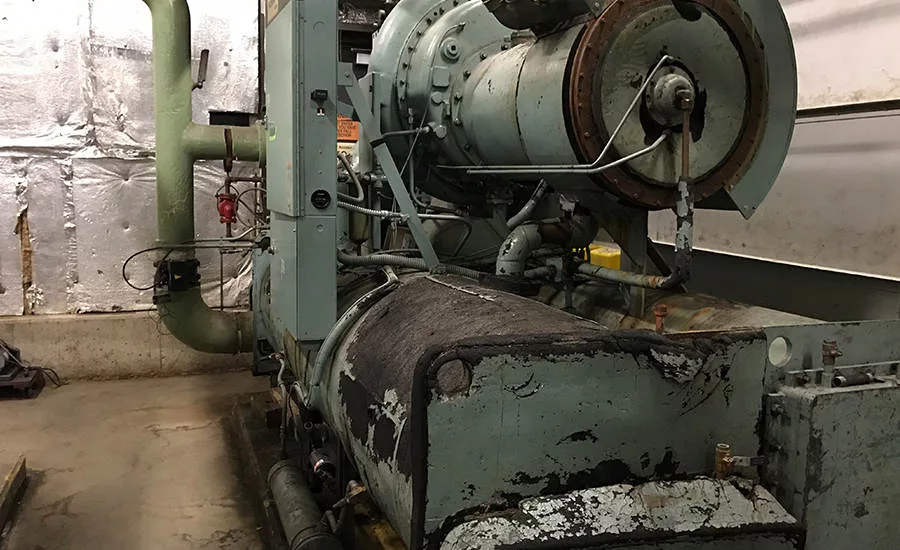
Rush University Medical Center in Chicago was in need of a chiller replacement. The original system, installed in the 1970s, was using twice the energy compared to modern and more efficient variable-speed chillers.
Founded in 1837 and named after the only physician to sign the U.S. Constitution — Benjamin Rush — Rush University Medical Center (RUMC) is now Chicago’s second-largest hospital, with multi-story buildings that dominate the city’s medical district. However, this prestigious location posed problems when RUMC’s 11-story Professional Building 2 needed to replace two aging centrifugal chillers.
It appeared the only alternative was to move a crane down a crowded street to lower new chillers through the roof. But some simple surgery made it possible for Smardt split-shell chillers with Danfoss Turbocor® compressors to simply take an elevator up to the penthouse mechanical room, a solution that cut installation costs while boosting energy savings.
“The professional building was using two fixed-speed 300-ton water-cooled centrifugal chillers,” says Mike Scalleta, mechanical systems manager at RUMC. “They were installed when the building was built in the 1970s. Consequently, the old centrifugal chillers were using twice the energy compared to today’s more efficient variable-speed chillers. It was time for them to go. The problem was that we’d have to cut open the mechanical room and use a crane to drop in conventional replacement chillers. Fortunately, we learned Smardt had a solution. Their split-shell Smardt chiller design with compact Danfoss Turbocor centrifugal compressors could be taken apart to fit into our freight elevator.”
The energy efficiency of the Smardt chiller turned out to be a big plus that fit into a small space. According to Bullock, Logan and Associates’ Curt Bullock, Jr., a Chicago representative for Smardt, the difference between the Smardt chiller and the old centrifugal chiller was night and day. Bullock calculates that when the old chiller was new, its integrated part-load value (IPLV) was 0.716 kW/ton but used oil-lubricated bearings. Because oil fouls heat exchanger tubes over time, actual efficiency was worse.
“In comparison, the IPLV of the Smardt chiller is 0.315 kW/ton — 57% more efficient,” says Bullock. “That’s partly because there are no oil-related heat transfer losses and no mechanical-bearing friction losses. Another energy-saving feature is the compressor’s ability to adjust automatically to off-design conditions. The Danfoss Turbocor TT400 compressor can turn down capacity to 10% of its total capacity. By automatically matching capacity to the load, the compressor reduces its speed, which also reduces energy consumption.”
But all that efficiency wouldn’t do any good if the chiller didn’t fit into the mechanical room.
“Professional Building 2 is sandwiched between Harrison Street, other professional buildings, and rail lines in the Medical District,” says Carl Wigginton, vice president of service for Murphy & Miller, Inc., the Chicago-based HVAC contracting firm who handled the installation. “There is no easy access. The front of the building is a little cul-de-sac where they turn cars around, and that’s where the crane would have to go. It’s a big reach — the crane would have to come in about 100 ft, then travel another 100 ft to the mechanical room doorway. But, there is a freight elevator that goes right to the penthouse mechanical room. It’s so much easier that way – if a chiller can fit into the elevator.”
The building’s large freight elevator was rated to hold up to 7,000 pounds. A conventional 300-ton centrifugal chiller would weigh around 12,000 pounds empty. Consequently, the weight and size dimensions prohibit using the elevator. In contrast, the empty weight of a 300-ton WA0962HG4 Smardt chiller is about 8,500 pounds and designed to be taken apart and easily reassembled.
“This Smardt chiller has a splitable shell design,” says Wigginton. “That made it possible to disassemble the evaporator and condenser shells. Disassembly took about half a day. We transported the parts by elevator to the penthouse. It took six trips. The first two trips transported the evaporator, and two more trips for the condenser. Then, the control panel and miscellaneous components took one trip, and the compressors took one trip.”
Inside the mechanical room, it took two technicians five days to reassemble the shells, compressors, and control panel and level the chiller. The next week, control and electric wiring were connected along with piping and valves.
The installation was also simplified because Danfoss Turbocor compressors don’t require an oil management system.
What’s more, RUMC’s utility gave the hospital a $24,000 rebate for using a variable-speed chiller. According to Bullock, the efficiency of the Smardt chiller beat out several competitive conventional variable-speed chillers.
“The size of the rebate is $10,000 more than they would have gotten with a competitive variable-speed chiller,” Bullock emphasizes. “The Smardt chiller minimizes the number of amps used at startup and during peak electric periods. The calculated difference in efficiency meant that over the eight-month cooling season, the new chiller saved about $12,000 more in utility costs than the proposed replacement chiller. In comparison with the old chiller, however, the new Smardt chiller saved approximately $75,000 in annual operating costs. When you add in the installation savings, the cost difference between the split-shell Smardt chiller and the competing chiller paid for itself in the first year of operation.”
Looking for a reprint of this article?
From high-res PDFs to custom plaques, order your copy today!