search
Ask ACHR NEWS AI
cart
facebook twitter instagram linkedin youtube
  • Sign In
  • Subscribe
  • Sign Out
  • My Account
  • NEWS
  • TECHNOLOGY
    • Heating & Boilers
    • Cooling & Chillers
    • Pumps & Flow Controls
  • SECTORS
    • Commercial
    • Health Care
    • Data Center
    • Educational Facilities
  • DESIGN | CONSTRUCTION
  • OTHER TOPICS
    • High-Performance Buildings & Automation
    • Ventilation and IAQ
    • Commissioning
    • HVAC Retrofits
  • TODAY’S BOILER
    • Today’s Boiler Archives
    • Today’s Boiler Digital Edition
  • MORE
    • Case Studies
    • Podcasts
    • Videos
    • Directory
    • Webinars
    • ES NEWS Store
    • White Papers
  • SIGN UP
  • Back to The NEWS
Engineered Systems NEWSHVAC Engineering SectorsVentilation and IAQCommercial HVAC

Follow Your Heart

What can we learn from one of our most vital organs when it comes to proper airflow and ventilation?
By Stephanie Taylor, M.D., M. Arch, CIC
Follow Your Heart

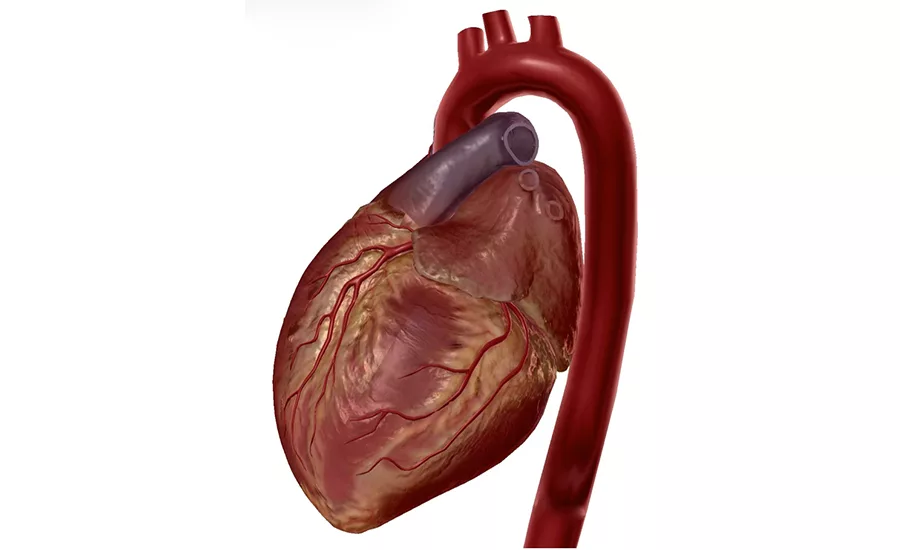
Figure 1. Health human heart with curved aorta channeling blood to the body.

September 1, 2017

The heart, sitting only a few inches behind an engineer’s shirt pocket protector, is an amazing organ. While often blamed for capricious love affairs, it beats steadily at the center of our circulatory system to provide life-sustaining connections between all cells in every corner of our body. Did you know that this system also models a scalable, energy-savings HVAC design, proven over centuries of use?

Studies comparing animal volume, or mass, to the amount of energy used to stay alive have revealed a startling constant. From a tiny single cell to the largest whale, living organisms use LESS energy per unit of weight as they go from small to large!

For example, if you already have a 20-pound dog and a new 40-pound dog comes to live with you, your canine food bill will not increase proportionately. The 100% larger new dog will only require 75% more food! This sublinear economy of scale, called a 3/4 power law, holds true for all measurable biological events from genome sizes to cell growth rates to entire life spans.

What dynamic underlies this universal pattern that exists despite huge differences in the environments and evolutionary pressures on living things? Around 1995, biologists and theoretical physicists teamed up and eventually discovered a mathematical framework for understanding quarter-power scaling laws. These calculations revealed that the underlying secret to energy-optimization is efficient connectivity between individual parts through branching networks with constrained geometric patterns, regardless of the specific organism design.

In animals, this branching network is the heart pumping blood through a healthy circulatory system. The efficiency of this movement determines how much energy is consumed to deliver essential resources to the end-units, or cells.

How does our bloodstream network guide the design and management of a HVAC system? Let’s look more closely.

The heart is a single pump with a central rate which serves the entire body. Zone-specific controls (vasoconstriction) regulates the blood flow through areas with different needs. Blood carrying oxygen for all cells leaves the heart through a single large, round, smooth artery — the aorta. When anatomy requires the aorta or other vessels to change direction or branch out, curved paths and forked branches of smooth vessels carry blood to the different parts of the body. You will never find 90-degree angles or friction-filled arteries and veins in a healthy circulatory system.

What does this suggest for the engineer? First, the energy-using pump or blower should be as efficient as possible with few friction points and dead zones. (A common condition, atrial fibrillation, results in suboptimal pumping and turbulent blood flow in the heart. People with this condition take medication to prevent blood clots from shooting to the brain and causing a stroke.) Secondly, the ducts should be round, clean, and take curving bends instead of 90-degree turns. This will decrease the friction of air on duct walls, as well as friction from air-against-air, or turbulence.

With close attention to these principles, HVAC systems can scale as successfully and efficiently as organisms do, so that increasing building space by 100% only requires a 75% increase in energy demands. Once again, follow your heart for a great outcome.

Share This Story

Looking for a reprint of this article?
From high-res PDFs to custom plaques, order your copy today!


Dr. Stephanie Taylor is the president and founder of Building4Health Inc. After working as a physician for many decades, Dr. Taylor obtained a Masters in Architecture as well as Infection Control certification. Her lifelong commitment to patient care includes focusing on improving the healthcare physical environment and clinical work processes to help patients heal quickly and save hospitals valuable dollars. Dr. Taylor is a graduate of Harvard Medical School (MD), and Norwich University (Masters Architecture). She has numerous research publications in Nature, Science, and other peer-reviewed journals. She can be contacted at stephanie@b4hinc.com or (860) 501-8950.

Recommended Content

JOIN TODAY
To unlock your recommendations.

Already have an account? Sign In

  • HVAC-enrollment

    The Trades Are Back: HVACR Programs See Nearly 30% Enrollment Spike

    A new wave of future technicians is entering the pipeline.  
    News
    By: Matt Jachman
  • 2025 Top 40 Under 40

    2025 Top 40 Under 40 HVACR Professionals List

    The 11th annual Top 40 Under 40 list highlights those...
    HVAC Light Commercial Market
    By: Hannah Belloli-Oster
  • LG Ductless Mini-Split Systems

    The 9 Types of Heat Pumps

    As the U.S. moves toward electrification, heat pumps are...
    Heat Pumps
    By: Joanna R. Turpin

More Videos

Today's Boiler

Spring 2026 Issue

Today's Boiler - Spring 2026 Cover

Read More from Today's Boiler

Case in Point Logo

Smarter Hydronic Design for Data Centers - Free Webinar - January 22, 2026

Related Articles

  • A Physical View IAQ

    The Key to HVAC Design: Just Follow Your Nose

    See More
  • ‘Howe’ Healthy Is Your Heart Kick-Off Party a Success

    See More
  • Influenza

    Your Weather App Is Key to Your Safety

    See More

Related Products

See More Products
  • front cover only.jpg

    How to Market Your HVAC Business

See More Products

Events

View AllSubmit An Event
  • November 13, 2025

    4 Lead Generation Mistakes You Might Be Making in Your Business & How to Fix Them

    On Demand From website gaps to follow-up breakdowns, you’ll walk away with practical tips to improve your lead flow process and turn your marketing investment into actual revenue results.
View AllSubmit An Event

Related Directories

  • Your Bargain Mart

    We are a MRCOOL Dealer and carry contractor-grade HVAC equipment, air handlers, condensers, heat pumps, gas furnaces, evaporator coils and heat pumps, gas, and electric packaged units.
  • BITZER Canada Inc.

    Welcome to BITZER; a global leader in major refrigeration component manufacturing. Welcome to the Heart of Freshness. Visit www.bitzer.de/ca/en/.
×

Sign Up. Stay Informed.

The #1 trusted source for the HVACR industry since 1926

SUBSCRIBE
  • RESOURCES
    • Advertise
    • Contact Us
    • Advisory Board
    • Classifieds
    • Submit a Letter
    • Directories
    • Store
  • ACCOUNT CENTER
    • Create an Account
    • Start a Subscription
    • Manage My Account
    • Sign Up for Newsletters
    • Visit Customer Service
    • Update Preferences
  • SERVICES
    • Marketing Services
    • Reprints
    • Market Research
    • List Rental
    • Survey/Respondent Access
  • STAY CONNECTED
    • LinkedIn
    • Facebook
    • Instagram
    • YouTube
    • X (Twitter)
  • PRIVACY
    • PRIVACY POLICY
    • TERMS & CONDITIONS
    • DO NOT SELL MY PERSONAL INFORMATION
    • PRIVACY REQUEST
    • ACCESSIBILITY

Copyright ©2026. All Rights Reserved BNP Media, Inc. and BNP Media II, LLC.

Design, CMS, Hosting & Web Development :: ePublishing