Case in Point
Iowa College Boiler Upgrade Goes To The Top Of The Class
With its central steam plant failing, Cornell College converted each of its buildings to a standalone high-efficiency boiler system, including remote operation for troubleshooting and diagnostics. The plan has created better individual HVAC control and fewer calls for service.
A failing steam heating system posed many challenges for facility services at Cornell College in Mount Vernon, IA. The college was founded in 1853, with some of the original buildings on campus dating back to the 1860s.
Installed in the late 1800s, the original Cornell College heating system consisted of a steam central plant that supplied all of the buildings on the university grounds with steam heat. Originally using coal, the school’s boiler plant was converted to gas in the 1960s. Three 350-hp gas powered steam boilers handled heat for the entire campus.
“When I joined the staff at Cornell College, 90% of the heat was produced by two steam boilers in our heating plant,” said Joel Miller, director of facility services for Cornell College.
According to Miller, the old boilers and infrastructure from steam piping and condensate piping had deteriorated.
“We were experiencing numerous faults with our in-ground steam lines and constant maintenance work on the steam boilers,” said Miller. “The steam lines were rusting, which required repairs from building to building. It would often take a week or longer to fix if one of the steam boilers went offline, and when one was finally up and running, then the other would go down.”
Miller faced two options: replace most of the steam piping or consider another heating solution. The university opted for cost effective high-efficiency boilers in campus buildings.
“It would have cost us significantly more money to replace all the steam piping and condensate piping throughout the campus,” said Miller.
Cornell turned to Pipe Pro Inc., a Cedar Rapids, Iowa-based company offering commercial and industrial plumbing and HVAC services.
Travis Godbey, service manager with Pipe Pro, oversaw the boiler upgrades. Working with Pipe Pro, Miller and team devised a strategy to take the college off of the central steam plant and convert each building to a standalone high-efficiency boiler system with remote operation.
One of the first retrofit projects took place at the Olin Hall residence facility, one of the farthest buildings from the steam plant that required constant repairs.
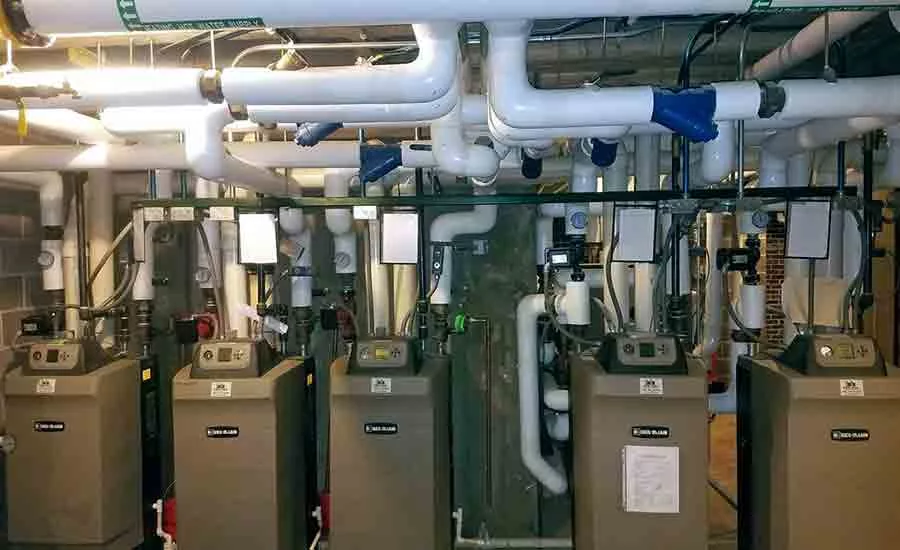
The team installed five Weil-McLain Ultra® 550 MBH high-efficiency condensing gas boilers in the building. The Ultra features boiler-to-boiler communication, Modbus® and BACnet® for linking with BAS, updated controls interface troubleshooting, and more.
Three units were configured as the main heating boilers for Olin Hall while the other two were set up for domestic water. As part of the retrofit, thermostats were installed in each student’s room for optimal comfort.
In addition to Olin Hall, the West Science Center was selected for a boiler upgrade. The team sought to replace the existing heat exchanger with a boiler that would fit into the same space. The SlimFit model was chosen for this installation. Two SlimFit 750 series boilers were set up as natural gas and installed in the building’s mechanical room.
The boiler’s narrow housing enhances maneuverability for confined spaces and weight restricted areas. The design also increases usability and access for installing contractors and facility managers for commercial retrofit projects.
The West Science Building already had a steam to hot water converter, so the team installed new T’s off of the header and then connected the boiler.
“We used the building’s original pumps, piping, plumbing for the retrofit,” said Miller. “The biggest issue was getting the intakes and exhaust for the boilers.”
“The SlimFit boiler was a perfect match for the space,” said Godbey. “We were able to remove the heat exchanger, and then just made a few simple changes.”
Each building upgrade had its own challenges. Some buildings required additional piping and new pumps. The science building already had natural gas running to the building for lab experiments, but many of the other facilities only had steam pipes.
“A major project hurdle was getting utilities to each building,” said Godbey. “We had to plan each upgrade in advance to make sure the utility company could get gas mains installed and then plan accordingly.”
Another challenge was limited space.
“Because the buildings were built in the late 1800s or early 1900s, mechanical rooms were smaller in size,” said Miller. “It was difficult moving the old equipment out and the new equipment in.”
“For Merner Hall, another large residence, we had to install a 1.5-million btu boiler,” said Godbey. “Thankfully, the SlimFit is built for tight spaces, and we could bring it in through a standard door frame.”
In total, Pipe Pro completed eight conversions at the campus. The boilers are configured to control each building individually and connected through a web-based system for monitoring and control.
“I can easily track every unit on campus and can even set alarms if needed,” said Miller. “The control system displays boiler parameters from each building on any computer, note pad, or phone, and our team can make adjustments as needed in real time.”
As a standalone system, each building operates based on its own heating requirements.
“One can set low or high limits and turn the boilers on as needed,” said Miller. “By setting parameters, building occupants have more heating options.”
The change-outs also have led to energy savings. Overall, the campus has experienced a 15% reduction in gas usage after eight conversions.
Looking for a reprint of this article?
From high-res PDFs to custom plaques, order your copy today!