Case in point
Naval Postgraduate School creates microgrid with ice bank storage
As the nation’s largest consumer of energy, the Department of Defense (DoD) has created a goal to explore different ways of optimizing renewable energy resources based on end-use application. With 70% of the DoD’s energy use being oil-based, an increase in the optimization of its current renewable energy resources would create financial, sustainable, and security benefits.
The universal challenge of using renewable energy is the fact that it is a form of pure energy. It needs to be used as it is generated or else it will be lost. In addition, renewable energy sources such as wind turbines and photovoltaic (PV) panels are intermittent in nature with generation outputs being dependent on weather conditions. This creates a major disadvantage compared to fossil fuels, which are a form of stored energy. Fossil fuels are always available as they are needed, allowing supply and demand to perfectly align.
With this in mind, the DoD created the Energy Systems Tech Evaluation Program (ESTEP) to conduct real-world tests on advanced energy technologies at Navy and Marine Corps installations. Under the umbrella of this program, Professor Anthony Gannon at the Naval Postgraduate School has created the Integrated Multi-Physics Renewable Energy Laboratory (IMPREL) in Monterey, CA.
The IMPREL is a microgrid demonstration project. Microgrids increase overall efficiency of energy systems by utilizing power generation from renewable solar and wind sources more effectively. A microgrid acts as a single entity that can connect to the power grid or work independently from the grid in what is called “island-mode.” The IMPREL project is unconventional in the fact that it uses a multi-physics approach.
Traditional power grids adjust power generation to meet demand. If a building needs more electricity, the utility increases its generation. The customer ultimately determines how much generation there is at any given point. With the multi-physics approach, this pathway is reversed. Instead, weather conditions determine the amount of renewable power that is being generated. The enduser then either uses the energy or stores it. This system approach requires fewer on-site solar and wind resources to meet the same demand, reducing size, costs, and the amount of unused energy.
To create the multi-physics microgrid demonstration project, sufficient renewable energy generation and energy storage were needed. To this end, the project consists of 6.4kW of photovoltaic panels, two 3.2kW vertical axis wind turbines, three inverters, customized controls to prioritize loads, and a variety of energy storage technologies.
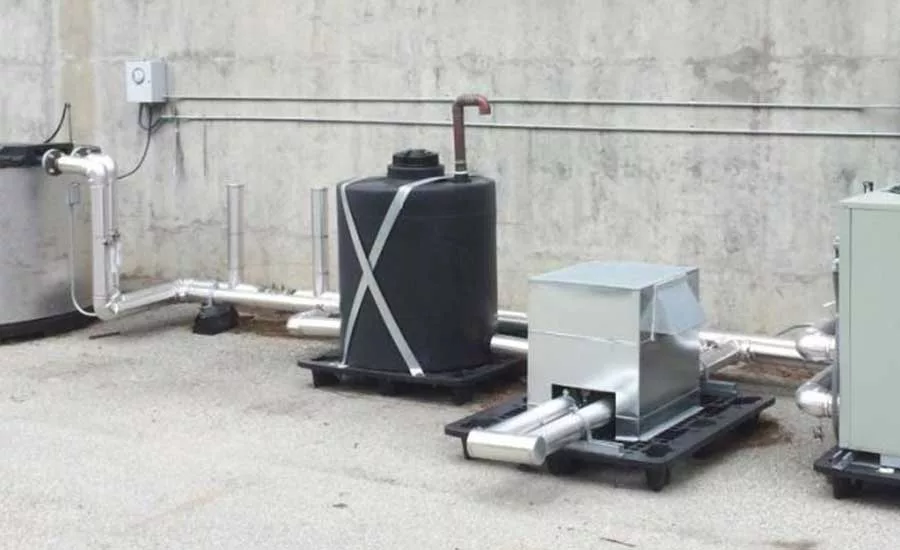
During the design phase of the IMPREL demonstration project, it was decided that some forms of energy would be stored in the form they would be needed in, as this would be most efficient from an energy and cost perspective. To run electronics, the IMPREL demonstration used 24 lead acid gel cell batteries (800-1,000Ah storage capacity). To provide heat to spaces, the project incorporated 102 kWh or just under 410,000 Btu of storage in the form of high-temperature ceramic bricks. Finally, to store cooling, the project used 48.8 ton-hours or 170 kWh of CALMAC’s ice-based energy storage technology. A chiller, equipped with a variable speed compressor and variable speed drive pump, used the renewable energy on the microgrid to create stored cooling in the form of ice. When cooling was needed, the ice was discharged, or melted.
“Ice-based technology is the low-hanging fruit of the energy storage industry,” said Mark MacCracken, CEO of CALMAC. “The technology is proven, durable, and has no moving parts so maintenance is minimal. From a comfort perspective, there is no way to tell the difference between cooling that was created on-demand or created the night before.”
In addition, there were also operational benefits to using thermal energy storage. During operation of the microgrid, the batteries were vulnerable to damage from cycling. The battery storage, unlike CALMAC’s ice-storage solution, could not be completely discharged due to the fact that complete discharging of the batteries could cause permanent damage. By relying on the phase change of water between solid and liquid, CALMAC’s thermal storage technology evades the negative effects of cycling and can completely discharge. Given this benefit, the lifespan of the ice-based energy storage tanks has been known to exceed 25 years and are 99% reusable or recyclable, according to Calmac.
The microgrid project was a success. Using the ice-based thermal energy storage, in combination with batteries and ceramic brick energy storage, the multi-physics microgrid project was able to successfully match the supply of renewable energy with demand. Controls prioritized loads by matching cooling and heat loads in response to changes in renewable power without necessitating additional power from batteries. Batteries were used to stabilize the microgrid by covering brief periods when there was no renewable power generation.
“Applying the multi-physics approach to our microgrid project, over the traditional microgrid approach, allowed for the use of fewer renewable energy resources to meet the same demand,” said Dr. Anthony Gannon, assistant professor of the Mechanical and Aerospace Engineering Department at the Naval Postgraduate School. “Using thermal energy storage allowed for the project to greatly reduce its costs and improve efficiency by storing the energy in the form that it would be ultimately used in. Based on the project’s operation, we feel like this design could easily be scaled-up for larger applications.”
Looking for a reprint of this article?
From high-res PDFs to custom plaques, order your copy today!