search
Ask ACHR NEWS AI
cart
facebook twitter instagram linkedin youtube
  • Sign In
  • Subscribe
  • Sign Out
  • My Account
  • NEWS
  • TECHNOLOGY
    • Heating & Boilers
    • Cooling & Chillers
    • Pumps & Flow Controls
  • SECTORS
    • Commercial
    • Health Care
    • Data Center
    • Educational Facilities
  • DESIGN | CONSTRUCTION
  • OTHER TOPICS
    • High-Performance Buildings & Automation
    • Ventilation and IAQ
    • Commissioning
    • HVAC Retrofits
  • TODAY’S BOILER
    • Today’s Boiler Archives
    • Today’s Boiler Digital Edition
  • MORE
    • Case Studies
    • Podcasts
    • Videos
    • Directory
    • Webinars
    • ES NEWS Store
    • White Papers
  • SIGN UP
  • Back to The NEWS
Engineered Systems NEWSHVAC Engineering SectorsVentilation and IAQCommercial HVAC

Pathogens 101

Learn how these tiny threats thrive and spread to the next person, and why your relative humidity and temperature decisions matter.
By Stephanie Taylor, M.D., M. Arch, CIC
IQA
September 7, 2016

In a sense, HVAC engineers are the physicians of the built environment because IAQ and water management determine the growth and transmission of microorganisms. Therefore, it is essential for engineers to understand the basic characteristics of these minuscule beings.

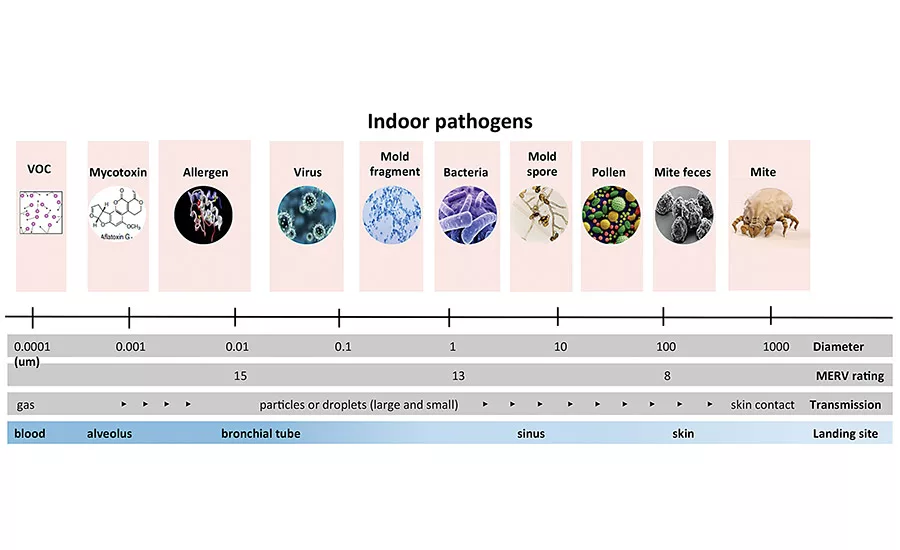
Many people think of “germs” as one big group of tiny (how tiny?) organisms that cause infections. There are, however, several different categories of microorganisms, and within these categories only some cause infections or disease. These are often called pathogens.

The main groups of pathogens that cause illness and are targets of disinfection in buildings are viruses, bacteria, fungi (mold), and parasites such as mites.

Here are some examples of transmission routes of these pathogens.

Direct contact. A person with contaminated hands touches another person or a common surface, thus passing the pathogen along. This route can spread viruses, bacteria, allergens, and parasites.

Indirect contact. Large droplets containing pathogens are expelled by a person sneezing, then settle onto a surface within several feet to be picked up by a second person’s hand. Alternatively, in dry air (less than 40% rh), these large infectious droplets quickly shrink to become tiny “droplet nuclei” which then travel on air currents over extended lengths of time and distance, ultimately causing illness in patients who had no contact with the first sick person. The smaller and lighter the droplet nuclei, the longer it can remain airborne. Viral and bacterial pathogens are often spread in this way.

 Airborne transmission. There are few communicable diseases which spread only through the air. One we are familiar with is Tuberculosis, caused by a small bacterium. This route is called obligate airborne transmission.

Viruses and bacteria that have the ability to be spread through the air in droplet nuclei are subcategorized as preferential, or opportunistic airborne microorganisms, depending on their effectiveness of causing disease through tiny aerosols or through other routes.

Diseases from pathogens that are considered preferential airborne microorganisms initiate infection through multiple routes but are commonly transmitted in droplets that land in deep regions of the lungs. Pathogens with opportunistic airborne transmission generally cause disease through other routes such as the gastrointestinal tract, but they can also cause infection through lung deposition and may use fine-particle aerosols as an efficient means of propagating in favorable environments.

Currently, environmental disinfection strategies are based on the idea that direct contact transmission is the most important route of pathogen spread. Consequently, indoor hygiene focuses on disinfection of hands and surfaces. However, this approach will not interrupt the transmission of pathogens through airborne droplet nuclei.

New studies show that the factors in buildings which most strongly influence the survival of airborne infectious droplet nuclei are indoor air rh and temperature. More studies are essential to better understand the impact of IAQ and water management on the prevention of infectious diseases in the built environment. 

Share This Story

Looking for a reprint of this article?
From high-res PDFs to custom plaques, order your copy today!


Dr. Stephanie Taylor is the president and founder of Building4Health Inc. After working as a physician for many decades, Dr. Taylor obtained a Masters in Architecture as well as Infection Control certification. Her lifelong commitment to patient care includes focusing on improving the healthcare physical environment and clinical work processes to help patients heal quickly and save hospitals valuable dollars. Dr. Taylor is a graduate of Harvard Medical School (MD), and Norwich University (Masters Architecture). She has numerous research publications in Nature, Science, and other peer-reviewed journals. She can be contacted at stephanie@b4hinc.com or (860) 501-8950.

Recommended Content

JOIN TODAY
To unlock your recommendations.

Already have an account? Sign In

  • HVAC-enrollment

    The Trades Are Back: HVACR Programs See Nearly 30% Enrollment Spike

    A new wave of future technicians is entering the pipeline.  
    Training and Education
    By: Matt Jachman
  • 2025 Top 40 Under 40

    2025 Top 40 Under 40 HVACR Professionals List

    The 11th annual Top 40 Under 40 list highlights those...
    HVAC Light Commercial Market
    By: Hannah Belloli-Oster
  • LG Ductless Mini-Split Systems

    The 9 Types of Heat Pumps

    As the U.S. moves toward electrification, heat pumps are...
    Ground Source Heat Pumps
    By: Joanna R. Turpin

More Videos

Today's Boiler

Spring 2026 Issue

Today's Boiler - Spring 2026 Cover

Read More from Today's Boiler

Case in Point Logo

Smarter Hydronic Design for Data Centers - Free Webinar - January 22, 2026

Related Articles

  • A Physical View IAQ

    Construction Zone: No Breathing

    See More
  • lead

    Infectious Microorganisms Do Not Care About Your Existing Policies

    See More
  • Breathe Easy: Humidity vs. Illness

    Breathe Easy: Humidity vs. Illness

    See More

Related Products

See More Products
  • The ACHR News - September 22, 2025

    ACHR NEWS September 22, 2025, Issue

See More Products

Related Directories

  • Decon7

    Decon7 manufactures D7, an EPA-registered disinfectant, sanitizer, deodorant and powerful cleaner for hard surfaces in HVAC and plumbing systems. Kills harmful pathogens.
  • SafeTraces (Manufacturer)

    SafeTraces provides veriDART®, the only indoor air quality verification that actively measures pathogen risk, leveraging patented aerosol tracing technology.
  • SafeTraces (Software/Video)

    SafeTraces provides veriDART®, the only indoor air quality verification that actively measures pathogen risk, leveraging patented aerosol tracing technology.
×

Sign Up. Stay Informed.

The #1 trusted source for the HVACR industry since 1926

SUBSCRIBE
  • RESOURCES
    • Advertise
    • Contact Us
    • Advisory Board
    • Classifieds
    • Submit a Letter
    • Directories
    • Store
  • ACCOUNT CENTER
    • Create an Account
    • Start a Subscription
    • Manage My Account
    • Sign Up for Newsletters
    • Visit Customer Service
    • Update Preferences
  • SERVICES
    • Marketing Services
    • Reprints
    • Market Research
    • List Rental
    • Survey/Respondent Access
  • STAY CONNECTED
    • LinkedIn
    • Facebook
    • Instagram
    • YouTube
    • X (Twitter)
  • PRIVACY
    • PRIVACY POLICY
    • TERMS & CONDITIONS
    • DO NOT SELL MY PERSONAL INFORMATION
    • PRIVACY REQUEST
    • ACCESSIBILITY

Copyright ©2026. All Rights Reserved BNP Media, Inc. and BNP Media II, LLC.

Design, CMS, Hosting & Web Development :: ePublishing