Case in Point
Chiller system helps ice hockey complex thrive
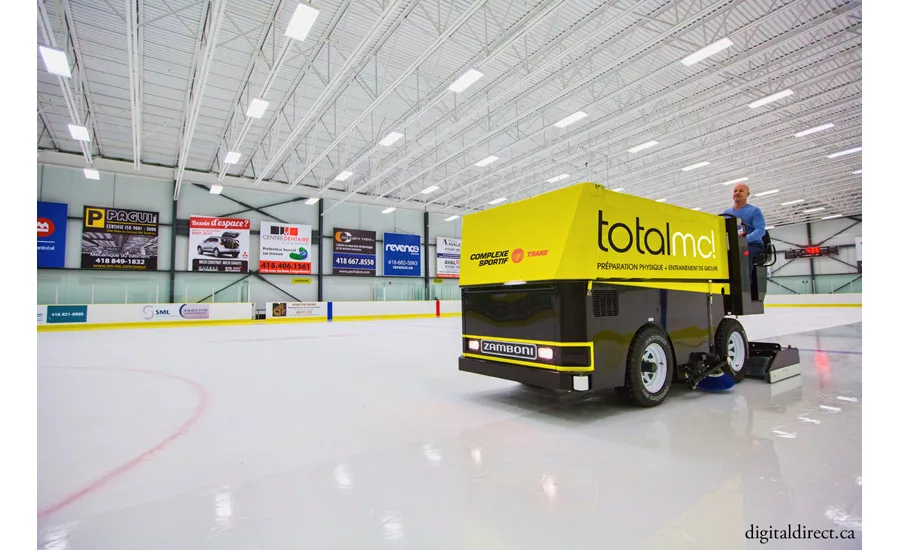
The Complexe Sportif Trane ice arena employed a number of HVAC solutions, including a water-cooled chiller and heat rejection system, in an effort to keep the arena project efficient and within budget.
Charles Vigneault had long dreamed of owning an ice rink, and he spent years planning to make that dream a reality.
His city of Boischatel, Quebec, didn’t have a rink, and residents had to drive to busy rinks in other cities, making it hard to get time on the ice. So Vigneault — a local businessman who is both a hockey player and a hockey dad — decided to fill that need for Boischatel, a city of about 6,500 residents near Quebec City.
Because he was privately funding the facility, it was important to Vigneault to build an ice arena that was not only cost-effective to construct, but offered affordable maintenance and expenses in the years to come. Choosing HVAC and mechanical systems with track records of reliability and safety were also key considerations.
His years of planning paid off. The Complexe Sportif Trane ice arena opened in September 2014, and has been thriving.
A cost-effective plan
As he was planning for the 40,000-sq-ft arena, which also has an adjoining gym and office space, Vigneault kept size and budget considerations in mind. He didn’t want to plan a facility that was too big or one that was not economically viable to build and maintain.
He chose a 250-ton conventional water-cooled chiller capable of operating at ice rink conditions — 90 tons at a leaving-evaporator solution of 12ºF — combined with a matching closed-circuit dry cooler for heat rejection. The chiller does not require a dedicated mechanical room, which helped Vigneault save floor space, installation time, and costs in his building plans.
Vigneault also liked that the chiller system offers simplicity and does not require highly specialized technicians to perform service and maintenance, which differs from some systems that use other types of refrigerants. In this case, the chiller at Complexe Sportif uses a current-generation refrigerant, R-134a, which offers a non-toxic and non-flammable solution.
Using a closed-circuit dry cooler for the heat rejection also eliminates the risk of Legionella — the pathogen that causes Legionnaires’ disease — which can be an issue with systems that use an open cooling tower.
Reliable technology
The ability to make ice efficiently and as quickly as possible to keep the ice at a precise temperature setpoint is very important for ice arena facilities.
The chiller at Complexe Sportif Trane uses two direct-drive helical rotary compressors on two dedicated refrigerant circuits. The direct-drive helical rotary compressor design provides the facility with precise temperature control and reliability. The chiller can be configured to produce leaving-evaporator solution temperatures as low as 10ºF, making it ideal for the quick-freezing operation needed for the ice rink.
In addition, the compressors have modulating slide valve technology, which allows the unit to run at precise, decimal-point setpoints.
The heat recovery mode in the system means the chiller is also used to generate condenser water temperatures as high as 115ºF while producing the low solution temperatures.
To maximize energy recovery, before sending any excess heat outside, the chiller’s heat rejection is used to heat the snow melt pit and the arena’s under-ice slab, and also to preheat or reheat the outside air unit. This makes the solution efficient, helping to control energy costs.
In addition to the mechanical equipment, Vigneault installed a BAS that lets him monitor and control the chiller and other building systems — including the building’s air handler and the rooftop units used in the gym and office area of the facility — from one interface.
The BAS can be accessed from a computer, tablet or smartphone, so Vigneault can keep tabs on his building and easily make changes to schedules or setpoints from almost anywhere.
Results
Vigneault wanted an ice arena that would be reliable and provide a comfortable environment for hockey players, ice skaters and guests, while also enabling simple maintenance and efficient performance. The first year of the facility has impressed Vigneault and the community — fulfilling a need in the area as the principal ice rink for city sports organizations and private groups. Vigneault is also happy with the performance of the systems he chose for the building.
“We are planning to use this facility as our model as we look for opportunities to work with other cities on similar ice rink projects,” Vigneault says.
Looking for a reprint of this article?
From high-res PDFs to custom plaques, order your copy today!