The Skinny On Reactors For VFDs
You’ve got options for avoiding trouble caused by harmonic distortion.
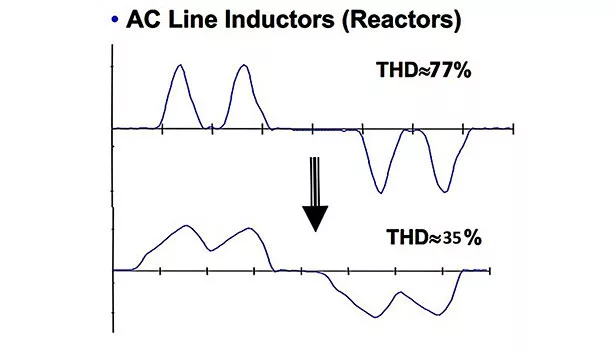
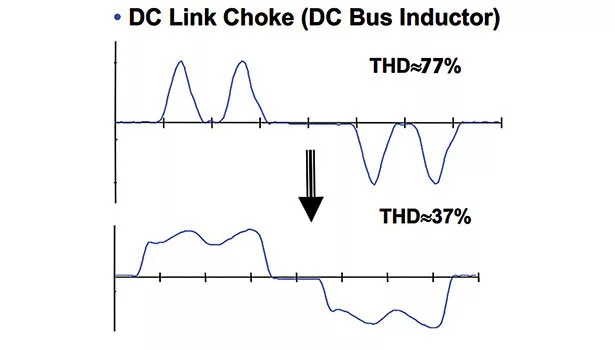
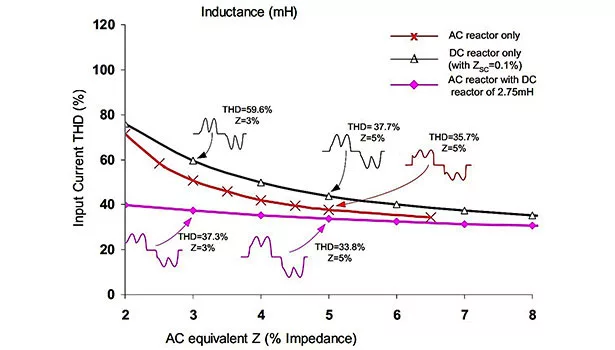
FIGURE 3. Comparison chart of Input Current THD(%).
Reactors for AC drives are available as either AC reactors or DC reactors (DC link chokes). Both serve the same main purpose: to smooth the current flow to the AC drive, and reduce damaging harmonics produced on the power line.
First, let’s look at the AC line reactor. In addition to providing protection from voltage transients created by power factor capacitor switching and lighting surges, the AC reactor also offers a degree of reduction of harmonic distortion the VFD generates back into the line. If we take a typical VFD with no built-in DC reactor and add a 5% AC input reactor, we can bring the THD it produces from roughly 77% down to roughly 35%.
The AC line reactor, however, does have its disadvantages. The first is that it causes voltage drop to the VFD due to a condition called overlap of diode conduction. This may not always be seen as a complete disadvantage, especially to those who see nuisance overvoltage trips regularly on their VFD’s. But a major disadvantage is the large physical size. Often times, an AC reactor can take up valuable panel space in a VFD configured package, forcing a larger enclosure and excessive additional costs.
Next we’ll look at DC reactors. The DC reactor’s advantages are that it results in no voltage drop, small physical size (these days they are internal to the VFD as standard), and lastly, they can provide almost as high a degree of harmonic distortion mitigation as the AC reactor can provide.
As shown in Figure 2, drives that incorporate a 5% impedance DC reactor as a standard feature, actually produce only slightly more harmonic distortion than those with a 5% AC input reactor.
The only real disadvantage is that a DC reactor doesn’t protect against voltage transients created by power factor capacitor switching and lighting surges. However, most drives like this on the market today include a built-in surge suppressor on the line side to protect against voltage transients, thus negating what would still have been the main advantage of using an AC reactor.
More and more often these days, specifying engineers are requiring an AC input reactor for each VFD to reduce harmonics, but is this really necessary? Let’s take a quick look at what there is to be gained.
Figure 3 provides test data showing the effects on Input Current THD (%) that AC and DC link reactors have, individually as well as in combination.
One can plainly see that the major benefit of using reactors for harmonic mitigation, whether AC or DC, is in the initial application. A VFD with no input AC reactor, as well as no DC reactor (built-in or otherwise), will likely have an Input Current THD (77%) or more.
As mentioned earlier, many of today’s VFD’s already have built-in DC link reactors and surge suppressors. That being said, the addition of an AC input reactor isn’t going to provide much harmonic mitigation bang for your added buck — resulting in a marginal gain at best.
These are the main facts to consider when using reactors as the main option to reduce harmonic distortion. Now, depending on the specification, jobsite specifics, or if you need to meet IEEE-519, many other options are available, including the addition of passive harmonic input filters, active harmonic input filters, multi-pulse transformers, and more recently, the use of low harmonic drives, eliminating the need for additional harmonic mitigation equipment in the first place. Most of the major VFD vendors offer free downloads of harmonic estimation software. A quick Google search can provide an engineer with hours of “fun with harmonic distortion,” and you would be surprised how much can be learned on the topic just from playing around with these free tools.
Looking for a reprint of this article?
From high-res PDFs to custom plaques, order your copy today!