Issues and Improvements In Commercial Kitchen Exhaust Ducts
Applicable codes and standards provide requirements for exhaust ducts connected to Type I (grease and smoke emitting) exhaust hoods. For many years, legacy and existing duct products have been predominantly 16-gauge carbon steel and mostly rectangular in shape. These ducts are usually planned, measured, fitted, and welded on-site, to comply with applicable codes and standards for materials, welding, connections, slope, drains, cleaning access, and other provisions.
Despite the good intentions of fabricators and installers, visits to operating foodservice facilities and fire scenes suggest there are challenges with unlisted, welded-on-site ducts, including:
• Integrity – welds not continuously liquid tight;
• Stability – not holding up to exposure of high temperatures (caused by internal grease fires);
• Poor connections between exhaust ducts and hoods, and also ducts and exhaust fans;
• Insufficient duct clearance to combustible construction or noncompliant duct wrapping;
• Improper penetrations of fire-rated barriers;
• Non-compliance with required slope and drainage means; and
• Lack of required access panels for cleaning.
Welded-on-site ducts that are not tested and listed to national consensus standards are hereafter referred to as “unlisted ducts.” In contrast, codes and standards provide many exceptions for round, stainless, factory-built ducts and accessories that are tested and listed to the requirements in UL Standard 1978 on Grease Ducts — hereafter called “listed ducts.” This article describes the relative challenges and benefits of using unlisted and listed grease ducts in construction of commercial kitchens.
Duct Integrity
Codes and standards require continuous, liquid-tight welds, regardless of duct dimensions and shape, on-site welding access, work lighting, and other factors. To validate liquid-tight integrity, the International Mechanical Code (IMC) requires a grease duct leakage test in Section 506.3.2. The test involves passage of a light with not less than 100 watts through “the entire section of ductwork to be tested.” Listed ducts are exempt from this requirement.
The Minnesota Mechanical Code, in section 506.4.2, requires evaluation of duct leakage by means of an air pressure test. Ducts must hold positive air pressure of 1.0 inch water column for a minimum of 20 minutes unless an equivalent alternate test is specified by the building official.¹ However, because this test is frequently conducted before access doors are installed and duct closure applied, the air pressure test has not been accepted in consensus codes and standards.
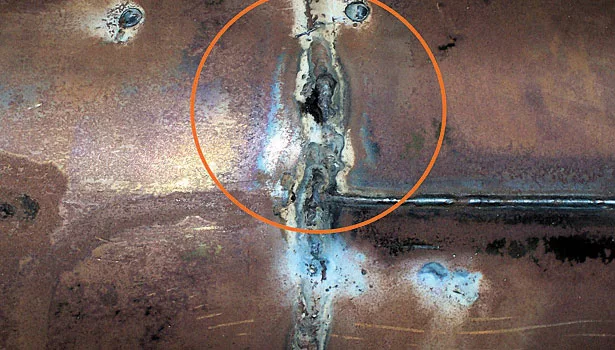
A more practical test is using an actual duct washing procedure. For example, a pressure washer can be used to internally spray all welds and duct access doors for the length of the duct, with acceptance if there is no water leakage. Unlike the air pressure test, this test method pinpoints where leaks occur in ducts and accesses. Such a test would help prevent fires from spreading outside ducts, such as through the holes in the fire scene duct shown in Figure 1.
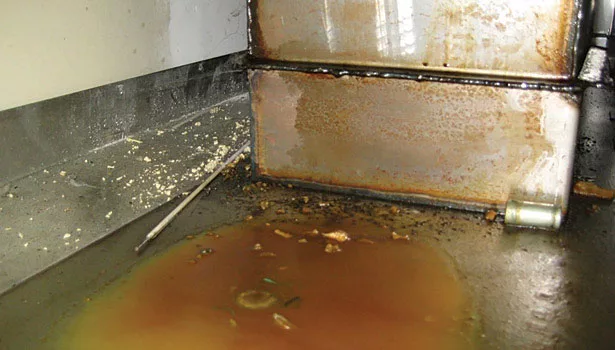
In many routine visits to operating foodservice facilities and fire scenes, the author has seen many leaking grease ducts and access doors, resulting in grease on tops of hoods, as show in Figure 2, on gypsum board ceilings, and permeating lay-in ceiling panels, thus providing flammable fuel for fires.
“Fireballs!”
A largely unknown fire risk with leaking kitchen exhaust ducts was discovered by a listing agency conducting a UL Standard 300 test of a prototype fire suppression system. The equipment included a UL 710 listed hood over a natural gas-fueled deep fat fryer. With the exhaust duct pre-heated as required, the deep fat fryer was ignited, and after the specified pre-burn time, the water and surfactant based fire suppression system was activated.
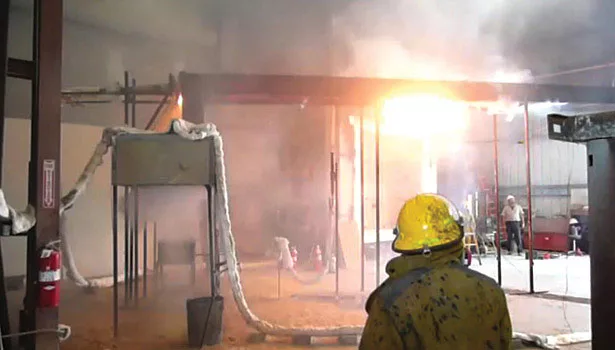
The unlisted duct utilized for the test was built by the testing agency, with rectangular sections bolted together with gaskets and rectangular flanges. The duct was intended to be liquid tight, but during the test procedure, the test engineer was surprised (more likely shocked) to see “fireballs” exploding from small leaks in the test duct, as seen in Figure 3.
A summary of the test procedure and likely explanation of the exploding fireball phenomenon is outlined below.
1. When the water based fire suppression system is activated during UL 300 testing, the fire is already underway in the hood and duct for a specified pre-burn time.
2. The duct is already pre-heated to a specified temperature with a large gas burner.
3. When the water based fire suppression agent contacts the heated hood and duct, much of the water vaporizes and pressurizes the duct.
4. Propelled by pressure in the duct, superheated grease liquid and expanding vapors escape from the leaky duct.
5. Liquid grease is vaporized as it exits through the holes in the duct.
6. The superheated grease liquid and vapors, which were unable to burn in the duct because of lack of oxygen, encounter fresh air and oxygen outside the duct and auto-ignite explosively, causing the “fireballs.”
Duct Stability
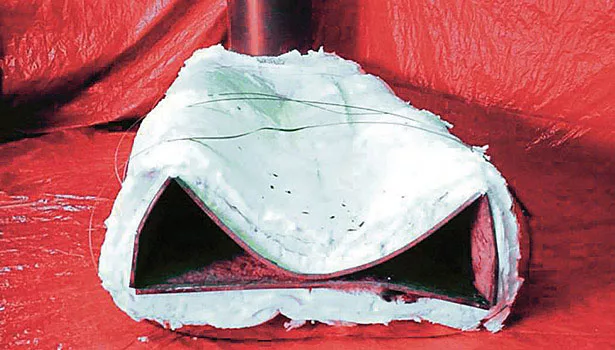
Codes and standards require welded duct to be 16-gauge carbon steel, but there is no requirement for how stable the duct must be when exposed to fire. UL Standards 1978 and 2221 require that listed grease ducts hold up to extreme internal and external fire exposures. When tested to the listed duct standards, unlisted ducts enclosed with duct insulation do not fare very well, as a result of retained heat and thermal stresses, as shown in Figure 4.
Duct Connections to Hoods
Codes and standards require welded connection of ducts to hoods with specified bolted, flanged, gasketed connection, or by listed and labeled connections. At one fire site, the author noted an unlisted hood with crudely cut holes for two unlistedducts, which were inserted through the rough cut holes withcrudely hammered flanged ends, without any means of sealing.Fire likely escaped through these connections, as wood trusses above the hood were burnt and fire spread throughout the attic.
Clearance to Combustibles and Fire Rating
NFPA 96, IMC, and Uniform Mechanical Code (UMC) require 18 in clearance to combustible construction for single wall, unenclosed duct. A reduction of the minimum 18-in clearance to 3 in is allowed where gypsum wallboard is attached to noncombustible construction, with exceptions in IMC section 506.3.6. The similar requirement in NFPA 96 section 4.2 and the UMC allows reduction to 3-in clearance to limited-combustion material, and 0 in to noncombustible material, as defined in NFPA 96 Table A.3.3.33. The table example of a limited-combustible wall is “gypsum board on metal studs.”
Fire scene visits by the author indicate that the most frequent example of non-compliant duct (and hood) clearance requirements is reducing clearance to 3 or 0 in with gypsum board on wood instead of the NFPA 96-required metal construction.
There are many listed duct products, typically including multiple double-wall models, non-fire-rated and fire-rated, which allow reduced clearances to combustibles down to 0 in, in contrast to unlisted ductwork with a single wall and fire-rated double layer wrapped for zero clearance.
Duct enclosures and penetrations
When grease ducts need to be hourly fire rated (i.e., after penetrating through a fire barrier such as a wall or floor relative to the building construction requirements), there are currently three methods for providing fire-rated duct enclosures, as approved by local code jurisdictions:
1. Traditional method: double-ply gypsum board shaft construction with steel studs surrounding unlisted duct, or listed non-fire rated single- or double-wall duct.
2. Field enclosed (wrapped): double-layer, joint overlapped, surrounding unlisted duct, with foil faced insulation that meets the requirements of ASTM E2336 — usually approved for zero clearance to combustibles.
3. Factory-built integral enclosure: factory-built, double-wall insulated, grease duct classified/listed to UL Standard 2221 — usually approved for zero clearance to combustibles.
Fire barrier penetrations
The field wrapped or factory-built enclosure methods 2 and 3 have through-penetration fire stops rated to ASTM E814.
Listed Duct Products
There are many advantages of specifying factory-built listed ductwork instead of unlisted ducts.
• With listed duct products, on-site labor is traded for highly trained factory labor that must conform to listing specifications, subject to inspection and sampling by the listing agency. Importantly, rigorous destructive testing, as part of the listing process, ensures performance in fire situations.
• Installation versatility is enhanced with listed duct products such as factory built elbows, tees, wyes, access doors, drains, and support brackets. Adjustable telescopic duct sections provide for dimensional adjustments and thermal expansion during extreme temperatures.
• Use of listed grease ducts reduces the number of field inspections compared to field-welded and -wrapped ducts, which should be inspected after welding, after the first insulation layer is installed, and after the second insulation layer is installed.
• Hoods, filters, and exhaust fans are generally accessible for firefighting, while ducts are often inaccessible. Listed ducts will withstand the rigors of grease duct fires better and longer than unlisted ducts.
• Round duct has better airflow characteristics than rectangular duct, as indicated by using industry standard air duct calculation methods, such as contained in ACCA Manual D3. For example, there is up to 45% less friction (per 100 ft) in a 15-in-round duct than in a rectangular duct (e.g., 4:1 aspect ratio) with the same cross sectional area and 1,000-cfm airflow at 800 fpm.
• There is less potential for leakage from listed ducts when installed properly, as the listing process tests joints with factory-flanged section ends, v-bands, and other means to secure joints including a specified, temperature resistant, elastomeric silicone joint sealant. Cleaning access doors are tested to UL 1978.
• Elimination of on-site welding increases safety during construction and remodeling.
After a notable fire at a large Midwestern casino undergoing remodeling, an $83.5 million lawsuit claimed a welder “inadvertently sparked the blaze in the kitchen area … and spread flames throughout the attic and truss space … because of the presence of combustible residue in the ductwork ….”²
• Installation errors are minimized by use of insulated double wall listed duct products, compared to issues in applying the ASTM E2336 required double overlapping layers of duct enclosure (wrap) products for single wall ducts.
• Stainless round duct is inherently stronger than rectangular unlisted duct during elevated fire temperatures, is more tolerant of cleaning agents, and grease does not adhere as easily because of the smoother finish and lack of corners.
• For multi-story installation, listed duct installs like traditional boiler pressure stack flue, which can be installed more quickly and less costly, particularly for vertical runs.
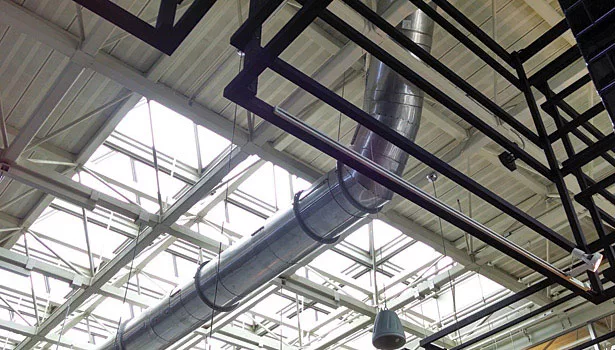
• Listed ductwork is lighter weight, and depending on listing test results, allows greater spacing of supports. A sample installation is shown in Figure 5.
Sample Specifications
Here are sample specifications for typical listed, insulated, double wall duct products:
• For use in kitchen ventilation applications where reduced clearance or zero-in clearance to combustibles is needed
• Listed to UL Standard 1978 and/or UL Standard 2221 for hourly fire ratings
• Duct sections are constructed with a 20-gauge stainless inner wall and a 24-gauge aluminized steel or stainless steel outer wall, with insulation between the inner and outer walls.
• Inner duct diameters range from 5 in up to 36 in at 0-in clearance or 48 in at specified clearances.
• Rated for continuous operation at 500°F and intermittent operation at 2,000°F, simulating a grease fire.
Summary and Recommendations
Based on its robust design, versatility, and safety as a result of rigorous evaluation and fire testing, the trend toward greater specification and installation of listed duct products makes sense. It also makes sense to codify the use of listed grease ducts, as a minimum requirement, for hoods serving solid fuel cooking, particularly in view of the accumulation in ducts of highly flammable creosote in addition to grease.
In most current specifications of commercial kitchen exhaust systems, Type I hoods are listed to UL 710, removable grease filters are listed to UL 1046, and exhaust fans are listed to UL 762. To provide enhanced building and occupant safety, it makes reasonable sense that the duct products between these components should be listed also. ES
Acknowledgements
Valuable suggestions and many technical details were provided by industry veterans Bill Griffin, vice president engineering at CaptiveAire Systems; Keith Page, commercial/industrial pipe product manager at Selkirk Corporation; and Shaun Ray, director of engineering at Metal-Fab, Inc. Photo credits: 1 and 2 – author; 3 – CaptiveAire; 4 and 5 – Selkirk.
References
1. Minnesota Mechanical Code. 2009. Section 506. https://www.revisor.mn.gov/rules/?id=1346&view=chapter#rule.1346.0506
2. Shelton, Leeann, “Suit seeks 83.5 million in Empress Casino fire,” October 24, 2012, Chicago Sun-Times (available online – search by title).
3. ACCA Association. Residential Duct Systems (Manual D). Arlington, VA. HYPERLINK “http://www.acca.org” www.acca.org
Doug Horton, MS, MBA, CFSP, is principal consultant at D. J. HORTON and Associates in Batavia, IL.
Standards for Listed Ducts for Commercial Applications
ASTM E119 -Standard Test Methods for Fire Tests of Building Construction and Material. Test methods in this fire-test-response standard are applicable to assemblies of masonry units and composite assemblies of structural materials for buildings.
ASTM E814 -Standard Test Method for Fire Tests of Penetration Firestop Systems. This test method is applicable to firestop systems of various materials and construction. Firestop systems are intended for use in openings in fire-resistive walls and floors that are evaluated in accordance with ASTM E119 test methods.
ASTM E2336 -Standard Test Methods for Fire Resistive Grease Duct Enclosure Systems. These test methods evaluate enclosure materials and grease duct enclosure systems with tests for noncombustibility, fire resistance, durability, internal fire, and fire-engulfment with a through-penetration fire stop.
UL 1978 –Grease Ducts. Requirements cover factory-built grease ducts and grease duct assemblies that are intended to be installed at reduced clearances where 18-in clearance is specified in NFPA 96, IMC, UMC, etc. Requirements also cover modular grease duct assemblies, unwelded connections between adjoining duct parts, fittings, and access doors intended for use with grease ducts installed in accordance with NFPA 96, IMC, and UMC. Clearances are defined by a 500°F operational fire test and a 2,000°F extreme test for 30 minutes.
UL 2221 –Tests of Fire Resistive Grease Duct Enclosure Assemblies. These tests are intended to determine the hourly fire resistance of grease duct enclosure assemblies, to limit combustibility, surface flammability, and smoke generation potential of coverings used to enclose grease ducts. These requirements also evaluate the effectiveness of the combination of grease duct and enclosure as a fire rated enclosure and through penetration firestop system. Clearances are defined similarly to UL 1978.
Looking for a reprint of this article?
From high-res PDFs to custom plaques, order your copy today!