Pharma Warehouses: Two Degrees Of Separation
In pharma warehousing, two degrees can be the difference between life and death. Tailor the HVAC to the specifics of the space with the help of CFD, and pave the way to a smooth “last mile” to the user in this critical distribution chain.
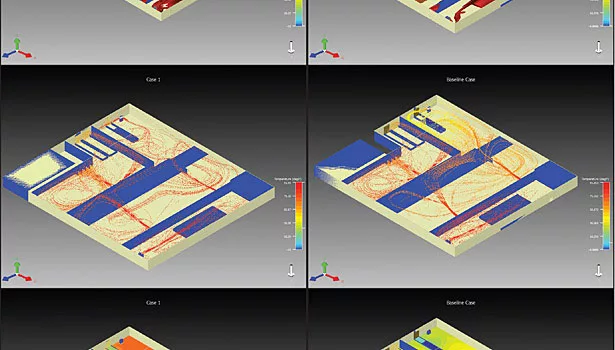
FIGURE 1. Top two images show the surface plots of temperature, each color representing a specific temperature. Middle images are particle traces illustrating the movement of air, which is used to identify dead spots and other air flow anomalies. Bottom images represent temperature cut planes at different levels above the floor. Pharma warehousing typically requires consistent temperature from floor to ceiling.
To see a larger PDF of this figure, click here.
“Mission Critical.” The term conjures up images of data centers populated with rows and rows of black boxes churning away, generating heat, and consuming power at an alarming rate. While the business implications of a data failure can be dramatic, this is not the only application where a temperature-control failure can have a significant, even life-threatening, result.
The health-care industry in the U.S. is ranked by some sources as the fourth-largest contributor to GDP and creates almost 700,000 direct jobs, plus another 2 million indirect jobs. A large portion of this significant industry is engaged in the research and development of pharmaceuticals.
We all take advantage of this R&D at some point in our life. Many of us are prescribed daily doses of drugs that target specific conditions. Some of those conditions can shorten, or even end, our lives if not treated with effective medication. Whether for data servers or pharma warehouses, maintaining a controlled temperature is equally critical, but how those environments are maintained can be vastly different. Mission-critical temperature control is not one-size-fits-all.
Unlike a modern server that will shut down if it gets too hot, pharmaceutical compounds have no such built-in safeties. They will simply lose their ability to effectively treat the condition they are intended to remedy — cholesterol levels can climb, blood pressure can spike, infections can spread, and quality of life can diminish.
As consumers, we represent the end of “the last mile” in the logistics chain for pharmaceutical products. At the front end of the chain is the pharmaceutical production facility — a sterile, climate-controlled world that makes a data center seem filthy and out of control.
But what happens between that “first mile” and the “last mile?” Pharmaceutical products get shipped around the country, and the world, to warehouses and distribution centers where they may sit on a shelf for an extended period. Suddenly, your average warehouse becomes “mission critical.” A temperature-control failure can cost millions of dollars in spoiled products, and the impact can be far greater. People can die.
In the U.S., the Food and Drug Administration has oversight on the quality of medications that reach the consumer. It is not uncommon for the FDA to conduct real-time monitoring of temperature and humidity — from floor to ceiling and wall to wall — in facilities where temperature-sensitive drugs are stored. In one case in which my company was involved, there were 60 real-time sensors in a relatively small 25,000-sq-ft warehouse. A temperature drift of more than 2?F in either direction from a setpoint would trigger alarms and quickly render the entire inventory useless. We have yet to see a modern data-center specification that stringent.
Solving a pharmaceutical “mission critical” application requires techniques that are similar to those used for data centers but perhaps even more complex. Computational Fluid Dynamic (CFD) modeling is an integral part of deciding how to maintain those tight conditions. In most data center models, designers can use rack-level objects or, on rare occasions, server-level objects. For mission critical pharmaceutical storage, we believe that designers should always use detailed 3-D models (sometimes down to the level of individual boxes on shelves). Advanced CFD software allows the designer to scatter dozens of “virtual sensors” throughout the space and use optimization algorithms to determine the best location and operating parameters for the equipment needed to ensure temperature consistency.
CFD software calculates trillions of iterations of the fluid and thermodynamic data, which can take some time, but ultimately it will convert the data into color-coded images of temperature or velocity, or vector plots of airflow direction and speed. Each X, Y, or Z plane in the space has an associated set of images that make it easy to identify hot spots, dead spots, odd airflow patterns, non-uniform temperatures, and other potential problems.
Take, for example, a typical data center: most equipment is installed in racks that are only 6 to 8 ft tall. To a data center facility manager, the air temperature above the height of those racks is not critically important. Conversely, a modern pharmaceutical warehouse could easily have temperature-sensitive products on racks rising as tall as 30 ft. Stratification control and airflow management is much more difficult in those cases, and careful selection of the type of mechanical equipment is obviously important.
Many of the techniques required to solve temperature-control problems in warehouse applications can seem a bit counterintuitive. That’s why we always recommend CFD analysis: to prove, or disprove, the proposed equipment layout and operating parameters. But even before the CFD analysis is run, there are some guidelines that a designer can follow for modeling the initial case, which the CFD results can then be used to refine.
Three rules for planning HVAC for temperature-sensitive warehousing:
- Avoid large differentials between the supply air temperature and the target space temperature. This helps to avoid “dumping” or “stratifying” of the air as it leaves the HVAC equipment that will immediately cause temperature control problems in the racks closest to the HVAC unit air supply point. The supply air temperatures are also much different than engineers typically specify for comfort cooling/heating applications
- Avoid locating HVAC equipment where the supply air must flow perpendicular to the racks immediately as it leaves the supply point. Although air is a fluid, like water, and will eventually fill the space by migrating through every opening, starting off blowing air into a “wall” will create problems. Again, CFD can help identify any situations like this that might not be readily apparent.
- Consider where the actual thermostats and humidity sensors can be located in the physical space, and make sure that some (or all) of the virtual sensors are in those locations. This will provide some insight into how the real, physical, HVAC system will respond. In a large warehouse, the physical location of thermostats can be a challenge because there are no interior walls on which to mount the sensors. Modeling potential locations up front in the simulation can help to identify the best locations later, especially when optimization algorithms are used to refine the design.
For purposes of clarity and rulemaking, the HVAC and construction industry might need to define “mission critical” as a data center environment, but a broader definition of that term should clearly include pharmaceutical warehousing and distribution — and the unique challenges inherent to this industry.
Looking for a reprint of this article?
From high-res PDFs to custom plaques, order your copy today!