Chiller Retrofits In Health Care Facilities
One of the worst things you can do is note the capacity and replace the chiller. Have the building loads and usage changed? What about motors and cooling towers? Consider these and your part-load realities to create real long-term improvements.
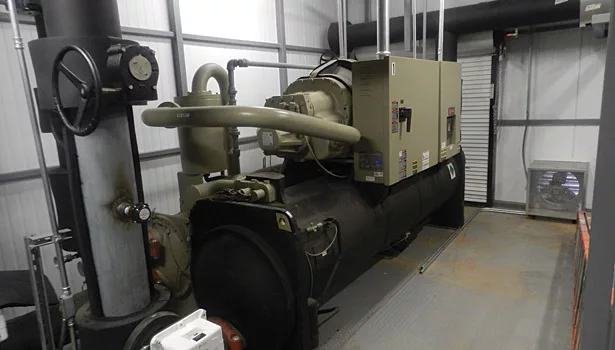

The replacement of chillers for hospitals and other health care facilities are often done out of absolute necessity, and it is often avoided for as long as possible. The chillers in health care facilities are usually the most expensive piece of equipment in HVAC system. The removal and replacement of chillers can be very disruptive, often requiring modification to the chilled water and condenser water piping system, and, in a lot of cases, the removal of walls and ceilings. Most hospitals have multiple chillers that are manifold together to serve the connected building load. Smaller outpatient facilities usually consist of one chiller serving the entire building. The replacement of chillers in any building is usually a time-consuming process requiring detailed planning long before the equipment is actually replaced.
Because of these factors, building owners and maintenance staff move very cautiously when faced with potential replacement decisions, simply keeping the chillers in place as long as it keeps operating. While such an approach may make sense for office buildings and other commercial buildings, this can create unsustainable situations for HVAC maintenance — with the most extreme outcome being chiller failure, which could leave the facility without cooling for an extended period of time.
Proceeding with caution is important given a chiller replacement’s potential cost and disruption, but other factors should also be considered when weighing options. A huge driving factor for the replacement of old chillers is the large increase in chiller efficiency that was not available 10-15 years ago.
Efficiency considerations bring other aspects of the overall chiller system into the conversation. Auxiliary equipment, such as pumps and cooling towers, are affected by the chiller operation. When looking at the replacement of a component of a HVAC system, you have to examine the individual components and how their interaction will affect the entire system. In addition to combined equipment capacity, several other factors will influence the system ability to meet the building cooling load. Type of refrigerant, operating hours, weather conditions, electricity rates, and building use all warrant examination in detail when retrofitting a chiller system.
A common mistake for health care clients and maintenance staff is to hire a contractor to replace chillers “like for like” without examining what is being specified. These habitual responses to chiller replacement will not achieve the most optimum efficiency for the chilled water system.
Chiller Efficiency
Chillers are the single largest user of electricity in a health care facility. Most hospitals are 24-hr operation, and therefore chillers are in operation every day, all year round. There are periods of free cooling available from the airside and waterside economizer, but this is less significant for hospitals where chilled water is often used for direct equipment cooling. Care must be taken when replacing chillers to ensure that some form of free cooling is included as part of the facility energy strategy.
Replacing older chillers that have been in operation for over 20 years can be a very good economic decision for the health care facility. The cost of the chiller and its auxiliary equipment is a large economical investment, but new levels of efficiency make the rate of return on the investment very attractive.
For example, chillers from the leading chiller manufacturers like Daikin, Trane, Carrier, and Johnsons Control have full load efficiencies of between 0.45 kW per ton and 0.5 kW per ton at AHRI conditions. These chillers also have integrated part load values (IPLVs) of between 0.29 kW per ton and 0.305 kW per ton. Newer magnetic bearings chillers such as Daikin Magnitude, Johnson Controls YMC2, and Multistack’s MagLev have integrated part load values as low as 0.29 kW per ton, which can be very attractive for replacement chillers.
Ten years ago centrifugal and screw chillers had full-load efficiency rating of 0.75 to 0.85 kW per ton. Ten years prior, the full load efficiencies were in the range of 0.85 to 1.00 kW per ton. Based on these numbers, this means that newer chillers are operating at as much as 60% better than chillers that were manufactured and installed 20 years ago. This does not take into consideration the reduced efficiencies that are associated with poor maintenance and normal wear and tear of existing chiller machines. New chillers should be selected not only on first cost but on lifecycle cost and overall equipment efficiencies.
Selecting a very efficient full-load chiller will not guarantee efficient chiller performance. Understanding the load of the existing system will enable most efficient chiller selection. Most chillers are operated at full load less than 5 percent of their total run time. Chillers that are operated at part load for most of the time will require a replacement with strong part-load efficiencies. Although it may cost more to purchase a chiller with better part-load efficiency, this incremental cost usually have a short payback period due to energy savings.
Facilities can go a bit further by installing frictionless chillers, which offer even more efficiency and less electricity use than the standard centrifugal chillers. The price of these chillers varies depending on the size of the equipment and the cost of installation; the first cost may be between 10% and 20% more than that of a conventional centrifugal chiller. However, in most cases, utility rebates and tax incentives eliminate most if not all of that difference, and over time, the systems more than pay for themselves. In three case studies done for the U.S. Navy, magnetic-bearing compressors showed annual energy savings of more than $20,000, overall power savings of 49%, and an average simple payback of only 6.4 years.
Magnetic-bearing centrifugal compressors are typically best suited for buildings with cooling loads larger than 300 tons, which makes them perfect for health care facilities. These chillers are available in units as small as 60 tons from Multistack. Daikin Magnitude is available at sizes up to 1,500 tons, which makes them perfect for large central plant system in hospitals. At the smaller end, other compressor technologies can often provide less expensive cooling, but the lack of maintenance and the improved efficiency of magnetic-bearing compressors may make them preferable in place of some screw and scroll compressors. Magnetic-bearing centrifugal compressor technology may not make sense for all applications, but they are worth looking at for health care projects, which usually have large cooling loads, and particularly in regions where electricity rates are high.
Refrigerants
The average useful life of hospitals is approximately 50 years. ASHRAE Service Life and Maintenance Cost Database list the average useful service life of a typical chiller as 25 years. Therefore a chiller should be replaced at least two times during the life of the hospital. However, this is hardly the case for today’s facilities, where capital cost is scarce and equipment is often operated until it falls apart.
Newer energy-efficient chillers are much better for the environment because their refrigerants have less effect on global warming and air pollution. The newer chillers’ refrigerants are better for the stratospheric ozone layer because they do not use ozone-depleting CFC refrigerants. Most chillers before 1995 used CFC-11, CFC-12, or HCFC-22 refrigerants. The Montreal Protocol forced developed countries to stop producing and importing CFC refrigerant in 1996. HFCs are less damaging to the stratosphere ozone layer and are considered as transitional refrigerants because they will assist in the accelerated reduction of CFC phased out under the protocol.
The most common refrigerants for chillers use are HFC-134a and HCFC-123; these two refrigerants are approved by the Environmental Protection Agency (EPA). Daikin, Carrier, and York use HFC-134a, while Trane uses HCFC-123. HFC-134a can achieve high energy efficiency and is ozone friendly, but it does have a higher global warming potential (GWP). HCFC-123 can achieve high energy efficiency but is not completely ozone friendly and has a low global warming potential. Energy efficiency should be the main criteria when selecting chillers, but care must be taken to ensure that chillers are carefully maintained and refrigerant emissions are minimized. Health care facilities can make significant contributions to the environment by replacing old chillers that contain CFCs.
Smaller screw chillers should be replaced with chillers that have HFC-134a or others that contain a blend of HFC R-407C and R410A. Larger centrifugal chillers should be replaced with chillers that have HCFC-123 or HFC-134a. The maintenance staff should be encouraged to properly maintain the chillers so that there is a minimum refrigerant leakage, which is the main source of emission. Replacing or retrofitting chillers will help in reducing refrigerant emission.
Building Deficiencies
The tendency is to think of chiller retrofits in a vacuum, where the focus is on the single piece of equipment. Instead, examine the whole building to determine how the chiller sizing can be optimized. Is there an opportunity to reduce the overall chiller load in the building by reducing the lighting load, improving the glazing, improving the envelope air tightness, improving the walls’ insulation? These possibilities should be examined and if these are planned projects, the chiller should not be replaced until all the upgrades are completed. Reducing cooling load will result in a smaller chiller requirement and a more optimized system design.
Avoid: Like for Like Replacements
When chillers reach the end of their service life, they are often replaced by a new chiller of the same type and capacity. This is the least disruptive and the easiest approach to chiller replacement. Many maintenance staff consider themselves experts in the design and selection of HVAC equipment and will consider this method as the best method of getting their system back online.
In truth, selecting the right replacement chiller is a detailed and meticulous process that maintenance staffs neither have the experience nor the time to conduct. Hiring an experienced mechanical engineer to conduct the design and analysis of the existing system can result in large energy savings and a reduction in operational cost.
While a straightforward swap may be a solution for a simple medical office building, the process is very complex for larger health care facilities. When selecting replacement chillers, designers will take into consideration that existing conditions today maybe very different from 25 years ago, when the chiller system was installed. When the system was designed initially, the chiller may have suited the building needs at that time, but because of the change in medical technology, equipment, and maybe building use, the old chiller size may not be able to meet the loads of the existing facility. To get the most out of chiller retrofits, the new chillers must be designed to match the current needs of the building.
In addition to the factors mentioned above, here are some other areas where efficiencies can be realized.
Energy-Efficient Motors
Motor designs have improved over the years, and thus careful motor selection for auxiliary equipment can save energy and contribute to an overall system downsizing strategy. When properly matched with their anticipated load, motors can run at peak efficiency more of the time, improving their performance and saving energy. Care must be taken not to overspeed the motor for extended periods, because this will reduce the life of the motor.
Cooling Towers
Larger cooling tower size can boost chiller efficiency by lowering entering condenser water temperature. Factors such as size, height, and fan configurations will affect the efficiency of the tower and should be considered when making a replacement selection. If there is a possibility of replacing the cooling towers, which usually occurs the same time as chiller replacement, then this would be a perfect opportunity to upsize the cooling towers.
Controls
A good building management system (BMS) can optimize the efficiency of individual pieces of equipment, as well as how they operate together. Incorporating chiller optimization cooling technology such as the Hartman loop can optimize the chiller system performance and save a significant amount of energy. Developing a metering system that is logged by the BMS will also allow the facilities team to monitor the chilled water use of the building.
Multiple Chiller Configuration
In the selections of multiple chillers, be sure to analyze the difference in system performance between chillers that are equal and unequal in size. Splitting the load unevenly can result in more efficient operation at lower connected building loads. Maybe this can be the opportunity to add a winter chiller for some buildings on a health care campus.
Variable Frequency Drives (VFDs)
Adding VFD drives to existing chillers can improve the performance because the chiller will be able to vary its power consumption based on the building load variations. Adding VFD to auxiliary equipment will also reduce the chiller loads. This is done by adjusting the speed of fan and/or pump motors to more precisely meet cooling load requirements and reduce power consumption. They are particularly helpful at part-load conditions.
Conclusion
An HVAC retrofit is a major undertaking for the facility department, the occupants, and the health care organization C-Suite. It is also an important opportunity for the health care facility — an opportunity that, because of the cost and disruption involved, might not come along again for the life of the health care facility. The bottom line is that a chiller retrofit makes sense if the chiller has surpassed its service life. Recent improvement in chiller technology and efficiencies makes the decision easier, especially at a time when energy costs are ratcheting upward every day. For facilities with critical loads that only have one chiller, care must be taken to include a temporary chiller in the cost of replacing the equipment. Taking the time to get the chiller retrofit right is worth the effort.
Looking for a reprint of this article?
From high-res PDFs to custom plaques, order your copy today!