Air Filtration in Health Care Facilities

Designing air distribution systems to serve hospital environments is a complex undertaking. Choosing the right filtration system plays a key role in preventing the transfer of airborne diseases within the hospital environment. This article will provide a detailed analysis of the code requirements for air filtration for all health care facilities. It will recommend the best engineering practices to ensure compliance with code requirements and means of ensuring that code requirements are properly implemented in the design and selection of AHU systems.
COMMON CONTAMINANTS IN HEALTH CARE FACILITIES
Fungal spores. Unicellular or multicellular, reproductive, or distributional cells that are an essential element of the various phases of the complex life cycles of the fungi. Fungal spores consist of many hundreds of different microorganisms that assist in the decay of plants. When fungal spores are reproducing, airborne spores are emitted into the air. These airborne fungal spores cause serious infections in humans and can lead to sickness and even death.
Bacteria. Single-celled microorganisms that can exist either as independent (free-living) organisms or as parasites (dependent on another organism for life). Bacterial infections in the hospital environment can vary from strains that cause minor sickness to strains that result in incurable disease and ultimately death. Despite the fact that operating, trauma, and procedure rooms may appear to be clean, they often contain many different strains of bacteria. The bacteria concentration in these areas is a balance between the rate of bacteria released by occupants and the rate of removal by an air filtration system. In a recirculation air system (which is permitted for most areas in a health care facility), filters must remove these dangerous bacteria before they re-enter in the health care environment.
Viruses. A virus is a small infectious agent that can replicate only inside the living cells of organisms. Most viruses are too small to be seen directly with a light microscope. Viruses infect all types of organisms, from animals and plants to bacteria. Currently, there is no filter technology that will completely remove viruses from an air system.
Pollens. A fine powdery substance, typically yellow, consisting of microscopic grains discharged from the male part of a flower or from a male cone. Pollens are not pathogenic but are a common cause of allergic rhinitis (i.e., sinus inflammation and eye irritation) and asthma. These are generally much larger than the contaminants discussed above and are easily removed by high-quality filter media.
GUIDELINES AND CODES AFFECTING AIR FILTRATION DESIGN
There are several guidelines that govern filtration requirements for licensed health care facilities. Licensed health care facilities are required to comply with the Joint Commission on Accreditation of Health Care Organizations (JCAHO). Regarding filtration requirements for health care facilities, JCAHO references the FGI Guidelines for Design and Construction of Health Care Facilities, the 2010 edition (which, in turn, references the ANSI/ASHRAE/ASHE Standard 170, Ventilation of Health Care Facilities for the requirements governing filters for all areas within a health care environment).
The FGI Guidelines for Design and Construction of Health Care Facilities, 2010 edition stipulates that all areas of inpatient care, treatment areas, and diagnosis, as well as those areas providing direct service or clean supplies, such as sterile and clean process, should contain two levels of filtration.
The first level is a pre-filter that meets ASHRAE 52.2 MERV rating of eight (MERV 8) and ASHRAE 52.1 average dust spot efficiency of 30%. The second level requires an after-filter that meets ASHRAE 52.2 MERV rating of fourteen (MERV 14) and ASHRAE 52.1 average dust spot efficiency of 90% to 95%.
For military health care facilities (Army, Navy, etc.), the Unified Facilities Criteria (UFC) 4-510-01, Design for Medical Facilities, February 18, 2009, Change 1 April 2009, Appendix A contains a table of architecture and engineering design requirements that list the HVAC requirements for filtration for all health care buildings. These design guidelines require AHU to be provided with two filter sections: pre-filters and after-filters. The UFC criteria requires that after-filters (final filters) be located “downstream of the supply fan.”
For Veterans Affairs (VA) health care facilities, VA HVAC design guidelines require AHUs to be provided with two filter sections: pre-filters and after-filters. In contrast to UFC criteria, VA HVAC guidelines mandate that pre-filters and after-filters shall be located “upstream of the supply fan and coils.” Adequate space should be provided between the two filter sections to locate sensors and tubing for measuring the pressure drops through both pre-filters and after-filters.
The following filter efficiency is required per VA guidelines:
Pre-Filters (VA Grade A)
MERV rating = 8
Particle sizes = 3 to 10 microns
Average dust-spot efficiency = 30% to 35%
Filter size = 2-in. thick throwaway
After-Filters (VA Grade B)
MERV rating = 11
Particle sizes = 1 to 3 microns
Average dust-spot efficiency = 60% to 65%
Filter size = 6-in. thick cartridge throwaway
After-Filters (VA Grade C)
MERV rating = 14
Particle size = 0.3 to 1.0 micron
Average dust-spot efficiency = 90% to 95%
Filter size = 12-in. thick cartridge throwaway
AHU DESIGN
Incorrectly, many designers, contractors, and owners assume that filtration requirements are only applicable to hospitals and not to medical office buildings, nursing homes, and other smaller outpatient facilities. This misconception is rampant in the engineering industry. In order to protect themselves from legal liability, designers, contractors, and owners must adhere completely to the requirements of ASHRAE 170. ASHRAE 170 states that two levels of filtration are required for all areas where there is treatment and diagnostics of patients. AHUs must be designed to have a pre-filter that deals with minor contaminants and final filters to handle smaller contaminants, which if left in the air distribution system could lead to serious illness or patient deaths.
The location of the filter bank is also very important as it affects the integrity of the final filters. Final filters are often installed downstream of cooling coils. When the filters become moist, this may affect their integrity and effectiveness. It should be noted that the VA and Naval Facilities Engineering Command (NAVFAC) have different criteria for the location of the final filter bank. The VA requires final filters to be located upstream of the supply fans before cooling coils and humidifiers, while the NAVFAC requires them to be located downstream of the cooling coils and supply fans.
Based on my professional experience, the NAVFAC approach is correct. Care must be taken when using this filter location to ensure that the supply air temperatures and humidity are high enough to prevent condensation on the cooling coils and ultimately moisture carryover. Clarification should be sought when doing government projects to ensure correct filter location in accordance with respective standards.
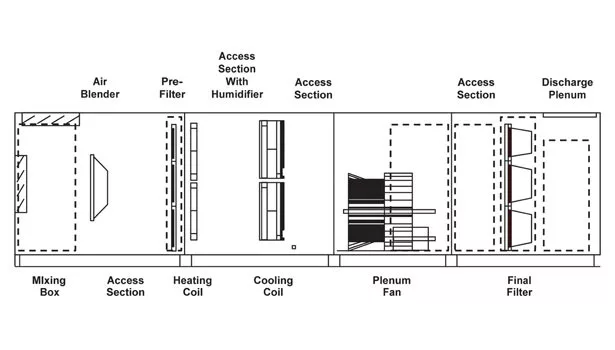
Figure 1 illustrates the preferred filter location in a draw-through AHU for a health care facility. The most effective means of supply filtered conditioned air to a health care space is the use of a draw-through AHU. This is the best means of preventing the common phenomenon of “wet filters and fog formation” in health care ventilation systems. Blow-through AHUs should be avoided in this setting. This is because critical spaces such as operating rooms require lower room air temperatures and humidity levels. For this reason, engineers are forced to design AHUs with deeper coils and lower chilled water temperatures. I have performed many facility assessments for various health care facilities throughout Europe and the U.S. and have observed many blow-through AHUs with deep cooling coils and low chilled water temperatures plagued with wet filter problems because of poor design.
Engineers must take caution to ensure proper psychometric evaluation is performed for the airstream within the unit to ensure that conditions for condensation will not be present during the operation of the ventilation system. Likewise, care must be taken to ensure that a diffuser plate is located downstream of the supply fan, and before the cooling coils, to ensure uniform air distribution over the full surface area of the cooling coils. Uneven air distribution through large banks of coils is the main contributor to the “fog” phenomenon associated with airstream in blow-through AHUs.
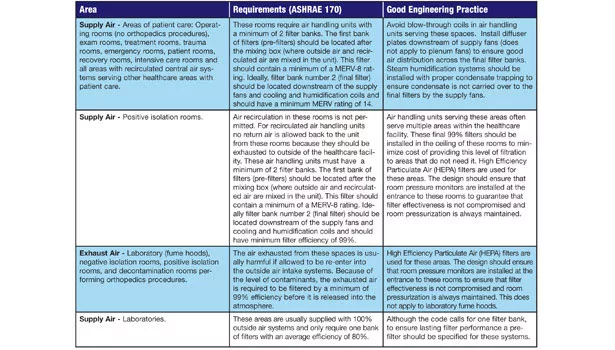
Table 1 analyzes the ASHRAE 170 requirements and some good engineering practices that can be applied to effectively achieve air filtration requirements for health care facilities. ES
Looking for a reprint of this article?
From high-res PDFs to custom plaques, order your copy today!