Restoring The Low Limit For Indoor Relative Humidity
The research is consistent over the years, and the cost of low humidity continues to rise. Even our increasingly computer-oriented lifestyle exacerbates the problem.
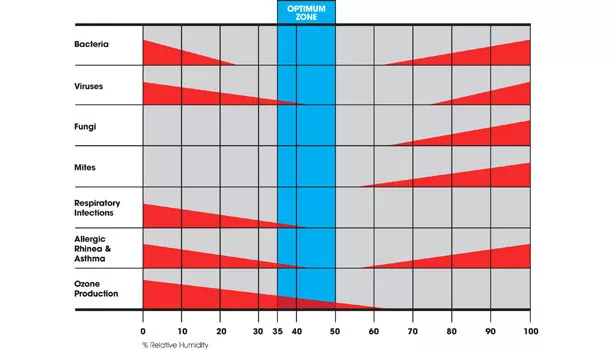
FIGURE 1. Sterling Chart
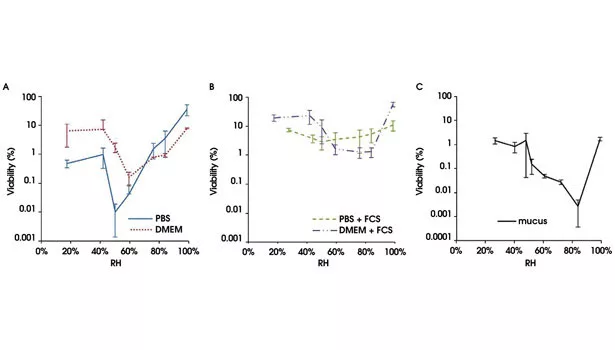
FIGURE 2. Results from an NIH study showing the relative humidity in relationship to the viability of influenza in droplets. Click here to view PDF.
Industry leaders realized hundreds of years ago that their processes and machines operate best when the indoor relative humidity is maintained at an optimum level for their process. They found it was necessary to use energy to increase productivity, lower scrap and environment impacts, maintain profits, and maintain costs to their customer. It does not matter if their process is related to food, woodworking, textiles, printing, pharmaceuticals, electronics, automotive, laboratories, or maintaining and preserving artifacts in museums and libraries. Controlling the indoor humidity was and is still critical for their applications.
One of the main reasons for the development of modern HVAC equipment was to maintain control of indoor relative humidity. The ASHRAE Handbooks as well as individual industry-specific manuals have a wealth of information on the recommended levels of relative humidity that should be maintained to assure preservation, productivity, and profitability.
ASHRAE and others have established standards recommending maintenance of the high end of relative humidity to a level below 60% at normal indoor temperatures. Unfortunately, when it comes to low indoor relative humidity, the very costly, critical, and valuable employees in the factories, offices, schools, etc., have been overlooked. Even though there has been well established research published on the subject of low relative humidity and its effect on the comfort, health, and well-being of people, there has been little consideration given to establishing an industry standard for a recommended low level of indoor relative humidity.
In the early 1980s, Elia Sterling of the University of Vancouver did an extensive study of previously published research concerning indoor relative humidity and its effect on the occupants of an indoor space. This study established that both high and low relative humidity levels had a deleterious and costly effect on the health and productivity of the occupants of a facility as related to bacteria, viruses, fungi, dust mites, respiratory infections, allergies, asthma, and ozone in the workplace, schools, and home.
Sterling Chart
This chart has been used extensively for years by building owners, designers, developers, etc., as a guideline for new and retrofit construction but is not an official standard for building design.
When discussing thermal comfort with building designers and developers, a common major question is, “what will the system do about high and low levels of humidity?” Designers usually refer to ASHRAE Standard 55, Thermal Environmental Conditions for Human Occupancy, as their guideline. The purpose of ASHRAE Standard 55 “is to specify the combination of indoor thermal environmental factors and personal factors that will produce thermal environmental conditions acceptable to a majority of the occupants within the space.”
The scope of Standard 55 section 2.1 states: “The environmental factors addressed in this standard are temperature, thermal radiation, humidity, and air speed, the personal factors are those of activity and clothing.” Section 2.2 states: “It is intended that all of the criteria in this standard be applied together since comfort in the indoor environment is complex and responds to the interaction of all of the factors that are addressed.”
This means that all the aspects of this standard must be considered when designing or calculating the indoor comfort conditions desired. Section 5.1 lists the “conditions that provide thermal comfort” as: metabolic rate, clothing insulation, air temperature, radiant temperature, air speed, and humidity.
Standard 55 Section 5.2.2 has established a maximum indoor humidity ratio at or below 0.012 pounds of water vapor per pound of air, or about 65% RH at 72ºF. Because of the criteria required for the comfort calculations, this section also states “There is no established lower humidity limits for thermal comfort, consequently, this standard does not specify a minimum humidity level. NOTE: Non-thermal comfort factors such as shin drying, irritation of mucus membranes, dryness of the eyes and static electricity generation may place limits on the acceptability of very low humidity environments.”
Unfortunately, to the discomfort of many clients and their employees, the “NOTE” above is brushed aside by many designers when discussing the HVAC systems with their clients. This is especially true when considering the following definitions from the Webster’s Dictionary.
AIR CONDITIONING - The process of regulating the quality, temperature, humidity, and circulation of air in a space.
COMFORT- to raise from depression, to soothe when in grief or trouble, relief from affliction, a state of ease, with relief from pain and anxiety and satisfaction of bodily wants.
One additional item to keep in mind is that ASHRAE indicates that their standards are to be considered as “minimum design standards.” A good example of this is the terminology used to define Class 2 Air in ASHRAE Standard 62 which states: “Air with moderate contamination concentrations, mild sensor irritation, or mildly offensive odors.” This is the definition related to the air exiting restrooms and bathrooms.
Although much of the research material used to develop the Sterling Study was created prior to the computer age, the data is still valid and has been confirmed multiple times by 21st-century research showing the comfort and health effects created by low indoor relative humidity.
A study published by the NIH in 2002 titled “The economic burden of non-influenza related viral respiratory tract (VRTI) in the United States” concluded that over $40 billion was spent annually on cold medicine, absenteeism from work, and other medical costs. It reported that there were over 110 million doctor’s visits and 6 million emergency room visits due to colds annually. It stated, “Spend a few million and call me in the morning” and indicated we spent over $6.2 billion annually for cold remedies, cough drops and syrup, nasal and sinus products, and unneeded antibiotics. The study estimated the annual economic cost of colds were $39.5 billion annually, with 55% of that amount resulting from missed work days. The above did not include the cost of the flu, pneumonia, skin irritation, eye and contact lens problems, etc.
If industry standards are designed for the comfort, health, and well-being of our clients and their staff, we should ask ourselves if this is really employee comfort.
Do we really want a person with the flu or cold greeting our clients, handling our papers, and spreading her cold throughout the office?
An elder care home in Pennsylvania had several years where residents, patients, and staff had severe health problems during the winter months related to colds, flu, pneumonia, excessive skin tears, etc. Because of these problems, much of the home was closed to visitors for extended period of time during the winter. The administrators of the home asked for assistance from the State Department of Health. After an extensive investigation, the DOH recommended addressing the low relative humidity in the facility during the cold weather months.
Steam-to-steam humidifiers were installed to maintain the indoor conditions between 35% and 40% rh. Two years later, a study provided some remarkable results. The following are a few comments from the case study. “It was the first winter at the home where I didn’t have a constant sore throat”; “The impact on the patients have also been dramatic, with far fewer respiratory infections”; “Skin tears went down an average of 50% in the first three months compared to the same period the year before without the humidification system”; “Healthy residents are more social and able to participate in more activities. It makes them physically and mentally healthier and happier.”
The NIH references several recent studies relating to our modern office and home environments and relative humidity. One that is especially interesting is titled, “Eye Complaints in the Office Environment.” A summary of the conclusions follow. In our modern home and/or office environment, we usually are using computers or video display terminals. Recent studies have indicated that while working we tend to stare at the screen more and blink considerably less. The low blinking rate significantly reduces the lubrication of our eyes by the precorneal tear film (PTF). When the relative humidity is low, the PTF is evaporated much more quickly. This lower level of PTF reduces the protection of the eyes from airborne chemical irritation and can seriously increase the problems of dry itching eyes, contact lenses, and more serious eye diseases.
A study by the University of Mississippi (The Uncertainty Associated with Thermal Comfort), presented at ASHRAE in 2003 concluded,“Human thermal comfort is dependent on four thermal environmental parameters — dry-bulb temperature, mean radiation, relative humidity (vapor pressure), and air velocity — and two personal parameters — level of activity and insulation. All the parameters are interrelated in affecting the thermal comfort of an occupant.”
Besides comfort, the health and wellbeing of the occupant, employees, students must also be considered. The most prevalent consideration should be the relationship of the indoor climate to upper respiratory diseases such as influenza, colds, pneumonia, and others. Many new studies have shown the seasonality of these diseases and low indoor relative humidity, as well as their costly effect on absenteeism and increased medical care.
In July 2010, The Department of Labor released their summary 10-06 titled “Illness-Related Work Absences During Flu Season.” The study shows the increased absenteeism in the workplace during the flu season of the years 2005 through 2010.
They stated, “While it is difficult to quantify all of the different ways that health issues affect the labor market, the CPS absence data can provide some measures of the effect that flu season has on workers. Further, an examination of changes in these data during flu season may be useful in evaluating the impact of a widespread illness on the nation’s labor force.”
In other research, the University of Illinois released the results in 2012 of their study titled “High Humidity Leads to loss of Infectious Influenza Virus from Simulated Coughs.” They designed a test room, which contained coughing and breathing mannequins. Nebulized influenza was coughed into the room and bio aerosol samplers collected size-fractional aerosols adjacent to the mannequins’ mouths and also other locations within the room. At constant temperature, the RH was varied from 7% to 70% and infectivity was assessed by the viral plaque assay.
Test Chamber
Researchers reported that the viral loading in the dry room was more than five times greater than the amount found in a room with greater humidity. An hour after the viral particles were released with a RH of 23% or less, up to 77% were capable of infecting.
The recommendations include “maintaining indoor relative humidity above 40% will significantly reduce the infectivity of aerosolized virus.”
In October 2012, the NIH released its extensive study. (Relationship Between Humidity and Influenza A Viability in Droplets and Implications for Influenza’s Seasonality). Results and conclusions (Table 1) were as follows: “At higher RH, larger droplets would settle more quickly due to gravitation because they do not shrink as much. Once settled on a surface, they serve as a reservoir for contact transmission. Low RH not only helps preserve the viability of IAV but also enables IAV carrier aerosols to persist longer in the air because of their smaller size and lower settling velocity that results in more vigorous evaporation.”
Additional consideration must be given to the seasonal costs of the common cold, pneumonia, and other non-viral respiratory tract infections. When considering average staff salary and benefits at $35,000 to $45,000 annually, or about $180 per day, what is the cumulative cost of one day of absenteeism, productivity losses, healthcare, and temp services when required? What are the costs to provide humidification for the people in your workplace and your client’s workplace to help protect them from acquiring the seasonal cold, flu, pneumonia and other VRTI’s? Keep in mind that they might be a recipient as well as a transmitter to others.
On average, a humidification system in the northern part of the United States and lower Canada will operate for approximately 2,000 hrs during the season. Once warmer weather arrives, the introduction of humidity from the outdoors will usually be enough to maintain healthy indoor relative humidity, and the humidifiers will usually shut off automatically. Once they are off for about three days, most modern humidifiers will automatically drain their reservoirs and remain dry until the next call for humidity.
Considering the above as well as the many previous and many more recent studies on humidity and health, it is time to reset industry standards to the people’s level for indoor health and comfort at 30% to 35% rh at 72ºF to 75ºF.
Looking for a reprint of this article?
From high-res PDFs to custom plaques, order your copy today!