Are There Hidden Problems In Your Hydronic Boiler Project?
Putting a new boiler in is a lot more complicated than just putting a new boiler in. You’re often taking ownership for any problem, real or potential, anywhere in the hydronics system.
Designing a commercial boiler replacement where you were not the original designer or installer might have some hidden dangers that could haunt you for years. The project is going to be a series of assumptions, educated guesses, design skills, and some good old-fashioned luck. The boiler is only part of the heating system, albeit an integral part. Always assume that the existing boiler is installed incorrectly.
When designing a replacement low pressure steam boiler, it should be sized according to the existing connected load. The connected load includes all piping, radiators, and heat emitters. Unlike the steam boiler replacement, a replacement hydronic boiler system will be sized according to the building heat loss.
I contend that we need to think holistically when designing or replacing a hydronic system, as there could be hidden liabilities inside the system. This may not affect the sizing of the boiler, but the existing system can influence the design and type of boiler we use. For instance, our first assumption will be that the existing system was designed for 180˚F. This means that the boiler was sized to maintain 70˚F inside the building at the outdoor heating design temperature using a supply hot water temperature of 180˚F. This was the typical design temperature. All equipment was designed for this temperature. We cannot be sure what the original designer used as the design temperature or what the installer did when they installed the system.
If the original designer used 180˚F as the design temperature and the building envelope or heat emitters have not changed since the original design, then we can further assume that the building will still require 180˚F at the outdoor heating design temperature. There is a way to test our assumptions. When performing a building heat loss, calculate the heat loss of a room or two. You could then compare the heat emitter size. For instance, if your room heat loss is 500 Btuh, check to see if the existing radiator will heat the room.
A good rule of thumb is that a hot water radiator will emit about 170 Btus for every square foot EDR or Equivalent Direct Radiation. This is based upon a room temperature of 70˚F and an entering water temperature of 180˚F. There are several sites including www.HeatingHelp.com that will show you the Btu capacity of old cast iron radiators with various entering water temperatures. This will help to verify the designers design temperature.
Ask questions
When tasked with designing a replacement boiler, I always ask questions of the person responsible for the existing boilers. The first question I ask is, Where are the building’s problem areas? Always assume that there is a problem area in the building. If the client does indeed have a problem area, you need to address it when you are designing the new system. You will own all the problems in the building once a new boiler is installed. One such building owner told me of an area that had never heated properly. After tracing the piping, we found that the 3-way valve was installed backwards 20 years ago. On a call for heat, the valve would bypass the radiator and not heat the room. The owner had installed extra heaters to provide heat for that section of the building.
If the client has two boilers, I will ask if one boiler will heat the building. If not, at what temperature does the second or lag boiler start. Some facilities such as hospitals use 100% backup sizing for their boilers. Typically, we see that each boiler will be between 66-75% of the heat load.
The owner will also be able to inform you if any changes have been made to the building shell. This may include new windows or if the walls were insulated. If that is the case, we may be able to heat the building using lower supply water temperatures. In some instances, we see that load has been removed from the boiler. Some of the buildings are installing packaged rooftop units so the area has air conditioning. Since the rooftop has heat, the load is lowered. Conversely, what if the building has a higher heat load than when it was designed?
During the energy crunch of the 1970s, some buildings were designed using 5 cfm of outside air per person for ventilation. It is a far cry from the ventilation requirements now in place. The ventilation load may have been increased. On another project, the gaskets surrounding the outside air dampers for the unit ventilators were in disrepair. The dampers could never shut all the way, increasing the amount of ventilation air for the space.
Building usage could also have changed since it was first installed. The building heat loss could be much different than when the building was first constructed.
Verify
One of the first tasks we need to do is to perform a heat loss on the building to see what size boiler we will require. If the original blueprints are available, it could be a great help. This also allows you to see if the system was designed according to the original design. The designers schedule may also help you to see the design temperature. When performing your due diligence, look at the settings on the existing boiler.
On one project, we saw that the boiler was set for 200˚F. When I asked the owner about it, he informed me that it had always been set that high. The original designer called for a system design temperature of 180˚F, but the project had come in over budget, so the owner asked the installer to come up with ways to “value engineer” the project to reduce the installation cost. The contractor chose to base his design on using 200˚F as the design temperature instead of 180˚F. This allowed him to use smaller pipes as well as emitters, lowering the installation cost. Fuel costs were not as important as they are now. If the boiler had been operated at 180˚F at the design temperature, it would not have been able to keep the building warm at design conditions. Our new system had to be designed using 200ºF water at the outdoor design temperature.
Check the piping size for the building
We had a school project where the existing boiler was sized for 2 million Btuh. When we checked the piping, it was sized for about half the Btuh capacity. Our heat loss showed that the system piping was correct and the boiler was grossly oversized. The owner told us that the boiler cycled constantly, even in cold weather.
Clock the fuel usage
This will allow you to know if the boiler is actually firing at the rated capacity. A boiler room with a 2.5-million Btuh boiler was piped with a 0.75 in gas pipe. We clocked the gas meter and found that the boiler was actually firing at less than 900,000 Btuh or about 36% of the firing rate. The surprise was that the boiler actually heated the building adequately at the lower firing rate.
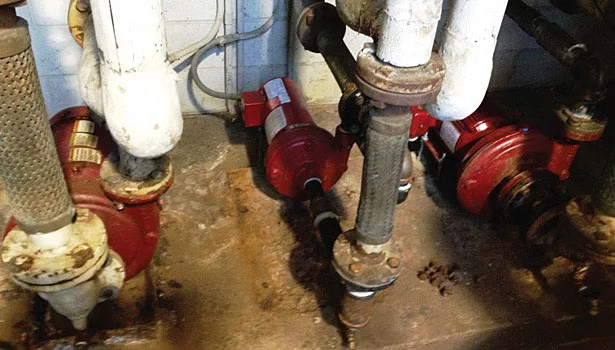
The pump capacity should also be verified. If the existing pumps are too small, the delta T across the boiler is too high. This could cause damage to the boiler and void the warranty. I would suggest replacing the pumps when the boiler is replaced. If the pumps are oversized, the velocity is too high going through the boilers and piping. This could lead to noisy operation and increased heating costs.
Look around
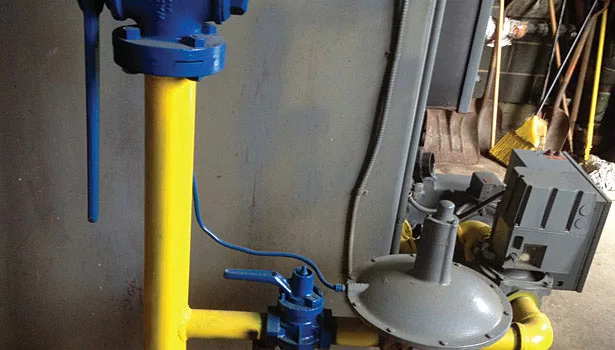
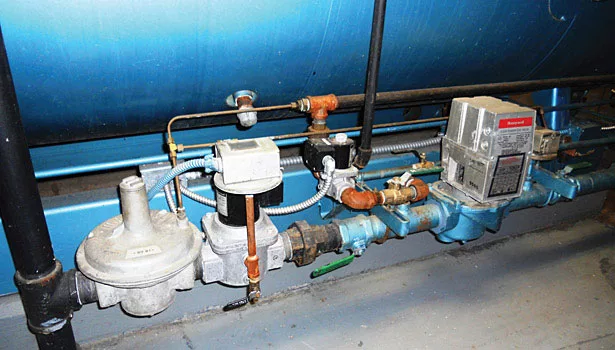
Many gas train components require venting to the outside. Unfortunately, this is usually something that is forgotten. The components that require venting, such as gas pressure switches, usually contain some thin membrane that stops the natural gas inside from escaping. On a system with low pressure gas, a leaking 0.25 in fitting can leak enough gas within an hour to fill a 10- by 10- by 10-ft room with enough combustible material to cause an explosion.
Asbestos is another concern with old boilers and the piping. It was common to use asbestos on the pipe insulation. This may have to be removed or encapsulated if piping changes are done. Some old boilers also used asbestos inside the boiler. You would commonly see it between the cast iron sections or where the flue hood attached to the boiler. The refractory inside a boiler may also contain asbestos.
Three-way valves could be very problematic on some systems. It could lead to thermal shock in the boiler, which causes extensive damage to the boiler. Thermal shock occurs when the temperature rise through the boiler is greater than the manufacturer recommends. A good rule of thumb is that most boilers are designed for a 20-degree rise. Thermal shock causes rapid expansion and contraction in the boiler. Most manufacturers require a blend pump to be used if three-way valves are installed. A blend pump takes hot water from the boiler supply piping and injects it into the return pipe to increase the boiler return temperature and lower the Delta T of the boiler. The blend pump may require 10-20 pipe diameters upstream of the boiler return opening to allow proper mixing. This could require extensive re-piping inside the boiler room.
All fuel-fired boilers and water heaters require air for proper combustion of the air. When using natural gas, it is typically 12 to15 parts of air for every part of gas. The combustion air should be verified that it is sufficient for the equipment. If the boiler uses a direct connection to the outside for the combustion air, care should be used when setting the fuel to air ratio of the fuel burning appliance. If the boiler is started in moderately warm weather, the fuel to air ratio will change as the combustion air gets cooler. Cooler air is denser and contains a higher oxygen level in the burner decreasing the efficiency. On the other hand, if the boiler is started and adjusted in the cold weather, it could have insufficient air when the weather is warmer, as that air will be less dense or contain less oxygen. Another consideration with combustion air is whether or not there is an air conditioning unit in the boiler room. If that is the case, the boilers may require direct venting of the combustion air or a refrigerant monitoring system in the room.
Venting
Be wary of the existing flue when considering a replacement boiler. If you plan to reuse the existing flue, make sure that it is the proper type and size for the new boilers. For example, if the new boiler is to be vented with a Category 1 vent that is non-condensing and negative, and the existing vent was a Category 3 and was noncondensing with a positive flue, I have heard of the flue collapsing. Another consideration is whether or not you are planning to use the existing chimney. Check to see if the existing water heater vent is still inside the old chimney. This is referred to as an “orphan” and will have to be addressed. Typically, a chimney liner must be installed to assure proper venting of the water heater.
When sidewall venting, extreme caution should be used. There are many regulations that have to be followed when sidewall venting. Even if you heed the requirements and comply with the codes, you may still have an issue. An engineer here designed a new boiler room for a nursing home that vented through the wall. His design met the code. On a cool rainy fall day, the flue gases gathered inside the L-shaped wing of the nursing home. The flue gases were drawn into the space, sickening some of the residents. The building was evacuated and the designer and installer had to pay for a new stainless steel flue from the boiler room up three stories. The job bankrupted both of them.
New installation
In many facilities, the boiler room was built around the boilers. In these cases, the old boiler may have to be cut up to be removed. The designer or installers will have to factor in how they will get the new boilers into the boiler room. Will they fit through the door? A local designer had to cover the cost of removing a wall to install the new boiler as he missed the sizing of the access doors, an expensive lesson.
Another consideration is spacing between the boilers. In my state, boilers are required to have 30 in between each boiler. This should be considered when choosing a boiler. Some boiler rooms require space above the boiler as well. It may range from 2 ft to 7 ft above the boiler, depending on the boiler type. There is a listing of these clearance requirements in the International Mechanical Code.
Teflon tape
When designing or installing a new boiler, Teflon tape or pipe dope is commonly used on pipe threads. When used on fuel piping, it could void the warranty or could cause a dangerous condition. Please see the following warning in the installation manual of a Webster Engineering model JB burner:
WARNING: DO NOT USE TEFLON TAPE OR COMPOUNDS CONTAINING TEFLON. THIS COULD DAMAGE THE VALVES CREATING AN UNSAFE OPERATION.
It seems clear cut that they do not want you to use products containing Teflon. It could void the warranty and gives the manufacturer an out if a problem occurs on the job site.
Boiler startup
When the boilers are started, the fuel to air ratio is adjusted at startup. Typically, the boiler startup is in the early fall so the boiler will be ready for the heating season. To properly adjust the fuel to air ratio, a burner should operate at 15 min to allow the flame to stabilize.
In most instances, the boiler will not be able to operate that long before shutting off on the operating or limit control. I would recommend that the boiler fuel to air ratio be checked and adjusted during the middle of the first heating season. It would be best to do it during the coldest part of the winter so the boiler will operate long enough to get a proper adjustment. This could be part of the job requirements.
Looking for a reprint of this article?
From high-res PDFs to custom plaques, order your copy today!