Trust But Verify
After 40 years and other engineering studies, a large university building still suffered from humidity problems. Our intrepid author dug into the data and the dark corners of the building in pursuit of the culprit — or culprits?
Sebesta Blomberg was commissioned to study a humidity problem for a 400,000–sq-ft library at a university in the Midwest a few years ago. The university shared with us the study another firm had completed for the chilled water system in the library as background information. They stated they had not implemented any of the recommendations in that study because they did not believe their findings were accurate.
The university had a small budget for the study, so our scope was limited to looking at three of the large AHUs serving half of the library (AHU-A, AHU-B, and AHU-C). At the time of the proposal, we knew the library was too humid in the summer and that the three large air handling units could not discharge less than 60°F supply air at that time of year. I knew the chilled water system was the most likely culprit, so we limited our scope to a review of the air handling units, their chilled water coils, and the pumps serving these units.
I met with the university project manager and one of the lead facility technicians on campus to see the chilled water system for myself. We started a tour of the facility by looking at the AHUs and taking measurements of the chilled water coils. I measured the coil face area on each coil, counted the fins/inch, verified the header connection size, and counted the number of rows and measured their size. I verified the coils were piped in counter-flow on each of the AHUs. I also collected as much information as I could on the chilled water control valves.
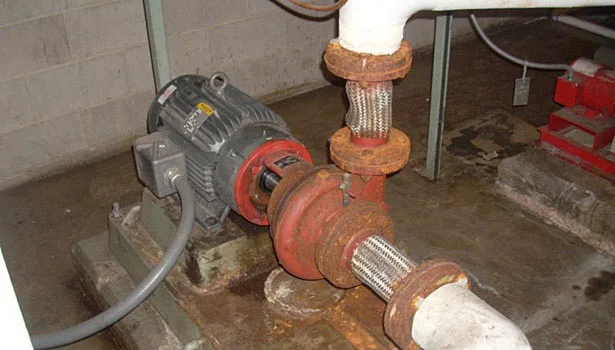
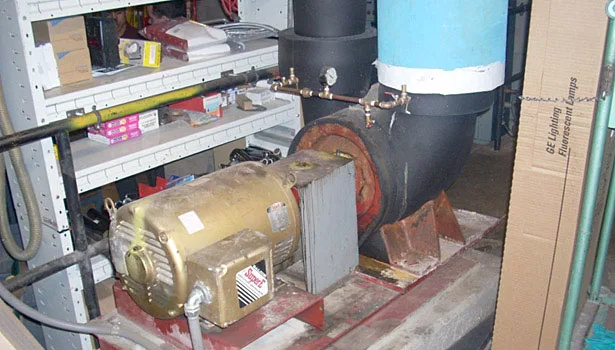
We then moved to the chilled water pumps that served these units. As it turned out, two of the three AHUs (AHU-A and AHU-B) were served by parallel pumps P-1 and P-2 that were dedicated to those units. I decided to start with these pumps. The manufacturer’s data tag had rusted off years earlier, so I only recorded the motor information and manufacturer. Since it was winter, neither pump was running. My tour guide said they only run one pump and that they’ve tried running both, but it didn’t seem to make any difference. The AHU (AHU-C) was served from a pump (P-5) that fed several other AHUs in the facility. The pump looked awfully small, and when I asked how many air handling units it served, my tour guide was unsure.
The documentation I had received prior to the trip was literally a data dump of all construction drawings they had on their server and in no particular order. I had spent a day looking at their files before the trip, which did not even begin to give me a full understanding of all of the additions and renovations the facility had gone through since it was built. Now that I was in the building, it was becoming clear I would need to track down all of the chilled water piping in the entire building.
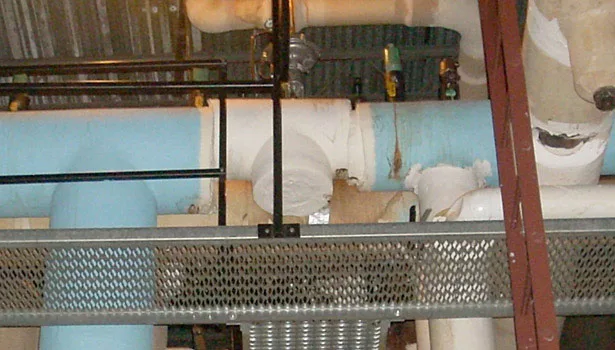
I knew our scope was limited to the three main air handlers, but I couldn’t leave without knowing what else that pump served. In my career, I am often faced with the decision of stopping with what I know or digging deeper. I am not sure if it is my willingness to serve or my inquisitive nature, but in almost every case, I’ve kept digging and have never once regretted that decision. I called my project manager and together we made the decision that I should track down all of the chilled water users on the system. My tour guide was up for it, so we started following the piping. After spending more than three hours crawling through the basement and crawlspaces, we were able to track down eleven AHUs that received chilled water from pump P-5.
THE NEXT STEP
| Back To College |
|
Want more articles tackling HVAC on campus? Our online archives has a faculty meeting’s worth of opinions, insights, and experiences.
From net zero to radiant design, from chilled water retrofit features to many Case In Point entries, see the full list with a simple URL:
|
Back in the office, I started researching the capacities and operating characteristics of the equipment I found on site. I called the sales representative to get the pump curves and was told that P-5 was a stock pump, which meant they are not typically selected for a certain operating condition, but instead kept in stock for immediate replacement needs. As a result, he couldn’t tell me what the pump was originally selected for.
I had a test and balance (TAB) report from the university where they had taken flow and pressure readings on this pump earlier that year. According to the report, the pump flow and pressure was 300 gpm at 185 ft of head. I reviewed the TAB data against the pump curves and concluded that I had the corresponding pump curve. I then summed up the design flow rates of the chilled water coils served by P-5 and came up with 963 gpm. If this pump was actually balanced to only 300 gpm, the AHUs on this system (including AHU-C) were definitely starved of chilled water. As it turned out, as I followed the progression of the renovations, it was clear that additional loads were added to this system without complete verification of whether the pumps or piping could handle the additional loads.
I then turned my attention to the pumps serving air handling units AHU-A and AHU-B. The schedule on the drawings listed the performance criteria of pumps P-1 and P-2 as 960 gpm at 60 ft of head, with a 20 HP motor operating at 1,150 rpm. I had recorded in my field notes that the motor was 20 HP and 1,150 rpm so at least that information matched. I then contacted my B&G sales representative who helped me track the pump curves which he had determined were obsolete. I then compared the scheduled data against the pump curve and found the operating point to be dead on with a 12.75 in impeller at 1,150 rpm. So far, things were adding up.
The study conducted by the previous consultant stated that the pump was selected for 1,750 rpm and the university had installed the wrong speed motor at some point in the past. This issue, they stated, was the cause for the shortage of flow for these air handling units. I called the manufacturer’s representative and asked if it was possible for someone to install a 1,150-rpm motor on a 1,750-rpm pump. He said it is possible but since the motor frame sizes and shaft diameters were different, someone would have had to modify the motor mounting bracket. So while it can be done, it probably wouldn’t have been an accident. The pumps didn’t show any evidence of this, so I concluded that the pumps were originally selected at 1,150 rpm and the university did not accidentally put the wrong speed motor on them.
Next, I looked at the chilled water coils for air handling units A, B, and C. The original construction drawings had scheduled the performance of the chilled water coils based on a 42°F entering chilled water temperature. The university told me they typically supply 44°F chilled water from the central plant. The chilled water supply is then mixed with the return water to supply 46°F water to the air handling units. I was also told the chilled water coils were replaced approximately 10 years ago, but the manufacturers order information was lost and no longer available.
I used the data I had collected on site and coil selection software to model the performance of the coils. I then compared the coil performance data scheduled on the drawings with the output from the software and confirmed that the original coils must have been replaced with new coils that matched the originally selected coils. This also meant these coils were not capable of delivering 55°F supply air unless the university could give them 42°F chilled water. In order to do this, they would have to lower the chilled water supply temperature and stop blending at the building. Knowing that that the university would not accept either of these options, I knew these coils were not going to provide the cooling and dehumidification the library needed.
Once I had the flow coefficients I calculated the pressure drop for each of the valves based on the flow rates scheduled on the drawings. In all three cases, the pressure drop of the valves far exceeded the available differential pressure of the system. My first thought was there must be two control valves for each air handling unit. The original construction drawings showed two valves per unit, but more recent drawings showed the units with one valve per unit. I only recalled one valve per unit, but of course I could have missed something. I called my tour guide at the university and asked him to go back and verify the number of control valves on the three air handling units. He called me a few days later confirming there was only one valve per unit.
CONCLUSIONS & CULPRITS
Ultimately, we found that the problem had three root causes: first, the coils were not selected for the correct chilled water temperature; second, the control valves were grossly undersized; and third, pump P-5 could not supply enough chilled water to AHU-C.
Since the existing cooling coils in the air handling units were only 10 years old, we recommended that new coils be installed in series to increase the heat transfer surface and allow the coils to deliver 55°F supply air with 46°F chilled water. We also recommended replacing the pumps and control valves with ones that were appropriately sized.
The university implemented all of our solutions and the next summer, the differences were remarkable. The library was cool and comfortable for the first time in its 40-year history.
Prior to this study, the university knew they had a problem with this building and had always wanted to fix the library, but it didn’t know what to do or how much to spend. They had studies providing recommendations, but the issue never got addressed because funding was always short and they weren’t confident the findings were valid. The conclusions from our study provided the university with a solid plan to fix the chilled water system at the library. I still find it interesting that if they had only addressed one of the causes, that single solution in and of itself would not have fixed the problem. The system would only function correctly after all three issues were corrected.
I learned a great lesson as part of this project. My tour guide summed it up by telling me one of the most solid truths of troubleshooting. His advice was both simple and wise, “Trust … but verify.”
I absolutely love the challenging problems. In this case, the issues were caused by several factors that all interacted with each other. I suppose if the problem had lasted this long, the answer wasn’t going to be simple. Still, I am often amazed at how long these issues go unresolved.
Looking for a reprint of this article?
From high-res PDFs to custom plaques, order your copy today!