Energy Retro-Cx
Based on Cx-3 ATC/FPT software 2
MONTH 2- The Energy Conservation Opportunity: Primary-Secondary Heating at an Industrial Building Application - Air & Water Readings and Solution Plan
Last month, we tested readers on commissioning three of the many automatic temperature control (ATC) sequences of operation associated with the primary-secondary hot water heating system for an industrial building application. This month’s Back2Basic is to water balance this existing system and to test readers on water balancing the primary/secondary water system at maximum design water flow during the heating season. Not included in this test are the following TAB requirements:
- Water balance building side during the fall and spring seasons for heating design water flow by each heat pump.
- Water balance building side during the summer for heating design flow by each heat pump.
The energy retrocommissioning team continues to include the facility manager, ATC operator, commissioning engineer, TAB engineer, and if possible, a LEED Accredited Professional. Going forward, the team, and more specifically the facility manager, will continue to be responsible for collecting the in-coming utility bills and measure them to the past utility bills to compare the difference in energy usage, as well as for maintaining good boiler log operating data.
We discussed three prerequisites to pursuing energy retrocommissioning opportunities in the past:
- Collect the utility bills and convert the energy used into Btuh per sq ft per year.
- If the results indicate it makes good sense, proceed further with a potential energy retrocommissioning opportunity.
- Document the Basis of Design (BofD) for the original HVAC design and the future HVAC design (once the energy retrocommissioning solution plan is mutually agreed upon).
To complete this month’s TAB tasks, the TAB engineer shall complete the following:
- Document the existing primary and secondary hot water heating system pumps performance so as to be able to benchmark and document water balancing improvements when comparing the existing systems to the new, energy retrocommissioning results.
- Document the existing water pump data to contribute energy conservation calculations to justify the replacement of the primary and secondary pumps for more optimum pump curve selections and their associated smaller high-efficiency motors. These changes will have been identified in the original ECM assessment and would take into account the changing out of pump motors, motor starter sizes, etc. based on pump curve performance and reduction in water system total pump head and GPM.
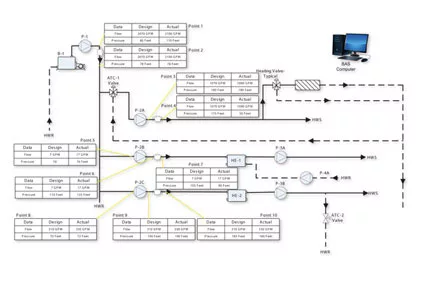
- Create system flow diagrams for the retrocommissioned primary/ secondary hot water heating system incorporating pertinent operating data (e.g., piping pressure drop from pump discharge back to the pump inlet, pipe velocity, pressure drops through equipment).
Before the TAB engineer can complete the flow diagram, she must also review the existing Basis of Design document to clearly understand how the system was/is to work. It is important to note the TAB engineer may complete the water flow readings in sync with the commissioning engineer completing his ATC/FPT pass-fail documentation (see last month’s B2B for example).
The TAB engineer should review record drawings, existing equipment shop drawings, and if necessary, make a “best guess” as to the original design calculations (i.e., pressure drop across the strainer) based on her experience with water system pressure drops. This information is inputted into the TAB System Flow Diagram TAB-3 process to document the estimated “design” pressure drop readings. Next, the TAB engineer picks up the tools and completes the water system readings, documenting the “actual” flow, pressure drop, and velocity, and note this data on the Design-to-Actual TAB flow diagram. Now the auditors have Design-to-Actual data to analyze.
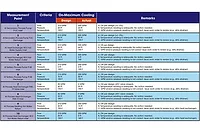
This month’s test is for you to select the correct answers in each of the Remarks column next to each water pressure drop reading. Refer to the B2B page 2 TAB System Flow diagram and note Design-To-Actual findings. The answers can be found here.
When coordinating the ATC/FPT-TAB initiative, the energy retrocommissioning team should use an Equipment Assessment Checklist to complete a static condition assessment of the equipment/system and to also identify energy retrocommissioning opportunities. See the Facility Files column for sample Equipment Assessment Checklist for the primary and secondary pump installations. Any deficiencies identified via the checklists need to be added to the Corrective Action Log, too. It is also important to note that the auditors should not assume there were no previous installation problems that were never identified prior to the building owner accepting this primary-secondary pumping system installation. These deficiencies may be an integral part of the energy retrocommissioning issues, and concerns and may have compromised system performance and energy wasted in the past.
With Data Analysis Phase and Solution Planning Phase completed, the energy retrocommissioning team can reformat the Corrective Action Log into a “Matrix of Opportunity” or Energy Conservation Measure (ECM) Report for presentation to those funding the energy retrocommissioning project. This will lead to the Solution Implementation Phase. An example of ROI parameters established for this B2B series are the following ECM Implementation Levels:
Level 1 = Quick-Fix (no-cost or low-cost) ROI
Level 2 = 1- to 2-yr ROI
Level 3 = 2+ to 4-yr ROI
Level 4 = 4+ to 6-yr ROI
Looking for a reprint of this article?
From high-res PDFs to custom plaques, order your copy today!