Back 2 Basics
Energy Retro-Cx
Based on Cx-3 ATC/FPT and TAB-3 software
MONTH 1- The Energy Conservation Opportunity: Primary-Secondary Heating at an Industrial Building
Application
Refer to the January 2010 Back2Basics for an introduction to energy auditing and energy retrocommissioning. A good guideline for implementing an energy audit is the “ASHRAE Procedures for Commercial Building Energy Audits” manual.
Our goal for this Back2Basics series is to provide methodology and guidelines by which you can increase equipment and system performance, save energy, and improve our environment. The energy retrocommissioning team/auditors for this 3-month test series shall include the facility manager, existing building ATC technician, retrocommissioning engineer, and TAB engineer. If pursuing LEED EB (existing building) certification, a LEED Accredited Professional will be required to be part of the energy retrocommissioning team.
The first step in implementing an energy retrocommissioning initiative is to collect the utility bills (e.g., electrical, gas, oil, etc.) for the building and convert the utility’s energy unit to the common denominator; Btuh. With a year’s worth of utility consumption in Btuh divide total Btuh by the building’s gross square feet to come up with a total Btuh per sq ft per year (e.g., 120,000 Btuh/sf/yr) and then compare this data with available benchmarks. There are a variety of resources to find energy benchmarking beginning with ASHRAE and the Department of Energy.
Based on the Btuh/sf/yr findings, this will be your first indicator that the building is or is not a candidate for energy retrocommissioning. If this energy indicator is excessive (e.g., 240,000 Btuh/sf/yr versus a benchmark of 120,000 Btuh) then the building is an energy retrocommissioning candidate. If the two values are within reason, then you should move on to your next potential building energy conservation opportunity.
Now that you have an energy retrocommissioning candidate, you should always start with a building envelope infrared survey (not part of this B2B series) to assess the overall condition of the building before you focus on a specific HVAC system(s). Fine-tuning an HVAC system within a building that has excessive heat loss, heat gain, or excessive outdoor air infiltration may add to your building operation problems (refer to Tomorrow’s Environment column, December 2009, Engineered Systems magazine).
For this B2B series we are going to focus on a primary hot water heating system with three separate secondary heating systems to serve the building heat, domestic hot water heat, and the industrial process heat as our energy retrocommissioning candidate. But before we do, we need to first document the original Basis of Design [BofD]. Referring to Amanda Parolise’s “http://www.esmagazine.com/Facility_Files,” this document should be created to identify the primary-secondary heating system original BofD document followed by documenting during the energy retrocommissioning “solution planning” phase of the proposed BofD based on the Energy Retrocommissioning Study. For our Back2Basics series herein, we have completed the energy audit portion of this energy retrocommissioning report based on this Facility File.
Our current primary-secondary heating system application, for an industrial facility with three work shifts depending on the work output requirements based on company’s sales, requires the following steps:
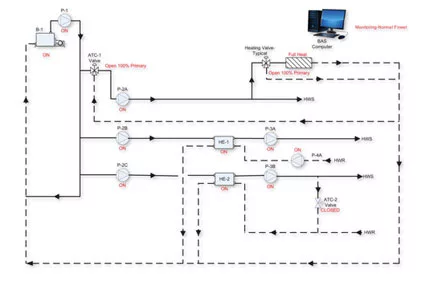
- Review existing record drawings and create a system flow diagram to document and create a visual survey aid for the hot water system.
- Inventory hot water system, using system flow diagram to capture the number of heating coils and baseboard radiant with relatively constant flow using 2-way automatic control valves.
- Inventory hot water pumps for pump head, motor horsepower, and GPM to confirm connected load and benchmark to rule-of-thumb pump head and heating Btuh per sq ft estimated load.
- Document hot water heating automatic temperature control strategy and compare with system flow diagrams.
- Document the domestic hot water heating system.
- Document the process hot water heating system and the three-shift coverage requirements.
In this data collection process we have identified the primary-secondary heating system operates 24/7/365 days a year to provide building heat, domestic hot water heat, and process hot water heat with the boiler antiquated and close to reaching its estimated useful equipment service life. In all four pumping systems, the preliminary energy retrocommissioning assessment is that all pumps are oversized relative to pump head and associated pump motor horse powers. The ATC valves are a mix of 3-way type and 2-way/straight through ATC valves. The hot water supply temperature set points are fixed and set in excess of needed temperature; the HWS-to-HWR temperature differentials are also not large enough for a couple of the heating systems, providing the energy retrocommissioning team several energy conservation measure (ECM) opportunities from a building-wide point of view.
This month’s test requires the energy auditor to document the existing System Flow Diagram, review the automatic temperature control (ATC) sequence of operation, mode by mode, on page 2 of this B2B. The existing ATC sequence will then be inputted into the functional performance test (FPT) retrocommissioning Cx-3 software, with the reaction device-by-device imbedded into the checklist below the flow diagram. The commissioning engineer working with the rest of the team checks each sequence to confirm each control device passes the specific ATC reaction to verify the existing system ATC/FPT is operating per the original design intent. The answers can be found at www.esmagazine.com. The sequences selected are Off-Fail Safe Conditions, On-Max Winter Heating, and On-Nominal Summer Heating for this B2B test, but there will be other sequences of operation plus verification of alarms and safeties to be confirmed (not part of this B2B test).
Looking for a reprint of this article?
From high-res PDFs to custom plaques, order your copy today!