Case In Point
Iconic cool: TES and chiller retrofit eases system strain from the other side of Rockefeller Center
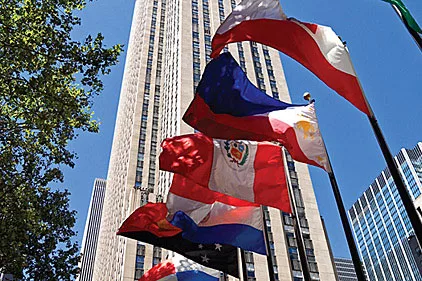
Rockefeller Center is not only a place of business but also a premier destination for shops and restaurants. It is home to NBC, Radio City Music Hall, and the world-famous ice skating rink and Christmas tree. The complex was built during the Art Deco period of the early 1930s and is currently co-owned and operated by Tishman Speyer.
Since 1996, Tishman Speyer has been dedicated to preserve and restore this New York landmark, increase tenant comfort, and make sustainable improvements to preserve the assets of the iconic building.
 |
|
A TES supplies Rockefeller Center with 8,600 ton/hrs of energy storage, keeping electrical demand low during peak hours. (Photo courtesy of Tishman Speyer/Photographer Bart Barlow.) |
THE CURRENT PROGRAM
To supplement the existing air conditioning by pumping chilled water around the entire Rockefeller Center complex, Joseph Szabo, managing director at Tishman Speyer, wanted to investigate technologies that could be incorporated into the complex’s existing chilled water infrastructure. Szabo approached Trane, a brand of Ingersoll Rand, to investigate the feasibility of applying Trane high efficiency electric chillers and Calmac energy storage technology.
The buildings of Rockefeller Center are served by a central chilled water plant containing 14,500 tons of steam- and electric-driven chillers. The water is distributed around the entire building campus through a primary water loop, which travels around the perimeter of the site. There are six primary pumps located in the main plant, four having 6,000 gpm capacity at 125 hp and two having 2,000 gpm capacity at 50 hp. Each individual building has pumps which then draw off of the primary loop and send the main plants chilled water to heat exchangers located within each building. There are seventeen of these primary chilled water riser pumps, which range in size from 1,000 gpm at 40 hp up to 3,500 gpm at 200 hp. The secondary side of the heat exchangers has pumps that serve the air handlers and fancoils, which serve the tenant spaces; individual building pumps draw chilled water to heat exchanges located within each building.
One of the biggest challenges has traditionally been the critical tenant requirement of supplying chilled water at the required temperature and flow to satisfy tenant comfort and lease requirements in all buildings of the center at all times of the year. While the supply and pumping capacity has always met requirements, Tishman Speyer sought a way to deliver the water more efficiently.
ENTER THERMAL STORAGE
After learning of some of the successes of applying thermal storage to buildings throughout New York City, Szabo approached Fred Limpert at Trane and Mark MacCracken of Calmac to conduct an analysis of the complex and identify the feasibility of applying Trane high-efficiency electric chillers and Calmac ice storage technology to Rockefeller Center. Tishman Speyer wanted an analysis to see how it could improve efficiency and lower overall energy costs.
Instead of meeting summer peak demand with a single electric chiller, the solution was to install an ice making chiller sized to provide 8,600 ton-hrs of energy storage. When it’s time to cool, especially during peak demand periods, cooling from the ice storage tanks is used instead of the electric chiller, keeping electricity demand as low as possible.
An additional benefit of having the energy storage available is greater operational flexibility. The stored cooling can be used as it is needed from a couple of hours to several hours to optimize plant efficiency while keeping demand and cooling costs low.
Due to the expansive footprint of the Rockefeller Center site, a number of locations were considered for a thermal energy storage plant. It was eventually determined that the optimal location was in areas on the other side of the property from the main plant. Having the energy storage plant located away from the main plant has shifted the burden of pumping chilled water from the main plant to the outer buildings. As the ice burn is injected to the center’s primary chilled water loop, the VFDs on the main plant’s primary chilled water pumps are able to be ramped down as the chilled water required by the outside buildings is satisfied by the chilled water being provided by the ice plant.
“The ice plant has provided a level of operational flexibility that has allowed my engineering staff to make intelligent decisions at any point in time that ensures we are able to balance tenant comfort with plant operational efficiency,” said Szabo. “The thermal energy storage installation has simplified plant operations, and we no longer have to make those tough, on-the-spot decisions as to when and if to turn on chillers in the main plant. Turning on chillers of this size can result in large electrical demand cost penalties, especially in New York City, which has a high electrical demand utility rate structure.”
ICE = FROZEN ASSETS
As Tishman Speyer began incorporating the energy storage plant into their overall HVAC strategy at Rockefeller Center, they began to see a positive ripple effect on all aspects of the plant’s operation. While there was an immediate benefit in allowing the operators to shift on-peak cooling loads to off-peak, there was an added benefit of allowing the operating staff to use the rate of ice melt, or “burn,” to meet the current needs of the buildings.
Prior to the energy storage plant, on peak cooling days, the building engineers would run one 4,000 ton steam turbine chiller, one 4,000 ton electric chiller, and one 2,500 ton electric chiller. Incorporating the ice burn into the operation of the main plant allowed Tishman to eliminate putting the 2,500 ton electric chiller online. The operators also take advantage of the fact that the ice burn rate can be adjusted from four hours to 10 hrs as needed based on plant conditions.
“Not only does the ice storage refrigeration plant provide ‘banked’ cooling capacity for peak demand periods during the day, but it also increases your operational flexibilities to the assets during spring and fall seasons, when you can side stream the ice reserve with smaller refrigeration machines to reduce your overall demand in shoulder months,” said Szabo.
The installation of a thermal energy storage system has significantly improved the energy efficiency of Rockefeller Center and dramatically lowered overall energy costs.
Looking for a reprint of this article?
From high-res PDFs to custom plaques, order your copy today!