Commercial vs. Industrial Automation In Data Centers

Traditionally, data center automation systems have been comprised commercial quality software, hardware, and components. However, there are important differences between commercial and industrial automation system hardware, software, and instrumentation that should be considered.
In addition to components, critical facility automation design requires a specialized methodology, which often blends traditional and industrial approaches to fit the facility owner’s project requirements (OPR). Ultimately, identifying how various system aspects contribute to performance, reliability, operations, and total cost of ownership (TCO) is the key to delivering a successful data center.
HARDWARE
Commercial and industrial control system hardware varies widely in both capabilities and costs. Input/output (I/O) capacity, performance, redundancy, integration options, and vendor support are some of the major considerations when selecting hardware for data centers.
Industrial hardware is designed for real-time control. The processors are more powerful, and the logic execution speeds are measured in milliseconds rather than seconds. For example, one application of industrial hardware in a data center would be for fast-acting pressure control loops.
More traditional airside designs can often utilize slower PID control loops, which can be supported by commercial controllers. In addition, controller input and output resolution is greater with industrial systems to support more granular control when using higher quality instruments.
I/O capacity is greater with industrial systems, which often includes flexibility with long-distance remote I/O modules. Commercial systems traditionally have a fixed number of I/O modules per controller and do not support remote I/O. However, more recent commercial controllers are evolving by expanding their remote I/O capabilities.
Most commercial products do not offer redundancy options, such as processors, Ethernet ports, and power supplies. Commercial systems can achieve redundancy by using external components and innovative engineering, but usually at a greater overall cost. However, redundant features are typically available as options for industrial controllers.
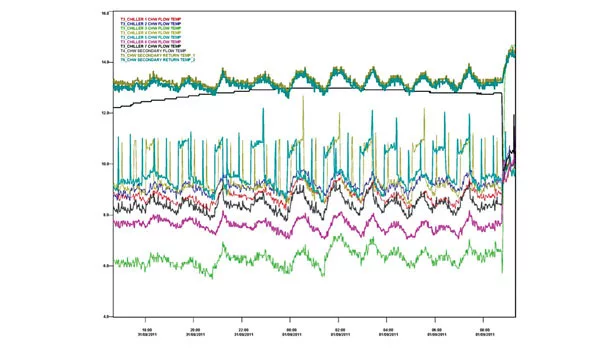
If an enhanced monitoring approach is being considered, the controller performance needs to be carefully analyzed for data collection (trending) and to determine how the data are processed. Commercial controllers have a limited ability to collect and upload data, typically using a temporary storage buffer or cache. The advantage of using industrial controllers is the ability to integrate data storage with servers in order to provide better trending.
The BMS is becoming more integrated with other facility systems, including power monitoring and data center infrastructure management (DCIM). However, it can be challenging to understand how to best integrate the hardware and software.
In general, industrial control systems provide greater means to integrate communication protocols to achieve more integrated solutions. Commercial systems are also improving their products to support this trend. Even if the commercial systems do not natively support a particular protocol, the systems can typically be integrated with certain third-party communication gateways (hardware) by using customized communication drivers (software).
SOFTWARE
The features, architecture, and performance of BMS software can vary widely between commercial and industrial systems and can even be substantially different between vendors. As a result, it is important to understand the capabilities of the system software and ensure that the proposed manufacturer will meet the project requirements.
There are various types of software used to develop and operate a BMS. Different software can be used to do the following:
• Edit programmable controller logic
• Configure a BMS data collection server
• Develop the human machine interface (HMI)
• Develop the interface graphics
• Collect ad-hoc data for analysis
• Assist with system startup and testing
• Access the system remotely
For commercial systems, these software tools are supplied by one vendor. With industrial systems, the supervisory software is generally detached from the field controller software and can integrate with various types of field controllers via industry-standard protocols like Modbus TCP.
To maximize data center reliability, it is advantageous to implement a more real-time BMS approach. Commercial systems poll data from field controllers slowly, have slower user interface refresh rates, and can handle less data. These systems can become sluggish when pushed to the limits of managing data.
Industrial front-end software systems are a good fit for data centers and other critical facilities because the systems are designed to handle substantially more data traffic and are powerful enough to support enhanced data collection/trending.
Data trending is an analysis tool that is rarely used by commercial integrators. This tool can be utilized to commission commercial systems but has limitations with sample times and storage limits.
It is difficult to achieve maximum data center reliability without powerful trending tools. High performance data collection, plotting, and archiving provide support to various project phases, including startup, commissioning, and mechanical design validation. In addition, trending can be a valuable tool with troubleshooting and root-cause analysis.
Arguably, the most important role for front-end software is to collect data from controllers (at various collection rates), archive that data quickly and reliably, and display the collected data in clear, flexible methods. If a commercial system meets all of the needs of a data center except data collection and trending, third-party data software solutions are available and can be seamlessly integrated by an experienced engineer.
Logic programming software is one aspect of a BMS system that is rarely exposed and understood by an owner/enduser. BMS integrators traditionally do not put much effort into ensuring the programming logic is easy to understand, troubleshoot, or modify.
For this reason, it is important to understand the differences between commercial and industrial controller programming software. While all controller programming is currently proprietary (i.e., cannot be transferred between one vendor’s controller to another), commercial programming logic is less standardized.
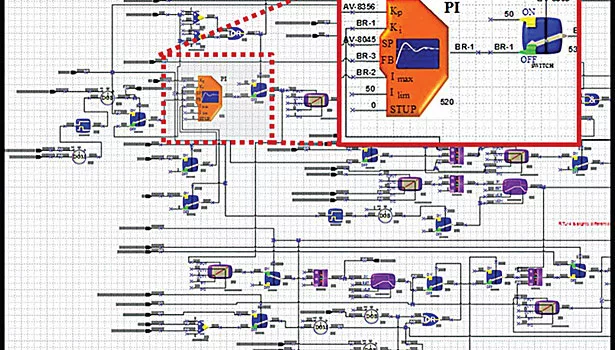
Most industrial controllers offer standardized programming languages that are very similar between vendors. Function block diagram, ladder logic, and statement list are the three most popular languages. Entry-level industrial controllers typically offer at least one of these programming languages, while the more advanced controllers can be programmed in all three languages and the logic can be converted between them.
Commercial system logic varies by vendor, from offering functional block diagrams to proprietary line programming. Some languages are easier to program, while some languages have limitations. For example, it may be easier to perform math functions with statement list vs. function block diagram. It is generally also easier to design and troubleshoot a motor circuit with function block diagram or ladder logic compared to statement list.
MONITORING
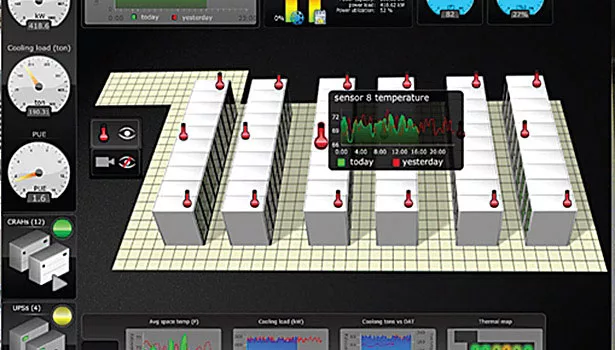
Data centers operate 24/7/365 and need to maximize uptime. Therefore, providing enhanced monitoring of the cooling process and environment should be considered as a means to forecast and troubleshoot dangerous failures. Enhanced monitoring can be achieved through various means, including additional instruments, more frequent sampling, enhanced trending, and more robust operator displays.
Enhanced monitoring can also serve as a valuable operator tool for system optimization, provide insight into the process performance, and identify areas where reliability can be improved. The facility software industry is rapidly expanding and tools are now available for aggregation of various facility systems to allow an enhanced analysis with this integrated data.
INSTRUMENTATION
Accuracy of a measuring instrument refers to the ability to indicate the true value of the measured variable. Repeatability (or precision) is the closeness of agreement among repeated measurements of the same variable under the same conditions.
In commercial facilities, the focus is generally on comfort control, thus instrument accuracy is not as critical. Accuracy is more crucial in data centers, but the real consideration should be repeatability and quality.
Quality instruments provide high confidence in the data and are often the lowest TCO solution when the alternative solution is the potential need for more frequent calibration, increased maintenance labor, replacement of lesser quality instrumentation, and poor-performing control loops. Enhanced monitoring as a critical facility operational, analysis, and commissioning tool is ineffective if data cannot be trusted.
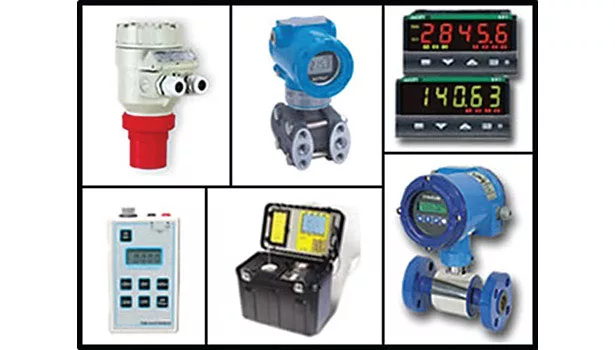
High-quality instruments also include features such as smart transmitters that provide flexible configuration and calibration. Smart transmitters also support communication interfaces such as HART, Modbus, and BACnet that can communicate process data and sensor health.
Instruments (often referred to generally as sensors) provide numerous benefits throughout the facility life cycle. During commissioning, instruments assist with mechanical design validation and automation system testing. Instrument specifications should therefore be developed with these methods and goals in mind.
Supporting an enhanced monitoring approach can be a valuable tool during implementation and during operations. Additionally, greater granularity supports successful approaches to predictive maintenance, energy and performance analysis, optimization, retrocommissioning, and historical comparisons.
DESIGN CONSIDERATIONS
Implementing a reliable automation system is not solely dependent on the quality of hardware, software, and components used. The engineering and programming approaches have a substantial impact on the system performance, reliability, and ease of use.
You can often achieve the same reliability goal with both industrial and commercial components. However, using commercial components often takes a bit more engineering and creativity.
It is a best practice to utilize a greater dispersion of components if they are of lesser quality. If lower cost transformers are more in line with the budget, a solid approach would be to segregate the control circuits into smaller sections.
For example, if there are N+2 chillers, the transformers supplying power to the chiller controls and the instrumentation need to be separated so that there are no more than two chillers and associated devices powered by one transformer. TCO must be factored in, as these more detailed power distribution approaches could cost more to engineer, install, and wire, eliminating any cost savings by using the commercial transformers.
Reaching a high state of reliability with commercial systems is possible but generally requires the systems to be “over-designed” because the failure rates of commercial components and systems will be greater. Failures should be expected at every level and planned efforts need to be made to ensure that the systems react in the appropriate way to buy valuable time before operator intervention is practical. Advanced failure planning is a necessary step for mission critical facilities using commercial components and systems.
Commercial hardware has a shorter mean time between failure (MTBF), and commercial software regularly needs to be “rebooted.” These factors need to be explored during the planning and design phases to understand the potential impact to the system. Since commercial hardware typically does not support redundant Ethernet or other protocol connections and some designs require a distributed architecture, the effects on system operation resulting from communication loss should be explored and tested thoroughly.
For applications where redundant or backup systems are needed, industrial controllers such as programmable logic controllers (PLCs) are easier to implement. Commercial controllers are not designed to sync-up with programming logic and data. Redundancy and backup with commercial hardware can be done, but it requires additional programming logic, components, and forethought, and even then it is not a perfect approach. Testing these systems thoroughly takes a larger effort and can add significant complexity and frustration for operators.
COST CONSIDERATIONS
It is important to consider TCO when evaluating commercial and industrial BMS solutions. Commercial products will have a lower first cost which can be substantial depending on the manufacturer. Commercial controllers are improving in performance and many manufacturers now offer “hybrid controllers” that are marketed for PID process control and priced somewhere between commercial controllers and industrial PLCs.
There can also be a large cost differential when looking at software. Commercial systems provide “packaged” software and typically license the software based on users not the number of points (or tags). Industrial software can be made up of many modules for various data collection and analysis applications. These systems are typically licensed based on number of users and points (tags) which can quickly raise the cost, especially when applying an enhanced monitoring approach.
High-quality industrial instruments are more reliable and accurate. Although the instruments are available at a higher first cost, they typically require little to no maintenance or calibration, and will often outlast a commercial device by a factor of four or five. Smart instruments can even provide enhanced sensor data that allow for remote troubleshooting, which can help save on maintenance costs.
High-quality industrial sensors can help reduce the time required for commissioning and design validation by reducing the number of retests due to errant readings, low repeatability, and low confidence in the numbers. An industrial-level solution is often the best choice when the client’s business mission is the key driver. Most clients see the value in spending a little more up front to get a more robust, reliable, usable, and informative system. The costs associated with a downed facility are difficult to quantify but can be enormous, since it will also involve lost reputation and client confidence.
CONCLUSION
Commercial, industrial, and hybrid solutions have all been implemented in mission critical data centers. Some commercial systems can significantly outperform more expensive industrial solutions when a non-traditional, holistic approach is taken. Many data centers use commercial systems that were implemented with the same approach as an office building or a school and have multiple points of failure that remain undiscovered by the engineers and the owner.
Selecting the proper hardware, software, and instrumentation are crucial steps for a data center BMS and are rarely given enough attention. Melding the right products with the right design approach can help maximize facility performance and reliability.
It is also important to consider how the system will be operated and maintained, and how the various options will affect operation’s hard and soft costs. Ultimately, evaluating various commercial and industrial options against the OPR for all aspects of the BMS, and doing so while looking beyond first costs, will deliver the best total solution. ES
Looking for a reprint of this article?
From high-res PDFs to custom plaques, order your copy today!