Reducing NOx Production While Keeping Expenses And Emissions Down

Sounds good, right? Catch up on what the latest analyzers can do, and visit a large company who expanded Its steam capacity by 50% in California’s tough regulatory environment.
As regulations regarding emissions become more and more stringent in the boiler industry, particularly those concerning NOx levels, it is also essential to maintain high combustion efficiency levels in order to keep carbon emissions to a minimum and keep fuel costs as low as possible. Current regulations on emissions are focused around single-digit NOx levels, typically 9 ppm. This trend towards lower NOx requirements looks set to continue, and before long, sub-5 ppm NOx may become a reality in certain parts of the U.S.
As is well documented, low-NOx combustion can be obtained from many different burner designs, whether through adapting the existing burner, fuel and/or air staging, flue gas recirculation (FGR), or a specialist burner head design, of which several are currently available on the market.
On many applications, lower instantaneous NOx levels are achieved by increasing the amount of excess air, typically from 10% to 50% (this is equivalent of an increase in the oxygen in the emissions from 2% to 7.5%). An existing EPA document, “Guide to Industrial Assessments for Pollution Prevention and Energy Efficiency,” states that the optimal quantity of excess air to guarantee complete combustion for natural gas is 10% (2% O2). In reality, this amount of excess air is not maintained in the majority of applications.
Increasing the excess air levels causes several issues. First, the combustion efficiency levels are reduced dramatically by higher excess air due to high O2 levels and elevated stack temperatures (increasing the amount of excess air causes the combustion gases to be pushed through the boiler tubes at higher velocities, leading to reduced heat transfer time and greater heat loss up the stack; this means that more fuel must be burnt in order to achieve the same output). Secondly, by introducing excess air and lowering the chances of complete combustion in the primary mix, there is a tendency to produce CO. This, in turn, can lead to carbon build-up in the tubes leading to increased maintenance requirements, but also reducing the heat transfer to the medium. Again, this will reduce the overall efficiency of the system.
FGR is commonly used in order to achieve lower NOx levels. Typically 15% to 30% flue gases are re-introduced into the mixing process. The effect is to lower the production of thermal NOx by reducing the flame temperature and amount of O2 available for combustion. There are obvious limitations to how much FGR can be introduced based on the burner design. Higher percentages of FGR can lead to major stability issues with flame retention causing nuisance failures, but also dangerous combustion characteristics such as boiler vibration, excess noise, and tube impingement.
While it is certainly important to examine ways of reducing NOx levels in the combustion process itself, particularly in light of regulatory requirements, it is crucial to ensure that this is not achieved at the expense of excessive carbon production, which is also regulated. As technology advances, low-NOx burner techniques will improve and higher efficiency levels will be maintained (particularly at lower firing rates), with burners also offering reasonable turndown (minimum 5:1 on natural gas) and reliability. Rapid technological improvements are currently being made in this area.
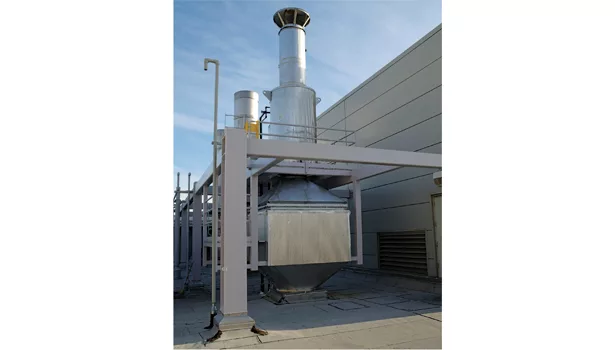
Another method of reducing NOx after the combustion process is to use a selective catalytic reduction (SCR) system; typical NOx emissions are reduced by over 70% and often over 90% for a gas-fired boiler application. This methodology uses a single-reactor unit complete with a catalyst and reducing agent delivery system (typically anhydrous ammonia). The unit passes the combustion gases through a grid system in which the reducing agent is added to the combustion gases and is absorbed by the catalyst to remove the NOx. The reaction of the NOx (NO or NO2) and NH3 (ammonia) produces a byproduct of nitrogen and water vapor. Typical performance of such units will see NOx levels reduced from 30 ppm to sub-5 ppm.
MONITORING AND AUDITING THE EMISSIONS
The majority of analyzers used in the package boiler market measure oxygen and stack temperature, offering a calculated CO2 value and corresponding efficiency. Further to this, CO can be an additional option for safety and monitoring clean combustion. In order to measure the NOx emissions, an additional analyzer will typically be required.
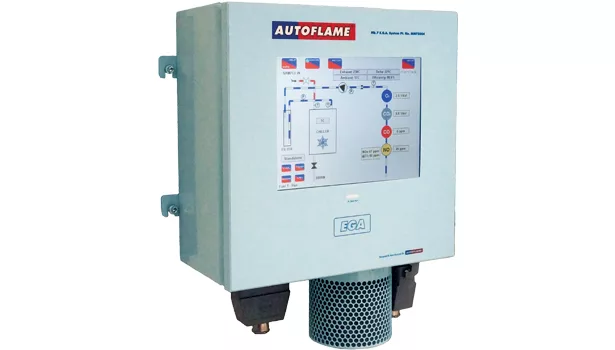
With low-NOx burner technology, it is essential that further parameters of combustion are measured. The latest Autoflame analyzer — the Mk.7 CEMS Exhaust Gas Analyser (E.G.A.) — has been specifically designed in light of current regulations on emissions monitoring. The E.G.A. offers all of the requirements for the boiler industry firing on both gaseous and liquid fuels. As standard, this analyzer measures O2, CO2, CO, and NOx, with the option to include nitrogen dioxide and sulphur dioxide. Three of these parameters (O2, CO2, and CO) are used for the patented trim process, enabling tight combustion control especially with high-performance burners. It is also possible to use limits of combustion on all measured parameters to inform the client when certain conditions exceed performance guidelines or state or federal regulations (e.g., NOx level).
All measured parameters offer an instantaneous analysis of the combustion gases (%, ppm, ft3/hr and lb/hr); additionally, a 10.4-in. full color touch screen HMI allows the user to view a totalised analysis of all of the emissions updating the data every second and logging up to two years of data. This data can be manipulated to review a monthly emissions total for all of the measured parameters, but particularly the NOx and carbon emissions (ft3, lbs, or tons).
Incorporated into the Mk.7 CEMS E.G.A. is the ability to input the fuel composition data, the fuel flow (via an input signal), and also the fuel cost per unit. This allows the E.G.A. to calculate not only the total fuel input and average combustion efficiency over the designated period, but also the fuel costs for each fuel. All of this data is displayed in tabular and graphical format and can be exported for client analysis.
All of the data recorded and analyzed by the Mk.7 CEMS E.G.A. can be monitored via the latest Autoflame Mk.7 Data Transfer Interface (D.T.I.) unit. This allows up to 10 boilers to be monitored and logged through any single D.T.I. unit, and this information can then be accessed via any EtherNet connection. The capabilities of this technology will allow the client to bring individual boiler room control to a higher management level, allowing immediate access to all emissions and operational data from each boiler located globally.
A RECENT SOLUTION AND CASE STUDY
In 2005, a leading health care company in California decided to expand their steam capacity by 50%. A new 1,000 hp, four-pass steam boiler was specified and selected for the expansion, along with a sub-9 ppm low NOx burner and control system.
By the end of 2006, the new boiler was installed and the sub-9 ppm low NOx target had been achieved. However, the residual oxygen levels were in the range of 8% to 8.5%. In addition, maintaining this low NOx level was causing many problems, such as excessive vibration from the 125-hp blower motor running at 3,600 rpm, flame failures, and material and refractory failures. Reliability was a serious issue with the existing system, and further to this the boiler could not reach the rated steam capacity.
In 2010, a steam reliability study was conducted on site and commissioned by the Autoflame Technology Centre in this region, One Source Engineering, Inc. It was decided at this time that reliability was a priority given the existing conditions and, therefore, replacing the burner and offering an SCR system was the best long-term solution for the client. This would not only offer the client improved functionality and reliability, but would also provide a high efficiency burner complete with low NOx and low carbon production.
There were several requirements that any potential new burner had to meet, such as the selected burner had to be robust incorporating a standard low NOx design (sub-30 ppm), as well as being able to perform with a reasonable turndown ratio (5:1). The dampers and bearing assembly, combustion air system, burner head, and igniter system all needed to demonstrate high quality engineering and craftsmanship. It was important to the client that the entire burner package had the appearance and design of a quality engineered product. After reviewing the available burners on the market today, One Source Engineering chose Limpsfield Combustion Engineering Ltd. to supply the burner, as theirs was a package that met all of these customer specific requirements and would guarantee the necessary efficiency levels.
The next stage was to review the SCR system. Again, One Source Engineering chose a supplier that had vast experience in this technology, including many installations and successful case studies, and was also a local manufacturer. The Nationwide Environmental Solutions CataStak™ system was chosen.
SYSTEM PERFORMANCE
Installation of the specified equipment began in November 2011. The Limpsfield burner was commissioned in January 2012, achieving a 5:1 turndown, sub-30 ppm NOx, corrected to 3% O2, CO was zero throughout the firing range, and the O2 level was 2% to 3% from low to high fire. The split head design manufactured by Limpsfield mixes the fuel and air in the high-pressure zone in the burner head offering superb stability and flame retention, which is essential for this type of application. Boiler capacity was also achieved for the first time ever.
In February 2012, the SCR was commissioned and the NOx was reduced from sub-30 ppm to 1 ppm throughout the firing range. The contractual NOx emission guarantee to the client was sub-5 ppm and below the required air permit level of sub-9 ppm NOx. Over time, the NOx will be adjusted to approximately 4 to 5 ppm, corrected to 3% O2, by reducing the ammonia flow.
The installation has been a great success and since commissioning the new Limpsfield LCN123 burner and CataStakTM SCR system have been operating without issue, with no faults, lockouts, or problems that were inherent before the upgrade.
Most importantly, the system has retained its commissioned values operating at high efficiency, low excess air levels, low carbon production and ultra-low NOx. TB
Autoflame Engineering Ltd. can be contacted through email at skemp@autoflame.com. Autoflame manufactures combustion management systems and solutions for the boiler industry having pioneered the first Micro Modulation fuel/air ratio controller. Autoflame works with a worldwide distribution network of technology centers.
For more information please visit the principal’s websites: One Source Engineering (http://www.onesourceengineering.com/home.htm); Autoflame Engineering Ltd. (www.autoflame.com); Limpsfield Combustion Engineering Ltd. (www.limpsfield.co.uk); Nationwide CataStakTM (http://www.catastak.com/index.html).
Looking for a reprint of this article?
From high-res PDFs to custom plaques, order your copy today!