search
Ask ACHR NEWS AI
cart
facebook twitter instagram linkedin youtube
  • Sign In
  • Subscribe
  • Sign Out
  • My Account
  • NEWS
  • TECHNOLOGY
    • Heating & Boilers
    • Cooling & Chillers
    • Pumps & Flow Controls
  • SECTORS
    • Commercial
    • Health Care
    • Data Center
    • Educational Facilities
  • DESIGN | CONSTRUCTION
  • OTHER TOPICS
    • High-Performance Buildings & Automation
    • Ventilation and IAQ
    • Commissioning
    • HVAC Retrofits
  • TODAY’S BOILER
    • Today’s Boiler Archives
    • Today’s Boiler Digital Edition
  • MORE
    • Case Studies
    • Podcasts
    • Videos
    • Directory
    • Webinars
    • ES NEWS Store
    • White Papers
  • SIGN UP
  • Back to The NEWS
Engineered Systems NEWSCommissioning

Heating Hot Water System Trend Analysis
By Rebecca T. Ellis, P.E.
Mc Kew
March 26, 2012
In this column, I will describe the “issue” disclosed through analysis of the trend graph included in my March, 2012 “Commissioning” column. I will also introduce a new system, show its trend graph, and then leave it up to the reader to discover the operational “issue” illustrated in the graph. The answer will be given at the start of my May 2012 column.    
Mc Kew

FEBRUARY 2012 TREND LOG ANALYSIS

Last month’s trend graph showed about two weeks of 15-min interval data for selected points on a single zone, constant volume, mixed AHU. The system was equipped with airside economizer, heating hot water coil, and chilled water cooling coil for discharge air temperature control. The discharge air temperature setpoint was reset based on space temperature setpoint.

From the perspective of discharge air temperature setpoint maintenance, this AHU appears to have been performing extremely well. However, the way in which the temperature was being maintained is suspect.

First of all, during hot water the outside air damper minimum position appears to have been 0%, or fully closed. About halfway through the graph, after the weather had turned colder, the minimum outside air damper position appears to have been 10%. This raises the question of whether the facility operators were manually adjusting the programmed minimum outside air damper position based on weather conditions or was this programmed into the control sequence? In either case, why? There could be a number of reasons, some of which may be masking fundamental problems with the system, such as 1) is the cooling capacity of the air handler insufficient to properly condition10% outside air during hot weather?; 2) are there high-humidity problems when introducing outside air during hot weather; and 3) are the operators trying to save energy?

Second, in the middle third of the graph, during cool weather and airside economizer operation, there were a few times when the chilled water valve was modulating when the outside air damper was not 100% open. For the most effective airside economizer, the control programming should be tuned to prevent mechanical (chilled water) cooling from occurring until the outside air “free cooling” is at its maximum (e.g., outside air damper 100% open) and unable to maintain the setpoint discharge air temperature.

Third, at the end of the graph and still during the cold economizer weather, the outside air stayed at a constant 10% while the chilled water valve modulated to provide all of the discharge air temperature control. The absence of active airside economizing resulted in unnecessary chilled water (electricity) use and expense.

Finally, when the chilled water valve was modulating to maintain a constant discharge air temperature setpoint over an extended period of time, the valve control signal hunted between about 0% to 80% resulting in discharge air temperature swings of about ±4° around setpoint. This is not a major problem from a temperature control or energy perspective, but it does cause unnecessary wear and tear on the valve.


NEW SYSTEM

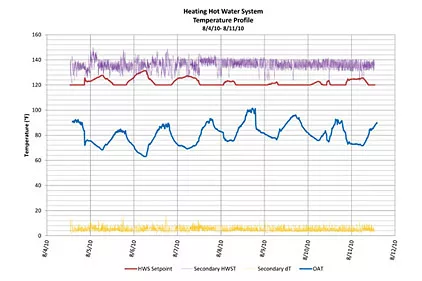
This month’s trend graph is for a central heating hot water system. The system consists of two high-efficiency modulating condensing hot water boilers with primary boiler pumps injecting hot water into a secondary distribution loop serving the building. The secondary loop includes variable-speed pumping and hot water supply temperature reset. As the outside air temperature decreases, the hot water supply temperature setpoint increases and vice versa. These boilers are located in a northern climate where winter heating and summer reheat are both critical for maintaining space temperature and humidity criteria.

The boilers are controlled by on-board manufacturer-provided controllers to maintain the secondary loop hot water supply temperature setpoint. The central BAS sends a temperature setpoint signal to the boilers, and the integral controllers modulate the boiler firing rates and the sequencing of the lead/lag boilers.


TRENDS

The BAS was used to trend the following sensor data at 5-min intervals for one week in August 2010:


• Secondary hot water supply temperature setpoint (red)

• Secondary hot water supply temperature (purple)

• Secondary hot water differential temperature = secondary supply temperature minus secondary return temperature (yellow)

• Outside air temperature (blue)  ES

Share This Story

Looking for a reprint of this article?
From high-res PDFs to custom plaques, order your copy today!


Rebecca is president of Questions & Solutions Engineering, Inc. She can be reached at rteesmag@qseng.com

Recommended Content

JOIN TODAY
To unlock your recommendations.

Already have an account? Sign In

  • HVAC-enrollment

    The Trades Are Back: HVACR Programs See Nearly 30% Enrollment Spike

    A new wave of future technicians is entering the pipeline.  
    Training and Education
    By: Matt Jachman
  • 2025 Top 40 Under 40

    2025 Top 40 Under 40 HVACR Professionals List

    The 11th annual Top 40 Under 40 list highlights those...
    HVAC Commercial Market
    By: Hannah Belloli-Oster
  • LG Ductless Mini-Split Systems

    The 9 Types of Heat Pumps

    As the U.S. moves toward electrification, heat pumps are...
    HVAC Residential Market
    By: Joanna R. Turpin

More Videos

Today's Boiler

Spring 2026 Issue

Today's Boiler - Spring 2026 Cover

Read More from Today's Boiler

Case in Point Logo

Smarter Hydronic Design for Data Centers - Free Webinar - January 22, 2026

Related Articles

  • AHU2

    Critical Air-Handling System Trend Analysis

    See More
  • Daikin AC (Americas) Inc.: Heating-Cooling, Hot-Water System

    See More
  • Heat Transfer Products: Hydronic Space Heating/Hot Water

    See More

Related Products

See More Products
  • 9781482255676.jpg

    Testing and Balancing HVAC Air and Water Systems, Fifth Edition

  • EHEP002028.jpg

    Principles of Heating, Ventilation, and Air Conditioning in Buildings, 1st Edition

  • whpm.png

    Water Heaters

See More Products

Events

View AllSubmit An Event
  • September 9, 2025

    How Maintenance Plays into the HVAC Decarbonization Trend

    On Demand This webinar will explore maintenance strategies for advanced HVAC systems, including VAVs and demand-controlled ventilation.
View AllSubmit An Event

Related Directories

  • Affiliated Steam & Hot Water

    We use a total system approach that allows us to offer complete solutions to successfully address the challenges and problems you face.
  • Affiliated Steam & Hot Water (Davenport, IA)

  • Affiliated Steam & Hot Water (Wauwatosa, WI)

×

Sign Up. Stay Informed.

The #1 trusted source for the HVACR industry since 1926

SUBSCRIBE
  • RESOURCES
    • Advertise
    • Contact Us
    • Advisory Board
    • Classifieds
    • Submit a Letter
    • Directories
    • Store
  • ACCOUNT CENTER
    • Create an Account
    • Start a Subscription
    • Manage My Account
    • Sign Up for Newsletters
    • Visit Customer Service
    • Update Preferences
  • SERVICES
    • Marketing Services
    • Reprints
    • Market Research
    • List Rental
    • Survey/Respondent Access
  • STAY CONNECTED
    • LinkedIn
    • Facebook
    • Instagram
    • YouTube
    • X (Twitter)
  • PRIVACY
    • PRIVACY POLICY
    • TERMS & CONDITIONS
    • DO NOT SELL MY PERSONAL INFORMATION
    • PRIVACY REQUEST
    • ACCESSIBILITY

Copyright ©2026. All Rights Reserved BNP Media, Inc. and BNP Media II, LLC.

Design, CMS, Hosting & Web Development :: ePublishing