The IRA’s Incentives at 2-Year Mark
Fans cheer public’s reception of residential HVAC incentives, but critics have issues with program
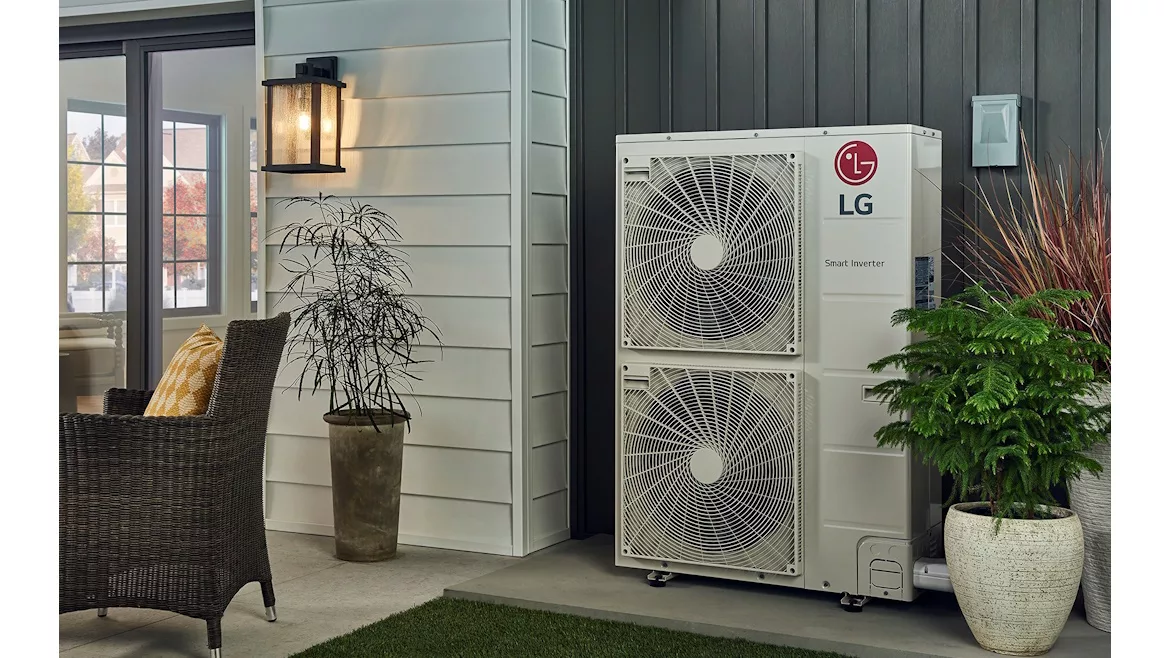
ELECTRIFICATION PUSH: The outdoor unit of an LG Multi F Max inverter heat pump system. The federal Inflation Reduction Act offers tax credits and consumer rebates for the purchase of qualified electric HVAC equipment, including certain heat pumps. (Courtesy of LG Electronics USA)
senior adviser, Office of State and Energy Community Programs,
U.S. Department of Energy
Last month marked the second anniversary of the Inflation Reduction Act (IRA), parts of which dedicated billions, in the form of incentives for high-efficiency and electric HVAC equipment and energy-saving measures, to building decarbonization.
The IRA extended and enhanced several existing tax credits for energy-efficiency projects in residential and non-residential buildings, and also set aside $8.8 billion in new, direct-to-consumer rebates for the purchase of qualified HVAC equipment, and for home improvements, such as insulation, windows, and doors, that result in energy savings. The rebate programs so far have been launched only in a few states.
In all, the IRA earmarked $369 billion for energy security and fighting climate change — including by incentivizing efficiency, electrification, and renewable sources of energy such as solar power.
It’s probably too early to estimate the amount of greenhouse gas emissions averted, but two years on, where do the IRA’s decarbonization efforts stand with homeowners? It depends on who you ask.
Fans of the sweeping legislation say it’s working, and point to statistics from the Internal Revenue Service to make their case. Critics, while acknowledging there are parts of the IRA they like, say it is too expensive, flawed, and could lead to a backlash against electrification and electric heat pumps, which it was intended to promote.
“I think the progress has been absolutely fantastic. The numbers are just astounding,” said Michael Forrester, senior adviser at the Department of Energy (DOE) Office of State and Energy Community Programs.
“There’s excitement, but there’s also disappointment,” said Sean Robertson, vice president of membership, advocacy and events at ACCA. “The question is whether it’s worth the price,” he added.
According to the most recent numbers from the IRS, more than 2.3 million individual tax returns claimed the Energy Efficient Home Improvement Credit — called 25C for its place in the tax code — for 2023, the year the IRA’s enhancements to the program kicked in. The 25C credits for 2023 totaled $2.1 billion, and the average credit per return was $882, the IRS said.
The 25C credit in 2023 was claimed for things like heat pumps (267,780 units), central a/c (488,050), home insulation (669,440), and heat-pump water heaters (104,180), according to the IRS report.
“Getting $2,000 back on the installation of a heat pump, on the installation of a heat-pump water heater, makes a big difference,” Forrester said.
“The policy is working, and it’s working actually better than expected,” said Ari Matusiak, CEO of Rewiring America, a nonprofit that works in support of the electrification movement.
Robertson and others, however, wonder whether the incentives are worth their price in government monies, and fear that incentives, particularly the rebates, will create a “sugar high” that will quickly wear off.
The incentive programs should put more attention toward ensuring quality installations, Robertson said, in order for consumers to enjoy the full benefits of new high-efficiency equipment.
“Without attention to quality installations, our customers aren’t getting what they paid for,” he said.
“It’s not moving the market, and it’s setting up several public relations risks,” said Nate Adams, a home performance expert known as The House Whisperer.
While he’s critical of parts of the IRA, Adams says he supports decarbonization goals and is all in on electrification. “Electrification, to me, is a deeply pragmatic path forward,” he said. The trend line shows the electrical grid will only get cleaner with the increased use of renewable sources of energy, both Adams and Forrester said.
But the IRA’s incentives, some critics say, present the risk of a public backlash against heat pumps if they’re sized incorrectly or installed poorly. In regions where the need for heating is greater than the need for cooling, a heat pump sized for the heating load may not dehumidify properly during the warmer months and may cycle on and off frequently in a/c mode, potentially leading to mold growth and higher electric bills, Adams said.
It’s the technology, he added, that’s likely to be blamed. A communicating system would be more effective in that scenario, Adams said, but would also add to the cost of a project.
Adams also criticized the tax credits, such as 25C, saying they’re not going to be used by people who can’t afford to wait until tax time for a credit, but by those who likely would’ve been investing in new HVAC equipment anyway. “It’s yet another incentive for rich people,” he said.
Much of the IRA rebate money, however, is to go to low- and middle-income households for high-efficiency HVAC purchases.
Forrester said the incentives are accompanied by consumer protections, including a consumer bill of rights and lists, kept by the states, of certified contractors. There is also money available for workforce development, he said, so that technicians can keep up with the best ways to install high-efficiency equipment. “We have done everything that we can,” he said.
Public awareness of the IRA’s HVAC incentives has “room to grow,” said Forrester, and word-of-mouth marketing will be critical in spreading the message. As awareness of the incentives spreads and the demand for incentive-qualified products increases, he said, contractors will make sure they have those products available.
“When something breaks it’s important that what’s on the truck is an energy-efficient choice,” Forrester said. “These products need to be easily accessible for the American public.”
Robertson, at ACCA, said the IRA’s Home Efficiency Rebates (HER) program, which is intended to subsidize home improvements, such as insulation, that lead to energy savings that can either be measured or modeled using approved methods, is one that ACCA can support. But individual states and territories, which are managing the rebates, should base eligibility on actual measured energy savings rather than on modeled savings, he said. (HER was formerly called Home Owner Managing Energy Savings, or HOMES.)
The DOE, said Robertson, should seize a “once-in-a-generation opportunity” that the IRA presents to require contractors working on incentive-eligible projects to use smart, internet-connected tools and third-party certifications to verify quality installations.
Matusiak, at Rewiring America, said the group is taking a multi-pronged approach to promoting the IRA’s incentives and the benefits of decarbonization. Momentum is building, he said.
“It’s good for American families and their pocketbooks,” Matusiak said. “People are clearly looking for and seeking out money that is rightfully theirs.”
Looking for a reprint of this article?
From high-res PDFs to custom plaques, order your copy today!