Sheet metal machinery purchases quickly reap benefits, experts say


Sheet metal work has its roots as a skill that was handed down from craft masters to apprentices who showed pupils how to hammer out duct and draw fittings by hand.
The learning process often took years — and in case of many union and trade school programs — it still does. The ductwork fabrication process, performed completely by hand, was labor intensive and error prone. A layout mistake and a whole piece likely had to redone.
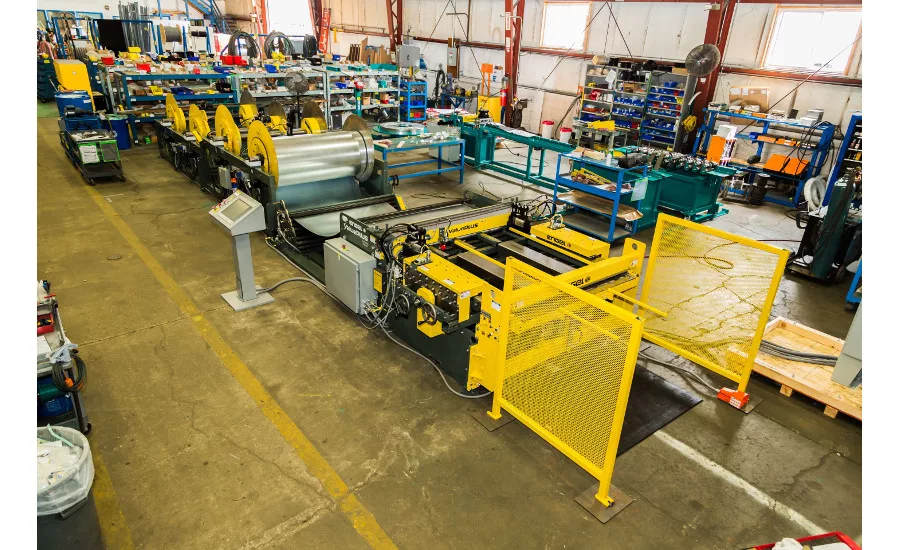
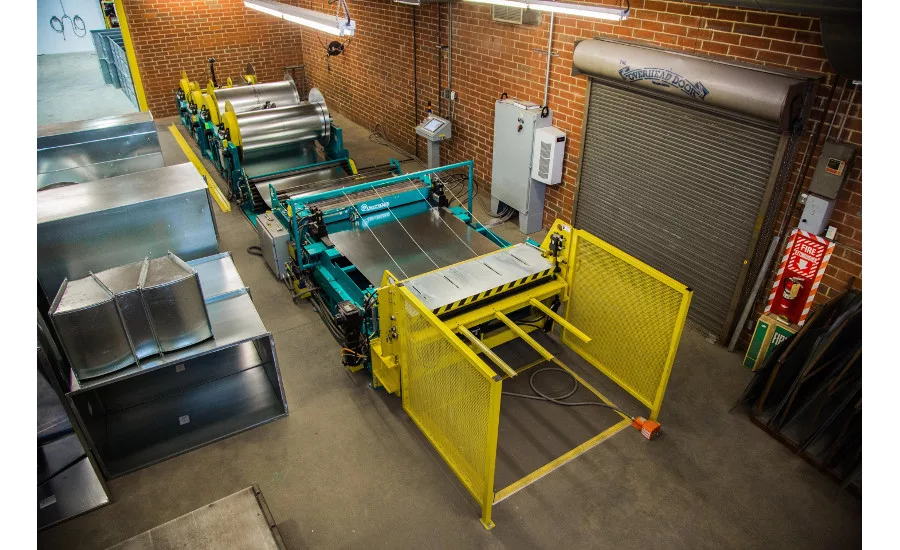
And while that’s the way things still work for some small, low-volume shops, the last few decades have seen an explosion in the numbers of contractors embracing automation. From small facilities with just a computer and plasma table to large-capacity will full-fledged complete coil lines, many of today’s sheet metal shops more closely resemble an automated factory than a shop with just a desk, tin snips and bench.
It’s a change that officials with Mestek Machinery have seen firsthand. According to the company’s own research, approximately 60 percent of the commercial duct made in the U.S. is produced on automated coil lines as opposed to flat sheets of light-gauge metal. That’s especially true for sections of straight duct, which are produced twice as often on coil lines versus through manual fabrication methods.
Uncertainty
And while there are many contractors that have made the switch, others are still not sure it’s the right move. Depending on the equipment purchased, it can represent an investment of hundreds of thousands of dollars.
That can make it difficult to convince shop owners that they need to automate, said Richard Burkart, vice president of sales and administration with Mestek in Cedar Rapids, Iowa.
“There are a few of them out there that are old school and that’s just the way it is,” he said, adding “but it’s getting to be very few.”
When you factor in the reduced productivity, increased setup time, much higher waste rates and worker fatigue, investing in automated sheet metal machinery may start paying dividends much quicker than many company owners realize, Burkart added.
For example, to manually fabricate two pieces of “L-section” ductwork with male and female snap-locks or Pittsburgh seams and drive cleats manually requires 22 separate steps and 12 minutes to make the complete ductwork joint, officials with Mestek said.
With just a “starter” coil line, such as the Iowa Precision Pro-Ductomatic, the process takes just two steps and the duct can be completed in about one minute.
With the sheet metal industry facing a looming employee shortage — the U.S. Bureau of Labor Statistics says the HVAC construction industry will need 39,600 more workers by 2024 — companies will need such equipment to work more efficiently to compete, many experts say.
Cost effective
Automation is one of the most cost-effective ways to do that, said Bill Dennis, a Mestek Machinery sales engineer.
“Laying out fittings is time consuming and it takes quite a bit of experience and knowledge,” Dennis said. “So now that knowledge is leaving the industry and retiring. So these guys with small shops are realizing the first thing (they) need is, say, a plasma table. It does the optimization and has all the fittings built into it. You no longer need the skill of the layout guy with the scribe and a pattern hand-cutting it.”
On its website, www.mestekmachinery.com, Mestek offers an online calculator to help company owners determine the time and labor savings a starter line such as the Pro-Ductomatic may offer. It includes sections to input figures such as the shop labor rate, the cost of sheets or coils per pound and the shop’s annual steel volume in pounds.
In general, once a shop’s annual volume starts to approach 100,000 pounds, that’s the threshold when investing in a starter coil line starts to make sense, Burkart and Dennis said. In addition to other efficiencies, buying steel in coils versus sheets offers a savings that shops can start to apply right away. Waste declines dramatically, as the scrap metal rate drops from 17 percent to 3 percent.
A starter coil line typically includes the ability to de-coil, feed, straighten, bead, notch, shear, tie-rod hole punch and make Pittsburgh and snap-lock seams.
“For a full and complete duct line, (return on investment) usually falls somewhere between 300,000 and 500,000 pounds,” Burkart said, but could be much lower depending on operating burden rates.
Payback
Depending on what machinery a shop purchases, labor rates and its volume, a machine can pay for itself in three years — or less.
“We try to be very conservative when we put the ROIs together,” Burkart said.
However, finding a place to put a plasma table, let alone a full or partial coil line isn’t always easy. Fortunately, machinery makers such as Mestek are used to being creative when it comes to shop layout and installation. Space is always a consideration, but perhaps less than some might think.
“We’ve done full duct lines in some amazing (places), fitting them in like a shoehorn,” Dennis said. “We try to do what we can. We have various footprints, configurations.”
Burkart agreed.
“It’s pretty amazing how tight a space we can customize and change a standard machine to squeeze it in,” he said.
Burkart recalled that once he helped contractors in Delaware and Ohio install coil lines by “stretching and squeezing” several different frames to turn a corner even ran a machine through a doorway.
“Little customizations like that can get it in an area where they never thought they’d have the space to do it,” he said.
Resistance to automation among workers is fading as computer-savvy younger employees see it makes their jobs easier while typically not resulting in layoffs.
“The company is really more productive as a whole,” Dennis said. “A lot of times you’re removing bottlenecks, too.”
Looking for a reprint of this article?
From high-res PDFs to custom plaques, order your copy today!