The Good Times and Bad Times of Moisture and Sealants
|
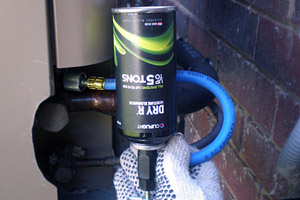
| Cliplight Mfg. makes Dry R, a hydrolytic moisture eliminator that changes the molecular structure of water into alcohol. Moisture in a refrigeration system can saturate drier/filters, corrode metal parts, create acids and other problems. Alcohol is compatible with refrigerants and oils. (Photo courtesy of Cliplight Mfg.) |
Put another way, particle-free, organosilane-based sealants, which seal multiple leaks against high operating pressures on a long-term basis, need moisture to cause the necessary chemical reaction to solidify and create a long-lasting, strong bond around a refrigerant leak hole. That moisture doesn’t come from within the system however, but rather outside the system. The escaping cold refrigerant gas lowers the ambient air’s dew point near the hole and causes moisture to condense. These water droplets react with the sealant composition to form a solid chemical weld over the leak point.
Moisture within the system is a totally different story, however. Besides its counterproductive nature that leads to metal corrosion, drier capacity depletion, acid production, waxing or wax-like films and other problems, moisture inside the system is never a good refrigeration environment whether sealants are present or not.
Some service techs are reluctant to try sealants because they fear that the sealants set up inside a system and impede moving parts. The truth is that particle-free sealants can’t solidify in an ACR system void of moisture. Instead they remain a liquid with the refrigerant and oil for the lifetime of the unit.
Danger in Not Treating
Left untreated, moisture inside the system potentially gets trapped in the compressor’s oil sump, between the piston and the valve plate in reciprocating models, or in low-lying areas of the condenser. Depending on the amount of moisture and the saturation of the filter/drier, moisture can potentially cause a sealant’s prepolymerization and reduce its sealing effectiveness. However, moisture in the system is going to eventually take its toll and lead to one or many of the aforementioned moisture-causing problems anyway.
Therefore, eliminating moisture has been a top priority preparation for applying sealants ever since they were developed for the HVAC industry in 2000. In the early days, it was recommended that service techs perform lengthy and laborious filter drier replacements, nitrogen purges, and multiple evacuations of 500 microns or less to boil off moisture. While these are recommended service techniques, many technicians didn’t want to bother with lengthy preparations, because it’s difficult to substantiate it on a service invoice, especially with residential customers. Instead, they chose to inject the sealant into a system and hope it wasn’t laden with moisture.
By 2008, moisture was affecting many HFC-refrigerant systems. The polyolester (POE) oil used with those refrigerants has an affinity to moisture that causes a multitude of problems. For example, moisture is blamed many times for TXVs and capillary tubes blocked with ice or resin-like particulates.
Looking for quick answers on air conditioning, heating and refrigeration topics? Try Ask ACHR NEWS, our new smart AI search tool. Ask ACHR NEWS
In another example, moisture tends to break POE oil down into base acids, which in turn, corrode compressor motor windings and the wiring’s insulation. The chemically broken-down insulating plastics can agglomerate in other parts of the system, commonly misdiagnosed as waxing. Agglomerations of loose particles inside a refrigeration system will continue to collect and eventually impede moving parts such as TXV orifices or compressor parts. If those woes weren’t enough, acids were taking their toll on the system metal components and suspected in contributing to coil leaks. These problems lead to R-410A and other HFC-refrigerant/POE system failures.
Moisture Eliminators
With the emergence of HFC/POE systems and the moisture problems they presented, came the development of many products to reduce and eliminate moisture. Moisture eliminators generally operate on one of two principles — thawing with alcohol (methanol, ethanol) or changing the H2O’s molecular structure with hydrolytic action.
The alcohol-based moisture eliminators are compatible with today’s refrigerants and are ideal for unblocking TXVs or capillary tubes blocked with frozen water by thawing the ice buildup. The disadvantage is that moisture still remains in the system. If enough alcohol is present, the moisture won’t freeze, but the effects of moisture, such as acid transformation or waxing, are still potential threats. Some alcohol-based moisture eliminators, which are applied by pouring into an oil injector, have the potential of accidentally being exposed to the atmosphere and causing unwanted moisture absorption in the process. Other alcohol-based moisture eliminators are injected by connecting their can directly to the refrigerant access port. They are propelled into the system using butane or propane, which adds another refrigerant to the refrigerant-oil mix of the system.
Hydrolytic moisture eliminators don’t mask the moisture with alcohols, but instead chemically change the molecular structure of water so it is no longer H2O.They break down the hydrogen and oxygen molecules into ethanol and hemiacetals that are compatible and harmless to the refrigeration process. Hydrolytic moisture eliminators typically are applied with a vacuum-packed can; therefore they aren’t exposed to atmospheric moisture. Refrigerant enters the vacuum-packed can via the pressure differential between it and the system. The refrigerant mixes with the moisture eliminator and then distributes it throughout the system without the need of introducing foreign propellants that are potentially contaminating or incompatible with the system refrigerant.
While service techs were using moisture eliminators to offset the H2O issues of POE-based systems, particle-free chemical-based sealant manufacturers were also promoting moisture eliminators as a time-saving preparation, instead of the moisture eliminating processes of filter/drier replacement, nitrogen purges, and evacuations.
Dealing With Premature Sealing
Besides the potential of premature sealing, excess moisture in a system can potentially decrease the sealant’s sealing power. Sealants are typically injected because there is a definite leak and moisture is one of the leading root causes of corrosion, which in turn forms micro leakages. What many service techs don’t realize is particle-free sealants treat the initial leak and then continue circulating in the system for years repairing future leaks as they occur, unbeknownst to anyone. As a double consequence of leaving moisture unresolved in a system, moisture becomes a two-edged sword that will perpetuate corrosion-formed leaks and also decrease the sealant’s long-term sealing performance potential.
The first use of moisture eliminators with sealants required separate applications. The moisture eliminator was injected into the system followed by a separate injection of a sealant. Some sealant manufacturers are now combining moisture eliminators and sealant in an all-in-one application, which further cuts down the service time of repairing a leak. The sealant-moisture eliminator combination can be applied in seven steps requiring less than five minutes.
New Sealants
Particle-free organosilane-based sealants dominate the leak sealant industry in North America and command more than a 95 percent market share. New on the scene are sealants that don’t react to moisture, but react to turbulence and pressure differentials. These sealants aren’t composed of organosilanes, but instead use particles such as graphite or polytetrafluoroethylene. Like organosilanes, these sealants are injected into the system and flow freely with refrigerant and oil. Instead of reacting to atmospheric moisture, however, these jagged 20-micron or smaller particles rely on pressure differential turbulence in the areas inside and around the leak hole. For example, a drop in velocity and pressure causes the particles to collide while exiting the hole and agglomerate into a hole-filling mass. While the materials are different, it is a similar concept behind automotive radiator stop leak products — filling a hole by agglomeration. The same concept was used for refrigeration leaks in the 1930s by putting black pepper in early air conditioning systems and waiting for it to expand and clog a leak hole.
Particle-free organosilane sealants do have a track record of maintaining a bond of up to 800-psi/12-year-long leak repair. Additionally, it remains a liquid that’s ready to bond leaks as they occur.
Marrying Sealants and Moisture Eliminators
Service techs are quick to say they don’t want to use any chemical additives in a refrigeration system, but in reality, all refrigerants and POE oil are chemicals to begin with. Using other chemicals to control chemical reactions within a system is a prudent measure. POE is a mixture of chemicals — pentaerythritolester of heptanoic and isopentanoic acids. It makes sense to use a chemical to reduce the moisture POE oil absorbs as a natural tendency.
Sealants, in particular, are chemicals that have become a vital part of the service tech’s tool arsenal today as system leaks are occurring more than ever before. Therefore, there’s no better chemical to add with a sealant than a moisture eliminator. Moisture eliminators reduce moisture so that particle-free organosilane-based sealants can react with moisture outside the system, rather than within.
It’s a marriage made in heaven.
Publication date: 9/24/2012
Looking for a reprint of this article?
From high-res PDFs to custom plaques, order your copy today!