The Green Solution for Big Box Cooling

The rooftop of the Alside big box facility in Yuma, Ariz., is dotted with United Metal Products’ evaporative cooling equipment.
In dealing with the issue of effective climate control, most of these facilities have always defaulted to a standard packaged air conditioning system. However, with the increased cost of energy in the past year, many stores, especially in the Southwest United States such as Wal-Mart Supercenter #4356 in Las Vegas, are opting for a economically and ecologically friendly method of thermal control known as evaporative cooling.
In addition to the significant economic advantage of evaporative cooling (up to 75 percent lower energy consumption than packaged air conditioning in climates with high heat and very low humidity) there are at least six reasons why it is a very environmentally friendly temperature control system.
NO. 1: NATURE'S OWN COOLING MECHANISM
When you walk along the beach in San Diego and feel a cool breeze coming off the water, this is a great example of evaporative cooling. However, if you go inland 50 miles, you will feel a very real difference because of the high drybulb temperature with no evaporation taking place. Evaporative cooling takes place when warmer air comes into contact with cooler water, causing the water to evaporate into the air and thus have a cooling effect on the air.This adiabatic process works by taking advantage of differences between the dry bulb temperature (dbt) and the wet bulb temperature (wbt). This differential is known as the wet bulb depression (wbd). The greater the wet bulb depression, the greater the felt effect is on the discharge air temperature. In ideal operating conditions, evaporative cooling systems are typically able to lower the sensible heat of the air by 80-90 percent of the wet bulb depression.
Once the outside air passes through the evaporative medium, it provides cool air that can now be moved through the facility, thus removing heat, and then be vented out, providing a continuous stream of fresh air.

Figure 1.
NO. 2: POWER USE
Evaporative cooling systems can use up to 75 percent less power than standard air conditioning rooftop packages. Not only does this decrease the energy consumption and the carbon footprint, but it will also have a significant impact on a company’s bottom line. (See Figure 1).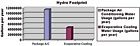
Figure 2.
NO. 3: SMALLER HYDRO FOOTPRINT
Evaporative cooling systems leave a smaller “hydro footprint” than traditional systems. One might assume that this method of cooling would use more water as it relies so heavily on the resource. However, when comparing water usage, there are more factors at play than the on-site water consumption of the cooling system.In order to produce the added energy used by packaged air conditioning, power companies are forced to generate up to four times more electricity. In creating this electricity, power companies primarily rely on large cooling towers and water that is stored in reservoirs that will, for example, evaporate up to 7.85 gallons of water to produce 1 kWh of power in the state of Arizona (NREL TP-550-33905). When this unseen additional water usage - what we refer to as the hydro footprint - is considered, packaged air conditioning usage actually requires up to 50 percent more water than evaporative cooling systems.
Example: The weighted power plant water use for Arizona according to the National Renewable Energy Laboratory (NREL) requires 7.85 gallons of water to produce 1 kWh of electricity. Notice in Figure 2 how the overall water usage for package air conditioning compares with evaporative cooling.
NO. 4: CONSERVES BUILDING MATERIAL
The light weight of evaporative cooling systems can reduce the structural members needed for building support. This reduction of material use is significant when compared to standard package air conditioning equipment, which weighs more. One obvious and positive environmental effect of this is that if fewer materials are needed to provide structural support, then fewer materials will eventually wind up in our landfills.NO. 5: RECYCLABLE MATERIALS
Not only do evaporative cooling systems require less material to support the units, but also they are free from environmentally harmful HCFCs. Evaporative units are also environmentally friendly in that all of the cooling media they use is a paper-based recyclable material, and the equipment is constructed from easily recyclable metals and other materials. These two factors: recyclability and the elimination of harmful HCFCs from the cooling process means that a much smaller carbon footprint is left on the environment.NO. 6: 100 PERCENT OUTSIDE AIR
Evaporative cooling systems are true 100 percent outside air (OA) systems. It accomplishes this by moving large quantities of air that are cooled close to the entering air wet bulb temperature. Not only does this provide cooling, but it also provides air that is approximately 50 percent rh, which is the ideal level for good health. Evaporative cooling is also a very practical solution in that it exceeds the Title 24 requirements that are enforced in California.The fact that evaporative cooling systems implement nature’s method of cooling, use up to 75 percent less power than other temperature control systems, leave a smaller hydro and carbon footprint, conserve building materials, are recyclable, and provide an effective 100 percent OA system, support the claim that an evaporative cooling system is the most environmentally friendly temperature control system. In light of these factors, any box store, warehouse, manufacturing plant, distribution center, or large industrial facility - in a hot and arid climate - that desires to be environmentally responsible must seriously consider using evaporative cooling as a means of climate control.
Publication date: 05/25/2009
Looking for a reprint of this article?
From high-res PDFs to custom plaques, order your copy today!