ACHR News
search
Ask ACHR NEWS AI
cart
facebook twitter instagram linkedin youtube
  • Sign In
  • Subscribe
  • Sign Out
  • My Account
ACHR News
  • NEWS
    • Breaking News
    • New HVAC Products
    • Featured Products
    • Manufacturer Reports
    • HVAC Data
    • Legislation
    • ACHR NEWS Centennial
  • RESIDENTIAL
    • Air Conditioners
    • Furnaces
    • Residential Heat Pumps
    • Ductless
    • Residential IAQ
    • Testing, Monitoring, Tools
    • Components & Accessories
  • COMMERCIAL
    • Air Handlers
    • Rooftop Units
    • Chillers and Cooling Towers
    • Commercial Heat Pumps
    • Boilers and Hydronics
    • VRF/Ductless
    • Commercial IAQ
  • REFRIGERATION
    • Refrigerants
    • Refrigerant Regulations
    • Leak Management
  • CONTRACTOR PRO
    • Geothermal
    • Homeowner Study
    • VRF and VRV Ductless
    • Unitary Trends
  • EDUCATION
    • Training and Education
    • Business Management
    • Service and Maintenance
    • Continuing Education
    • Market Research >
      • HVAC Brand Awareness Report
      • VRV, VRF, VRVZ Report
      • Unitary Trends Report
      • Water Heat Professionals Report
    • Webinars
    • Sponsor Insights
    • eProducts Info
    • White Papers
  • EVENTS
    • HVAC Contractor Forum
    • Industry Events and Webinars
  • MEDIA
    • Videos
    • AHR Expo 2025 Videos
    • Podcasts >
      • ACHR News Podcast
      • HARDI Podcasts
      • AHR Expo Podcasts
      • ACCA Podcasts
    • Interactive Spotlights
    • Quizzes
    • eBooks
    • HVAC Talkback
  • HVAC GROUP
    • ACHR NEWS >
      • Current Issue
      • Digital Edition
      • Subscribe
    • Distribution Trends
    • SNIPS NEWS >
      • Join SNIPS NEWS
    • Engineered Systems News >
      • Join ES News
    • HVACR Directory
    • Contests
    • Newsletters
    • Contact
    • Advertise
    • My Account
Service and MaintenanceRefrigeration

The Role of the Suction Line Accumulator

August 29, 2001
Figure 1. A vertical accumulator. (Figures courtesy of Henry Technologies.)


The refrigeration compressor is designed to compress vapor only. A suction line accumulator prevents compressor damage from a sudden surge of liquid refrigerant and oil that could enter the compressor from the suction line.

The suction line accumulator is a temporary reservoir for this mixture, designed to meter both the liquid refrigerant and oil back to the compressor at an acceptable rate. This prevents damage to the reed valves, pistons, rods, and crankshafts.

Accumulators have a metering ejector device that picks up liquid, vaporizes it, and returns it to the compressor. This prevents liquid slugging and controls oil return. It is particularly important on hot gas defrost systems, heat pumps, etc., where surges of liquid refrigerant frequently go back down the suction line.

Vertical accumulators use a U-tube or tube-within-a-tube design to draw gaseous refrigerant off the top of the vessel.(See Figure 1.) At the bottom of the U-tube, an orifice picks up a small amount of oil and liquid refrigerant and meters it back with the gaseous refrigerant. The small amount of liquid refrigerant will boil off in the suction line. The oil will be carried with the gaseous refrigerant back to the compressors.

A vent hole at the top of the accumulator U-tube outlet acts as a vacuum break to prevent an accumulator that has flooded during an off cycle from slugging upon start up of the system. ASME accumulators over 6-in. diameter are manufactured to ASME Code, Section VIII. A female pipe connection is supplied for a pressure relief device. A pipe plug is installed in this connection for pressure testing and painting at the factory.

Vertical accumulators should have a heat exchanger coil or a heat element added on low-temperature applications (0?F and below) to help boil off liquid refrigerant and raise the oil temperature to help facilitate oil flow. (See Figure 2.)

The heat exchanger can be used on low-temperature systems to subcool the liquid line while helping to boil off liquid refrigerant in the accumulator by passing the liquid line through the heat exchanger coil. This can increase system efficiency while helping oil flow in the suction line. Do not use discharge gas through the heat exchange coil or there is a risk of overheating the compressors.

Horizontal accumulators (Figure 3) should not be used when the temperature of the liquid refrigerant is less than 15?F (9?C) in the accumulator. At temperatures below this point, the oil will become thick and will not draw up the dip tube to be metered back to the compressor.

Looking for quick answers on air conditioning, heating and refrigeration topics? Try Ask ACHR NEWS, our new smart AI search tool. Ask ACHR NEWS →

Heat bands are available to help boil off liquid and aid oil flow. Do not add too much heat or there is a risk of overheating the compressors. Any heat bank that is added should be installed at the bottom of vertical accumulators and the outlet end of horizontal accumulators.

Selection of a suction line accumulator should be made on the basis of the following three capabilities:

1. The accumulator should have an adequate liquid-holding capacity that can vary with the system. Normally this should not be less than 50% of the system charge. If possible, this value should be checked based on actual tests.

2. The accumulator should perform without adding excessive pressure drop to the system. The recommended maximum tonnages are based on a pressure drop equivalent to 0.5?F. These ratings are those of the accumulator based on oil return through the accumulator, and will be modified by the length of the suction line and compressor displacement.

3. An accumulator should have the capability of returning liquid at the proper rate and under a range of load conditions.


INSTALLATION

Install the accumulator after the suction line filter or the orifice in these accumulators may clog if the oil into the accumulator carries wax or other debris. This is especially important on systems using POE oil.

Insulate the accumulator to prevent condensation from forming on the outside. Many customers prefer not to insulate the accumulator to gain some heat transfer from the air surrounding it. But some means of catching the condensation formed is necessary in most cases.

On accumulators with heat exchanger coils, the coil should be connected to the liquid line after the receiver. Since the heat exchange coil is a closed loop, the heat exchange coil “in” and “out” fittings may be switched.


VERTICAL ACCUMULATORS

Install the accumulator in a vertical position as close to the compressor as possible.

(Warning: Wrap a wet rag around the base of the copper fittings on the S-7000 Series to prevent damage of the factory- installed braze.)

Connect the suction line from the evaporator to the inlet of the accumulator. Connect the outlet of the accumulator to the suction line of the compressor.

On systems with a reversing valve and on heat pump systems, the accumulator should be installed between the compressor and the reversing valve. The pump-down cycle should precede all compressor shutdowns.
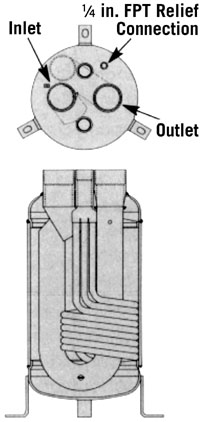


Figure 2. A vertical accumulator model with heat exchanger.

HORIZONTAL ACCUMULATORS

Install the accumulator in a horizontal position with the top of the inlet being level so that the return tube is at the lowest part of the accumulator, leaving a smaller pool of liquid in the bottom of the accumulator. The connection size must be the same as the line size.

Connect the suction line from the evaporator to the inlet connection.

Connect from the outlet to the compressor allowing a straight run of 12 in. (minimum) to permit full venturi action. Avoid sharp 90-degree bends wherever possible and use two 45-degree elbows to encourage laminar flow of returning gas.

The accumulators referenced in this article have a ½-in. FPT connection for liquid injection and a ¾-in. FPT connection for hot gas bypass. These connections can also be used as a relief device as required by UL 207.

The accumulator should be supported by the use of two angle brackets. These brackets are designed to be fastened to the stud on each end cap.
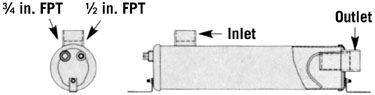


Figure 3. A horizontal accumulator.

TROUBLESHOOTING

On accumulators with fusible elements, if the fusible element leaks, the accumulator must be replaced. The fusible element is a UL requirement for venting of gas during a fire to prevent rescue personnel from injury due to a tank rupture. Soldering over this connection or in any other way preventing the fusible element from melting out to relieve pressure will void UL listing.

By removing the insulation on an accumulator, it is possible to observe the level of refrigerant in the vessel in most cases by the level of condensation or frost on the exterior. On systems in which slugging is suspected, observe the vessel during a variety of conditions, especially during defrost cycles.

If refrigerant slugging is witnessed on a system with an accumulator, there are several possibilities for the cause of the problem:

  • The accumulator is too small to catch all of the refrigerant.
  • Double-check to make sure that the accumulator can hold 50% of the system charge. Also check to make sure that there is sufficient superheat on each evaporator. Adding a heat band to the accumulator will help boil some refrigerant off but will not always work if the refrigerant is due to defrost flooding. In this case, ensure that each evaporator goes through its defrost cycle at different times with 15 to 20 minutes between evaporators. Otherwise, the only sure fix is to install the proper size accumulator or install an additional accumulator in series with the first.

  • The accumulator is sized too small to handle the tonnage. This problem will cause the orifice to meter back more refrigerant due to the increased gas flow past the orifice. Double-check the sizing of the accumulator, ensuring that the tonnage is not above the maximum capacity. It is necessary to install the correct size accumulator in this case, or install a second identical accumulator in parallel.
  • A standard accumulator should not be used for a heat pump application. The orifice in standard accumulators is larger than those in heat pump accumulators. The smaller orifice prevents excessive liquid refrigerant return during winter heating. The standard accumulator must be removed and replaced by a heat pump model.

    If there is no oil returning from the accumulator and the oil cannot be accounted for by the separator and oil control system, there are a few possibilities for the cause of the problem:

  • The accumulator is sized too big to handle the tonnage. The orifice will not meter back oil due to the reduced flow through the accumulator. Double-check the sizing of the accumulator to ensure that the tonnage is above the minimum rating. It is necessary to install the correct size accumulator in this case.
  • Wax or other debris has clogged the orifice. This occurs more often on vertical accumulators than horizontal ones due to the difference in size of the metering device diameters. Small orifices are screened to help prevent clogging, but excessive debris can still clog the screen element. The only cure to this problem is to change the filter elements in the system, especially the suction filter, and to replace the accumulator.
  • If a horizontal accumulator is used on a system in which the evaporator temperature is too low, oil will not be returned in sufficient quantity due to the sluggish flow at colder temperatures. A heat band may help in this case, but if oil return continues to be a problem, replace the accumulator with a vertical model.
  • If too much oil is returning to the compressor from the accumulator, it is possible that the oil separator is not functioning properly or that an oil separator needs to be installed. On certain low-temp or flooded systems, it may be necessary to install a higher efficiency oil separator. If a high-pitched whistle from the accumulator is noticed upon initial start- up of the system, ensure that the accumulator inlet and outlet have been piped correctly.

    The article was prepared by Henry Technologies. The company can be reached at 800-323-4052; www.henrytech.com (website).

    Publication date: 09/03/2001

    Share This Story

    Looking for a reprint of this article?
    From high-res PDFs to custom plaques, order your copy today!


    Recommended Content

    JOIN TODAY
    To unlock your recommendations.

    Already have an account? Sign In

    • HVAC-enrollment

      The Trades Are Back: HVACR Programs See Nearly 30% Enrollment Spike

      A new wave of future technicians is entering the pipeline.  
      News
      By: Matt Jachman
    • 2025 Top 40 Under 40

      2025 Top 40 Under 40 HVACR Professionals List

      The 11th annual Top 40 Under 40 list highlights those...
      News
      By: Hannah Belloli-Oster
    • LG Ductless Mini-Split Systems

      The 9 Types of Heat Pumps

      As the U.S. moves toward electrification, heat pumps are...
      Air Source Heat Pumps
      By: Joanna R. Turpin
    Subscription Center
    • Create an Account
    • Start a Subscription
    • Manage My Account
    • Sign Up for Newsletters
    • Visit Customer Service
    • Update Preferences

    More Videos

    Sponsored Content

    Sponsored Content is a special paid section where industry companies provide high quality, objective, non-commercial content around topics of interest to The News audience. All Sponsored Content is supplied by the advertising company and any opinions expressed in this article are those of the author and not necessarily reflect the views of The News or its parent company, BNP Media. Interested in participating in our Sponsored Content section? Contact your local rep!

    close
    • Piggy Bank
      Sponsored byWatercress Financial

      Energy Prices, Inflation, and HVAC: What Today’s Homeowners Care About

    • Refrigerated Food
      Sponsored bySolstice Advanced Materials

      R-455A Refrigeration: A Cold Storage Solution for the Future

    • Airex Rooftop Units
      Sponsored byAirex Manufacturing Inc

      Consolidating Roof Penetrations: A Growing Trend in Multifamily HVAC Design

    Popular Stories

    Refrigerants-and-gauge.jpg

    HVAC Industry Warns of Counterfeit Refrigerants Entering U.S. Supply Chain

    U.S. Supreme Court building

    95% Furnace Efficiency Rule to Get New Hearing

    Midea-training.jpg

    HVAC Workforce Crisis Expands Beyond Technicians to Instructor Shortages

    Data_Center_facility.jpg

    HVAC Manufacturers Respond to Growing Data Center Backlash

    HVAC Minute retail refrigeration system

    EPA Final Rule’s Impact on R-410A Deadlines

    View The ACHR NEWS
    Centennial Anniversary Timeline

    The ACHR News Timeline Chart
    Submit a Letter
    Submit a letter to our editors.

    Events

    November 6, 2025

    Next-Gen Data Center Cooling: HVAC Innovation and Real-World Solutions

    On Demand As AI workloads and high-density computing push traditional cooling methods to their limits, the data center industry is accelerating the adoption of next-generation HVAC technologies.

    June 23, 2026

    HVAC Duct Sealing Mastics: Why Selection Matters

    In this webinar we will detail what HVAC material buyers and technicians need to know when selecting duct mastics, including matching mastic to substrate, alternatives to liquid mastic, and where UL 181 Listings fit into real world installations.

    View All Submit An Event

    Poll

    Summer Staff

    Are you fully staffed for the summer season?
    View Results Poll Archive

    Products

    BNI Mechanical/Electrical Square Foot Costbook, 2026 Edition

    BNI Mechanical/Electrical Square Foot Costbook, 2026 Edition

    See More Products
    HVAC Duct Sealing Mastics: Why Selection Matters - Free Webinar - 6/23/2026

    Related Articles

    • The Role of the Metering Device

      See More
    • Ice Breaker: The Role of the Liquid Receiver

      See More
    • The Professor: Suction Line Accumulators

      See More

    Related Products

    See More Products
    • Uncomplicating The Heat Pump: Refrigeration & Air Flow Systems DVD

    See More Products

    Events

    View AllSubmit An Event
    • May 21, 2026

      The A2L Genie is Out of the Refrigerant Canister – What Now?

      On Demand Join this webinar to learn about key updates to refrigerant regulations. We will cover practical installation and servicing content gathered from thousands of our interactions with contractors across the US and Canada.
    View AllSubmit An Event

    Related Directories

    • The Whalen Co.

      The Whalen Company is the pioneering manufacturer of HVAC vertical stack riser heat-exchanger fan coil units and water-source heat pumps for hotels, apartments and other multi-story buildings.
    ×

    Sign Up. Stay Informed.

    The #1 trusted source for the HVACR industry since 1926

    SUBSCRIBE
    • RESOURCES
      • Advertise
      • Contact Us
      • Advisory Board
      • Classifieds
      • Submit a Letter
      • Directories
      • Store
    • ACCOUNT CENTER
      • Create an Account
      • Start a Subscription
      • Manage My Account
      • Sign Up for Newsletters
      • Visit Customer Service
      • Update Preferences
    • SERVICES
      • Marketing Services
      • Reprints
      • Market Research
      • List Rental
      • Survey/Respondent Access
    • STAY CONNECTED
      • LinkedIn
      • Facebook
      • Instagram
      • YouTube
      • X (Twitter)
    • PRIVACY
      • PRIVACY POLICY
      • TERMS & CONDITIONS
      • DO NOT SELL MY PERSONAL INFORMATION
      • PRIVACY REQUEST
      • ACCESSIBILITY

    Copyright ©2026. All Rights Reserved BNP Media, Inc. and BNP Media II, LLC.

    Design, CMS, Hosting & Web Development :: ePublishing