ACHR News
search
Ask ACHR NEWS AI
cart
facebook twitter instagram linkedin youtube
  • Sign In
  • Subscribe
  • Sign Out
  • My Account
ACHR News
  • NEWS
    • Breaking News
    • New HVAC Products
    • Featured Products
    • Manufacturer Reports
    • HVAC Data
    • Legislation
    • ACHR NEWS Centennial
  • RESIDENTIAL
    • Air Conditioners
    • Furnaces
    • Residential Heat Pumps
    • Ductless
    • Residential IAQ
    • Testing, Monitoring, Tools
    • Components & Accessories
  • COMMERCIAL
    • Air Handlers
    • Rooftop Units
    • Chillers and Cooling Towers
    • Commercial Heat Pumps
    • Boilers and Hydronics
    • VRF/Ductless
    • Commercial IAQ
  • REFRIGERATION
    • Refrigerants
    • Refrigerant Regulations
    • Leak Management
  • CONTRACTOR PRO
    • Geothermal
    • Homeowner Study
    • VRF and VRV Ductless
    • Unitary Trends
  • EDUCATION
    • Training and Education
    • Business Management
    • Service and Maintenance
    • Continuing Education
    • Market Research >
      • HVAC Brand Awareness Report
      • VRV, VRF, VRVZ Report
      • Unitary Trends Report
      • Water Heat Professionals Report
    • Webinars
    • Sponsor Insights
    • eProducts Info
    • White Papers
  • EVENTS
    • HVAC Contractor Forum
    • Industry Events and Webinars
  • MEDIA
    • Videos
    • AHR Expo 2025 Videos
    • Podcasts >
      • ACHR News Podcast
      • HARDI Podcasts
      • AHR Expo Podcasts
      • ACCA Podcasts
    • Interactive Spotlights
    • Quizzes
    • eBooks
    • HVAC Talkback
  • HVAC GROUP
    • ACHR NEWS >
      • Current Issue
      • Digital Edition
      • Subscribe
    • Distribution Trends
    • SNIPS NEWS >
      • Join SNIPS NEWS
    • Engineered Systems News >
      • Join ES News
    • HVACR Directory
    • Contests
    • Newsletters
    • Contact
    • Advertise
    • My Account

Choosing The Right Terminal Outlet
December 3, 2003
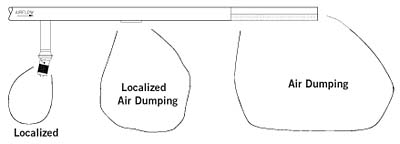
Figure 1. Three main types of terminal outlets and their discharge profiles.
When confronted with the task of choosing terminal outlets (grilles and diffusers) for a supply duct system, the designer has many types from which to choose. Whether the duct system will be exposed or not is one of the things that will dictate the type of terminal outlet chosen.

Since exposed duct systems generally result in lower construction costs, there has been a surge in the use of exposed-type terminal outlets. Fortunately, there are several types of terminal outlets that allow different methods of airflow distribution. Most commercial and industrial air distribution applications require one of the following types of methods: localized or concentrated distribution, air dumping (displacement ventilation), or a combination of the two, which we will call "localized air dumping." Figure 1 shows the airflow patterns of each type of terminal outlet discussed. The terminal outlet chosen should match the airflow distribution requirement.

We will examine some of the features of several types of terminal outlets that use the three methods of air distribution discussed.
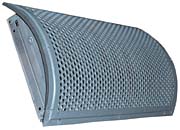
Terminal outlets from McGill AirFlow include the Duct-D-Fuser framed grille (above) and the FactAir Model 100 (below), which allows workers to adjust the velocity and pattern of the air.

Localized Distribution

Most industrial plants use ducted air distribution with low-level discharge for the most efficient heating and cooling of work zones located in large, open areas. The low-level discharge is accomplished through the use of drops from the main air system to the work zone.

To effectively use low-level distribution for heating and cooling, positive control of the velocity of the ducted air over the worker is required. Because of the natural variables associated with each individual and the continuing change in ambient conditions, this important velocity level cannot be a preset figure.
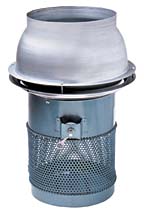
Ideally, the worker should be able to adjust the velocity and air pattern easily to suit his or her individual comfort needs. For example, the FactAirâ„¢ terminal outlet, manufactured by McGill AirFlow Corp., allows the worker to control the velocity and pattern of the low-level air being discharged into the work zone.

Workers may control the discharge pattern by setting the opposed-blade outlet damper (called a vari-damper) in an open, intermediate, or closed position. The discharge patterns range from a direct, full-velocity flow to a gradually widening pattern with lower velocity.

There are models available with a swivel ball joint that allows directional control in any direction up to 20 degrees from the vertical axis.

Type A air diffusers are constructed to be flush mounted to curved or flat surfaces.

Air Dumping

Many air distribution applications involve supplying air to critical processes without creating a noticeable draft. For example, many university labs require low air discharge velocities in the room. These short throw (distances where the air reaches 100 fpm) applications could benefit from the use of an air dumping type of outlet.

Diffusers that fall in this category are fabric ducts and perforated metal ducts (diffusers). The characteristics are low throw and radial discharge, meaning you wish to have slow air discharging perpendicular to the duct centerline. When a perforated metal duct has internal orifice plates, the resulting diffuser assembly can perform similarly to a fabric duct.

Perforated metal diffusers used for air dumping generally have holes of about 1¼8 inch in diameter and an open area of about 20 to 30 percent. These diffusers should not be used in applications where forced air is required, where the volume exceeds the capacity of the diffuser, or where the air supply is not filtered and contains lint or felting types of dirt.

Looking for quick answers on air conditioning, heating and refrigeration topics? Try Ask ACHR NEWS, our new smart AI search tool. Ask ACHR NEWS →

One type of perforated metal diffuser, the Type SP Duct-D-Fuser, also manufactured by McGill, has a radial throw of 5 feet if the velocity entering the diffuser is 500 to 800 fpm. McGill is currently working on a Web-based program so that a diffuser can be sized online. The program will exclude orifice plate sizes, as this information is proprietary and will be supplied when the diffuser is shipped.

The common perforated metal air dumping diffuser has a 360-degree flow pattern along its entire length. Other common configurations include a 90- and 180-degree discharge. These diffusers are sized as a continuous perforated diffuser with internal orifice plates to promote radial airflow. Individual perforated ducts with solid duct in between may be used for long runs of duct as long as there are orifice plates or dampers between perforated sections. This type of diffuser is ideal for harsh environments, as the perforated metal body can be wiped down and will not tear.

The most common perforated metal air dumping diffuser is the round assembly with orifice plates. The radial discharge can be any angle up to 360 degrees, although angles of 90 degrees, 180 degrees, and 360 degrees are most common.

Perforated metal diffuser de-signs have an average surface discharge varying from 5 to 50 cfm per square foot of surface area. The air distribution pattern from the diffuser is dependent on entering air velocity. Typical entering velocities into the diffuser range from 500 to 1,200 fpm. As a general rule, the ideal entering velocity is 500 to 800 fpm, and should never be higher than 1,800 fpm. The static pressure required to operate this type of diffuser is unusually low; it is always less than 0.10 inches water gauge. This is primarily due to the fact that the perforated metal body is 20 percent to 40 percent. The low operating pressure may surprise those familiar with fabric ducts.

Unlike most perforated metal diffusers, fabric ducts have a much lower percentage open area, which results in a higher static pressure to operate for a given entering velocity.
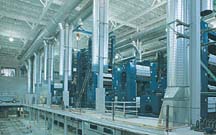
Most industrial plants use ducted air distribution with low-level discharge for the most efficient heating and cooling of work zones located in large, open areas. The low-level discharge is accomplished through the use of drops from the main air system to the work zone. (Photos courtesy of McGill AirFlow Corp.)

Localized Air Dumping

For many years the rectangular register or grille mounted on a rectangular tap has been the predominant configuration for localized air dumping. In recent years, however, there has been a movement towards the flush-mount terminal outlets that are more aesthetically pleasing. All of these outlets allow local control by the strategic placement of the outlet on the trunk duct, while air dumping is accomplished by varying the number and size of these outlets.

The grilles and registers used for localized air dumping have attributes of both localized and air dumping terminal outlets. This means that these types of terminal outlets have the feature of strategic air placement by locating the units where needed, and the feature of the massive air dumping by locating several units in close proximity to each other.

Some of these units have opposed-blade damper assemblies mounted behind a perforated screen or fins. This allows for volume control.

There are many types of grilles and registers that fall into this category of localized air dumping, including the perforated flush-mount grille with an opposed blade damper (OBD), and fin-type flush-mount with OBD. Each of these types may be ordered with OBD assembly, which results in a less costly outlet but does not provide volume control.

Gierzak is the mechanical engineer and laboratory supervisor for McGill AirFlow. He can be reached at jgierzak@mcgillairflow.com.

Publication date: 12/08/2003

Share This Story

Looking for a reprint of this article?
From high-res PDFs to custom plaques, order your copy today!


Recommended Content

JOIN TODAY
To unlock your recommendations.

Already have an account? Sign In

  • HVAC-enrollment

    The Trades Are Back: HVACR Programs See Nearly 30% Enrollment Spike

    A new wave of future technicians is entering the pipeline.  
    Training and Education
    By: Matt Jachman
  • 2025 Top 40 Under 40

    2025 Top 40 Under 40 HVACR Professionals List

    The 11th annual Top 40 Under 40 list highlights those...
    News
    By: Hannah Belloli-Oster
  • LG Ductless Mini-Split Systems

    The 9 Types of Heat Pumps

    As the U.S. moves toward electrification, heat pumps are...
    HVAC Residential Market
    By: Joanna R. Turpin
Subscription Center
  • Create an Account
  • Start a Subscription
  • Manage My Account
  • Sign Up for Newsletters
  • Visit Customer Service
  • Update Preferences

More Videos

Sponsored Content

Sponsored Content is a special paid section where industry companies provide high quality, objective, non-commercial content around topics of interest to The News audience. All Sponsored Content is supplied by the advertising company and any opinions expressed in this article are those of the author and not necessarily reflect the views of The News or its parent company, BNP Media. Interested in participating in our Sponsored Content section? Contact your local rep!

close
  • Piggy Bank
    Sponsored byWatercress Financial

    Energy Prices, Inflation, and HVAC: What Today’s Homeowners Care About

  • Refrigerated Food
    Sponsored bySolstice Advanced Materials

    R-455A Refrigeration: A Cold Storage Solution for the Future

  • Airex Rooftop Units
    Sponsored byAirex Manufacturing Inc

    Consolidating Roof Penetrations: A Growing Trend in Multifamily HVAC Design

Popular Stories

HVAC-Price-Increase-graphic

HVAC Price Increase List: June 2026

Trump-Section-232.jpg

Trump Reduces Section 232 Tariffs on HVAC Equipment to 15%

Heat-pump-cutaway.jpg

PFAS Rules and A2L Building Codes Continue to Evolve

Midea-training.jpg

HVAC Workforce Crisis Expands Beyond Technicians to Instructor Shortages

Refrigerants-and-gauge.jpg

HVAC Industry Warns of Counterfeit Refrigerants Entering U.S. Supply Chain

View The ACHR NEWS
Centennial Anniversary Timeline

The ACHR News Timeline Chart
Submit a Letter
Submit a letter to our editors.

Events

November 6, 2025

Next-Gen Data Center Cooling: HVAC Innovation and Real-World Solutions

On Demand As AI workloads and high-density computing push traditional cooling methods to their limits, the data center industry is accelerating the adoption of next-generation HVAC technologies.

June 17, 2026

Decarbonization Without Disruption

This webinar will explore practical HVAC decarbonization strategies that minimize disruption while maximizing long-term performance and ROI.

View All Submit An Event

Poll

Summer Staff

Are you fully staffed for the summer season?
View Results Poll Archive

Products

BNI Mechanical/Electrical Square Foot Costbook, 2026 Edition

BNI Mechanical/Electrical Square Foot Costbook, 2026 Edition

See More Products
Decarbonization Without Disruption - Free Webinar - 6/17/2026

Related Articles

  • Ice Breaker: Choosing the Right Multimeter

    See More
  • Choosing the right damper for the job

    See More
  • iStock_86466601_XLARGE

    Choosing the Right Wholesale Distribution Supplier

    See More

Related Products

See More Products
  • The ACHR News - February 16, 2026

    ACHR NEWS February 16, 2026, Issue

See More Products
×

Sign Up. Stay Informed.

The #1 trusted source for the HVACR industry since 1926

SUBSCRIBE
  • RESOURCES
    • Advertise
    • Contact Us
    • Advisory Board
    • Classifieds
    • Submit a Letter
    • Directories
    • Store
  • ACCOUNT CENTER
    • Create an Account
    • Start a Subscription
    • Manage My Account
    • Sign Up for Newsletters
    • Visit Customer Service
    • Update Preferences
  • SERVICES
    • Marketing Services
    • Reprints
    • Market Research
    • List Rental
    • Survey/Respondent Access
  • STAY CONNECTED
    • LinkedIn
    • Facebook
    • Instagram
    • YouTube
    • X (Twitter)
  • PRIVACY
    • PRIVACY POLICY
    • TERMS & CONDITIONS
    • DO NOT SELL MY PERSONAL INFORMATION
    • PRIVACY REQUEST
    • ACCESSIBILITY

Copyright ©2026. All Rights Reserved BNP Media, Inc. and BNP Media II, LLC.

Design, CMS, Hosting & Web Development :: ePublishing