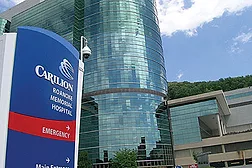
“Quality of care” is more than just a phrase at Carilion Roanoke Memorial Hospital (CRMH), one of the largest hospitals in Virginia. CRMH defines quality of care using six characteristics: excellence in care, patient safety, clinical outcome, technology advances, accessibility, and patient experience.
How many energy-efficient or certified buildings are not living up to the label? Very, very many, if this Ohio commissioning/auditing firm’s experience is close to typical. They report on common weaknesses in efficiency strategies and on real-life patterns of upgrades gone wrong across an array of equipment types. While flaws in well-intentioned processes remain, a more careful investment of human energy can still yield the desired reduction in building energy.
Done right, going modular can be a good fit for hospitals in search of efficiency. From design to specification to pre-shipment, the process demands engineering attention to the right details at the right times. Get a designer’s notes from experience and learn how to take advantage of what a modular central plant can offer.
What are the key technical challenges and design options for optimizing a geothermal heat pump design? Review the pros and cons involved with centralized or distributed pumping, with hybrid or decoupled systems, and with the controls that can guide them.
Today, commercial property owners and facility managers are constantly looking for ways to reduce their utility bills. An often over-looked opportunity arises when it is time to replace old, inefficient compressors in HVAC systems.
Kevin Amyot had serious qualms last spring when contractor Ed Friedrich first proposed a major pump-retrofit project at the Sunset Motor Inn, one of the properties Amyot manages for the H. A. Manosh Corporation in Morrisville, VT. Friedrich’s $13,000 estimate called for the replacement of 18 fixed-speed circulating pumps in the heating system at the Sunset with 10 circulators from the Grundfos Pumps Corporation.
Sometimes, what seems like a need for more cooling capacity could be the need to take a hard look and fine-tune the existing chiller plant. With a hospital expansion coming up, the team on this UMass Memorial Health Care project avoided adding up to 120 tons of capacity with tactics that included attacking inefficiencies in piping, valves, cooling towers, and controls.
A small team led by an award-winning Florida engineer decided to test conventional wisdom about pressure loss, both in a straight run and in comparing supply and exhaust scenarios. Early returns suggest the data may be flowing in an unexpected fashion.
 RSS
RSS