Cooling Towers Facing New Water Reality
Large facilities under growing pressure to conserve water are exploring alternative treatment approaches as a practical way to reduce blowdown
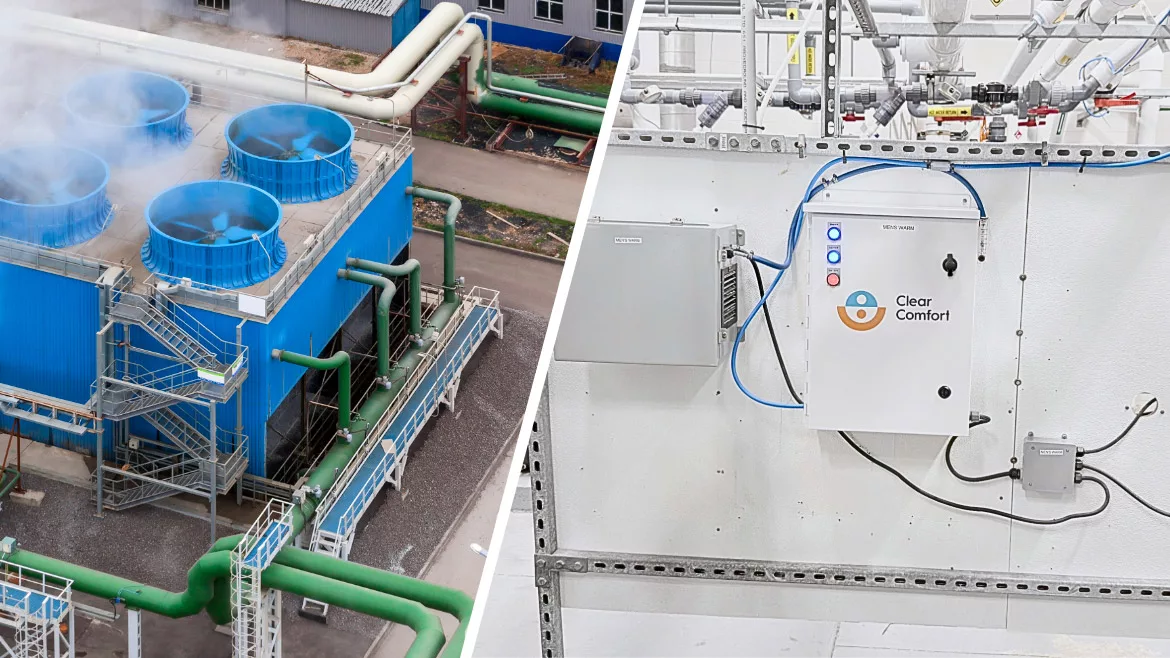
LEFT-RIGHT: Left: Cooling tower atop a Midwest food and beverage facility. Right: The advanced oxidation process (AOP) installation, compact and straightforward.
Data centers continue to attract much of the scrutiny over rising water demand in North America. While that focus is warranted, similar pressure is building across oil and gas, food processing, manufacturing, and power generation, where operators are also being pushed to find meaningful water savings without disrupting uptime.
One of the most practical targets is the cooling tower, and more specifically, the treatment strategies used to keep those systems running. Cooling towers are inherently designed to lose water through evaporation as they expel heat. That makes them a logical target for conservation because facilities can often reduce water loss within these systems without replacing core capital equipment or altering primary production processes.
While some evaporative loss is unavoidable, there is also the issue of blowdown, or the intentional discharge of water to prevent mineral buildup, scaling, and corrosion. In fact, the U.S. General Services Administration (GSA) identifies reducing blowdown as one of the most effective ways to lower a facility’s overall water footprint.
In conventional treatment programs, blowdown is part of the balancing act. As pure water evaporates, dissolved minerals stay behind and become more concentrated. To prevent that buildup from damaging equipment, operators flush out some of the concentrated water and replace it with fresh makeup water. If a facility can safely operate at higher cycles of concentration, it can reduce the amount of water that has to be discharged and replaced.
Alternative Cooling Tower Treatments Gain Momentum
As scrutiny around industrial water use continues to build, the reality of where that water goes is becoming clearer. A recent report, "Data Centers are Facing Scrutiny over Water Usage," from the Houston Chronicle noted that while data centers have drawn headlines for their water demands, thermal power plants—including nuclear, coal, and natural gas facilities—place an even larger burden on water systems.
That challenge is pushing more facilities to look beyond conventional treatment programs and consider whether a different approach can reduce blowdown without disrupting operations. One category gaining more attention is advanced oxidation process, or AOP. This approach uses reactive oxidants to reduce contaminants and treatment burden, helping facilities operate at higher cycles of concentration and lower blowdown.
“Cooling towers use a tremendous amount of water, so if you can add something to the system that has no impact on production but a major impact on water use, that becomes a very meaningful place for a power plant to look for savings,” said Shawn Ewer, Water Treatment Specialist at Aquagy.
Aquagy still provides conventional chemical treatment, but after more than a decade of working with AOP, it views the technology as another option for facilities looking to cut water and chemical demand without compromising system performance.
In public findings tied to one AOP-based system, the U.S. General Services Administration (GSA), the U.S. Department of Energy (DOE), and the National Renewable Energy Laboratory (NREL) reported average water savings of 26%, along with 50% less maintenance.
How AOP Changes the Water Equation
In many facilities, conventional cooling tower treatment is built around control rather than prevention. Operators add chemicals to limit scale, corrosion, and biological growth, then use blowdown to keep dissolved solids from climbing too high as water evaporates. That approach works, but it also creates a familiar tradeoff: the more conservative the treatment strategy, the more water often has to be discharged to keep the system in balance.
AOP changes that equation by helping create more stable water chemistry. The GSA’s cooling tower guidance makes the relationship clear: high cycles of concentration are linked to lower blowdown, while low cycles are linked to higher blowdown.
According to the Cooling Technology Institute, AOP-based cooling tower treatment helps maintain cleaner, more stable water with fewer operational variables. By reducing the organic and biological load in the system, it can interrupt the chain of events that often leads operators to rely on heavier chemical feed, unstable cycles, and rising blowdown. In many conventional programs, that burden is spread across core chemical categories such as biocides, biodispersants and cleaners, and anti-scalant treatments.
“Traditional chemical treatment is still a large part of what we do, but we never saw AOP as a competitor,” Ewer said. “We see it as another tool in the tool belt, especially for clients looking for measurable impacts on water and chemical savings.”
Proven Technology Finds New Opportunity
AOP is not a new concept. The category has been around for decades, and in cooling tower treatment, it has been used commercially for more than a decade. Its use in cooling towers can be traced back to a hospital facilities manager looking for a better way to address water quality and treatment risk in a sensitive environment. That effort eventually led to the first industrial AOP water treatment platforms, originally launched as Silver Bullet and now Clear Comfort.
In an AOP system, reactive oxidants are generated in a separate unit and introduced into the circulating water as a gas, rather than requiring the water itself to pass through the treatment device. That distinction helps explain why this alternative treatment option has drawn interest in cooling tower applications: it offers a way to improve water conditions without replacing the tower itself or shutting down the larger process to install a new treatment approach.
Field results are one reason AOP is getting more attention. At the Denver Federal Center, a 600-acre campus housing more than 20 different federal agencies, public records show the Clear Comfort system reduced average annual makeup water by more than 527,000 gallons, equal to 26.3% water savings. The same project also reported cleaner condenser tubes and significantly lower maintenance costs.
A second example from a large Midwest food and beverage facility showed a similar pattern in an industrial setting. Using the same AOP platform, the site increased cycles of concentration from 7 to 10, reduced blowdown from 75 to 50 gpm, and saved roughly 36,000 gallons of water per day.
Aquagy has seen the same type of performance over a longer operating window at one Northeast U.S. natural gas-powered electric plant.
“After more than 10 years of using the Clear Comfort technology, we’ve seen the facility reduce its chemical footprint by more than 90% and cut water consumption by more than 25%,” Ewer said. “The fact that the system can be installed without shutting the plant down makes it even more attractive for facilities looking for savings without disrupting operations.”
Beyond Water Savings
Reducing blowdown does more than conserve water. When a cooling tower can operate at higher cycles of concentration with more stable water chemistry, operators can often reduce treatment complexity, lower dependence on chlorine-heavy and corrective chemistry programs, and spend less time managing the side effects of instability.
In addition, cleaner condenser surfaces, less fouling, and fewer treatment variables can reduce maintenance burden and help protect heat-transfer performance over time. As facilities are pushed to conserve while maintaining uptime and controlling costs, cooling tower treatment is moving from a maintenance issue to a more strategic operating decision.
Looking for a reprint of this article?
From high-res PDFs to custom plaques, order your copy today!