NOx Optimization is the Next Step in Boiler Sustainability
How to future-proof emissions compliance
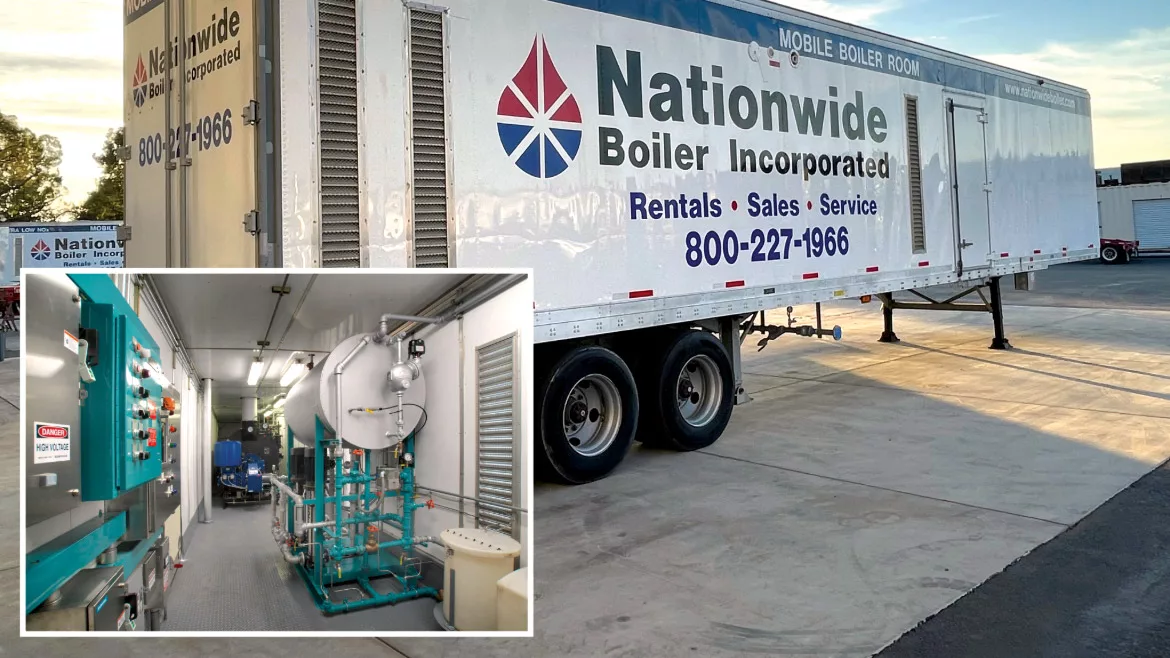
NOx: 650 HP Ultra-Low NOx mobile boiler room for temporary rental needs.
Within today’s industrial environment, emissions compliance has shifted from being a singular achievement to a continuous obligation. Since the mid 1980s, regional air districts have systematically tightened emissions standards, particularly in severe non-attainment areas like California. With routine regularity, industrial operators are being required to further reduce nitrogen oxide (NOx) emissions; from 9 ppm to 7 ppm to 5 ppm, and now to 2.5 ppm. Although these reductions may seem incremental, the resources, costs, and operational disruptions required to meet these evolving emissions standards can be significant. Consequently, forward-looking companies are reevaluating their emissions control strategies, transitioning from a short-term reactive approach to more proactive, future-oriented designs.
Why Are NOx Limits Still Dropping?
Much of the pressure to reduce NOx emissions originates from the Environmental Protection Agency (EPA). The EPA’s role is to improve air quality throughout the country by targeting pollutants like ground-level ozone, a precursor to smog that is known to cause respiratory problems and other health issues. In Southern and Central California specifically, where ground-level ozone consistently exceeds federal thresholds, local air districts are tasked with developing new regulations that continue to ratchet down contributing emissions standards. Since they have minimal authority over mobile emissions sources like vehicles, air districts instead focus on stationary sources like boilers, engines, and industrial equipment, even though these account for a much smaller percentage of total emissions. This review and reduction process will continue until attainment is eventually achieved for each regulated pollutant.
This regulatory focus has led to increasingly strict emissions limits for stationary equipment, often requiring operators to retrofit or replace systems they installed just a few years earlier. The costs of new NOx reduction equipment, re-engineering efforts, and production downtime can add up quickly, especially when the emissions reduction required is relatively small.
Designing for What’s Next
Given the inevitability of tighter emissions standards, many plants are seeking strategies that can evolve with future regulations. Instead of installing equipment that only meets today’s requirements, companies are investing in systems that can easily be optimized for future lower emissions limits, as the need arises.
This approach is particularly viable when it comes to Selective Catalytic Reduction (SCR) systems. This post-combustion technology utilizes a reagent (anhydrous ammonia, aqueous ammonia, or urea) that is injected into the flue gas to react with a catalyst and convert NOx into harmless nitrogen and water. With proper design and tuning, SCR systems can reliably achieve near-zero NOx and CO performance, as well as minimal ammonia (NH3) slip.
NOx optimization takes this a step further by evaluating existing flue gas flow characteristics and SCR / catalyst performance to determine where additional improvements can be made. It may also involve a purposeful plan that incorporates future NOx reduction capability into the original design. In some cases, achieving lower emissions may simply require improved exhaust flow and reagent mixing, or other less invasive enhancements, rather than a full system rebuild. While the process varies significantly from site to site, the goal remains the same: to reduce NOx emissions efficiently and in the most cost-effective manner, while addressing our customers’ immediate and future NOx reduction needs.
A Case Study in Agility
Consider the case of a seasonal food processor in Central California. The facility coordinates the annual rental of an ultra-low NOx boiler, equipped with a CataStak SCR system, designed to meet a 5 ppm NOx limit during their high-production summer months. Weeks before the 2024 production season, the local air district unexpectedly announced a new NOx limit of 2.5 ppm.
Instead of replacing the entire SCR system or risking non-compliance, the plant worked closely with Nationwide Boiler’s engineering team to implement an expedited Catalyst Optimization Plan. Leveraging field experience and historical data, our team developed a flow and mixing optimizer to improve catalyst efficiency without significant structural changes.
The custom hardware was designed, built, and installed in just under four weeks. Formal compliance source testing confirmed an average NOx reading of 1.9 ppm, well below the new permit limit, with no increase in NH3 slip. The facility met its emissions requirements on time and without disrupting operations during a critical production window.
This outcome demonstrates the true value of NOx optimization: enabling plants to remain agile in the face of changing emissions regulations, without the risks associated with new or unproven technologies.
The Role of Rentals in Emissions Readiness
For industries with seasonal or long-term steam needs, rental boiler programs can play a critical role in balancing operational flexibility, finite financial resources, and emissions compliance. In fact, much of the development of Nationwide Boiler’s rental fleet, in-stock boiler program, and our proven CataStak SCR systems have been shaped by the demands of our rental customers.
The ability to rent pre-packaged ultra-low NOx mobile boilers provides facilities with a unique advantage. Not only can they quickly respond to production needs, but they also gain access to proven emissions-reduction technology that can positively influence their new and existing permanent boiler systems.
Vast experience in both rental and permanent boiler installations fosters a culture of speed, quality, and proven performance. As a leading provider of mobile rental boilers and new, in-stock solutions, Nationwide Boiler has leveraged decades of experience to refine the CataStak SCR technology, building systems that are not only effective but designed to be modified or upgraded as regulations change. Our position as both a manufacturer and supplier has allowed us to remain agile, delivering fast, reliable solutions grounded in real-world operating conditions.
Optimization as a Bridge to Sustainability
While emissions compliance is the driving force behind NOx optimization, it also supports broader sustainability and decarbonization goals. Reducing NOx is one part of the equation, but improving overall system efficiency is another.
Optimized SCR systems often allow boilers to run at lower excess oxygen levels, improving combustion efficiency while lowering electrical usage. Paired with heat recovery technologies like exhaust stack economizers, which capture and reuse heat that would otherwise be lost, boilers can achieve a 6% or greater increase in efficiency, effectively reducing CO2 emissions. This translates to lower fuel consumption and reduced greenhouse gas emissions, helping align emissions control with energy and cost savings.
As industries look ahead to carbon-free fuels like hydrogen, NOx optimization is even more critical. Though hydrogen combustion produces zero carbon emissions, it burns hotter than natural gas and generates more NOx. Fortunately, our CataStak SCR systems are already capable of managing these higher NOx levels. With supply infrastructure still catching up, hydrogen may be a longer-term play, however, the NOx reduction technology needed to support it is available now.
Future-Ready Strategies for Sustainable Compliance
As emissions standards evolve and sustainability goals tighten, industrial operators must think beyond today’s minimum emissions requirements and toward long-term, proactive compliance strategies. Embracing an optimized, proactive approach to NOx reduction is not just a function of meeting today’s regulations, it is a long-term solution that helps shield a plant from unnecessary and repetitive retrofit projects and the costly operational disruptions that follow. Optimizing your NOx reduction strategy offers a smart, scalable, and cost-effective solution for facilities looking to reduce emissions in a more strategic manner.
Whether it’s modifying an existing SCR system to meet reduced emissions limits, renting an ultra-low NOx boiler for seasonal use, or purchasing a new permanent boiler solution, the emphasis is shifting toward agility, efficiency, and future compliance readiness. This mindset enables companies to maintain productivity and compliance even in the face of unforeseen regulatory shifts.
For nearly 60 years, Nationwide Boiler has helped industrial clients navigate challenging steam generation and emissions compliance requirements. With over 250 SCR installations, a fleet of over 100 rental boilers including pre-permitted, ultra-low NOx mobile boiler systems, and an inventory of new and used, in-stock equipment, our team brings the technical depth and hands-on experience needed to deliver “Emissions Compliance, Without Compromise”.
As industries continue to pursue both emissions reduction and efficiency enhancements, partnering with an experienced solutions provider like Nationwide Boiler helps ensure that compliance efforts also support broader sustainability objectives. Ultimately, NOx optimization is not just a bridge to regulatory compliance; it is a pathway to a more sustainable, adaptable, and cost-effective future for industrial operations.
Images:
1-TB1225-Ntionwide-Boiler-NOX-ULN-Mobile-Boiler-Room
650 HP Ultra-Low NOx mobile boiler room for temporary rental needs. Photos courtesy of Nationwide Boiler
2-TB1225-Ntionwide-Boiler-Case-Study-Rental
82,500 lb/hr Ultra-Low NOx rental boiler equipped with anhydrous ammonia based CataStak SCR System.
3-TB1225-Ntionwide-Boiler-Extra-SCR-Installation
110,000 lb/hr package watertube boiler equipped with a urea-based CataStak SCR System for ultra-low NOx performance.
Looking for a reprint of this article?
From high-res PDFs to custom plaques, order your copy today!