Insulating for Resilience and Efficiency: 6 Factors to Inform the Spec
Lessons learned from Borlaug Center for Southern Crop Improvement design
Thermal Strength: Flexible wrap insulation fibers are “crimped” during production, giving them improved compressive strength and better thermal performance compared to fabricated wrap. (Courtesy of Owens Corning)
Gracing the campus of Texas A&M University in College Station, Texas, the newly renovated Borlaug Center for Southern Crop Science pays tribute to agronomist and “father of the Green Revolution” Norman Borlaug’s enduring contributions to agricultural science and his belief in the power of efficiency-enhancing technologies to help improve food security. While Borlaug’s legacy is rooted in his efforts to make crops resilient and agricultural production efficient, the newly renovated Borlaug Center also makes use of mechanical insulating materials that support resilience and efficiency. The project also serves as an example of factors to consider when choosing insulating materials.
As with most building projects, multiple variables had to be considered when specifying, sourcing and installing the materials used to insulate pipes and ductwork throughout the facility. The pipe insulation, duct wrap, and flexible wrap installed in the project completed in September 2024 support domestic hot water for plumbing pipe, cold water piping in exterior wall areas and all ductwork except for general exhaust. Factors ranging from product availability to thermal performance to ease-of-install and project budget helped inform the selection, sourcing, and installation of mechanical insulating materials.
Leading up to and throughout completion of the 10-month insulating project, collaborators had to work through multiple decisions. For example, was a fabricated more rigid pipe and tank insulation a better option for pipes compared to a flexible continuous crimped blanket insulating material?
Below, we look at six factors that helped influence the selection of insulation and duct products installed at the center. Both flexible and fabricated pipe and tank insulating materials provide good thermal performance, compressive strength and handling on the job site. However, the nuances of this job prompted the contractor to choose a flexible wrap insulating material. Other considerations beyond flexibility – for example, thermal performance and project cost – also factored into the decision.
Understand the building’s purpose
Every building has a purpose and that purpose can help influence the choice of insulation. The Borlaug Center includes 24,000 square feet of leading-edge laboratories, 5,370 square feet of core lab facilities, and 3,300 square feet of computational lab space, supporting Texas A&M University faculty and the U.S. Department of Agriculture and Agricultural Research Service scientists. The clean and pristine ethos of these areas continues into other areas of the building, including the mechanical room, plenum area and piping concealed in the rotunda’s ceiling area. The contractor wanted insulating material and jacketing that would project the clean and sleek setting of a world-class research venue.
Assure availability
Beyond being easy for workers to handle on the jobsite; a material must also be available when and where it is needed. As work on the Borlaug Center’s renovated mechanical areas got underway, supply chains were continuing to unravel from historic disruptions. The contracting team sought to source an insulating material that could be dependably sourced.
The contractor also wanted a material that could be easily staged and utilized on different diameters of pipe. The flexible wrap installed at the Borlaug Center was readily available in the market and could be cut on site to fit the varying dimensions of pipes. For example, piping in the rotunda includes a network of 10” and 12” pipes that serve to channel water off the roof. Being able to transport fewer shipments of products to the job site helped streamline operations and required less room on the jobsite for product staging. Workers were able to cut the material onsite to fit the size of the pipes.

>Seamless Detail: Duct insulation seams have a smooth, clean look while supporting thermal efficiency across the Borlaug Center’s upgraded systems. (Courtesy of Owens Corning)
Factor in geometry
Insulation must often be installed around complex or geometrically challenging shapes and in tight locations. Protuberances, attachments, elbows, and interruptions in a line can present install issues. The choice to use a flexible wrap instead of a rigid, fabricated material made it easy to seamlessly navigate such disruptions and contributed to the overall aesthetics. The individual segments of fiberglass used to make the fabricated pipe and tank wrap tend to fall off of the insulation facing while cutting small or special shapes. Given that the flexible wrap is bonded together, it does not have this issue. Another factor that may have shaped the decision was that the individual segments forming the fabricated pipe and tank wrap led to a “stop sign” appearance that was undesirable for the project.
Respect safety
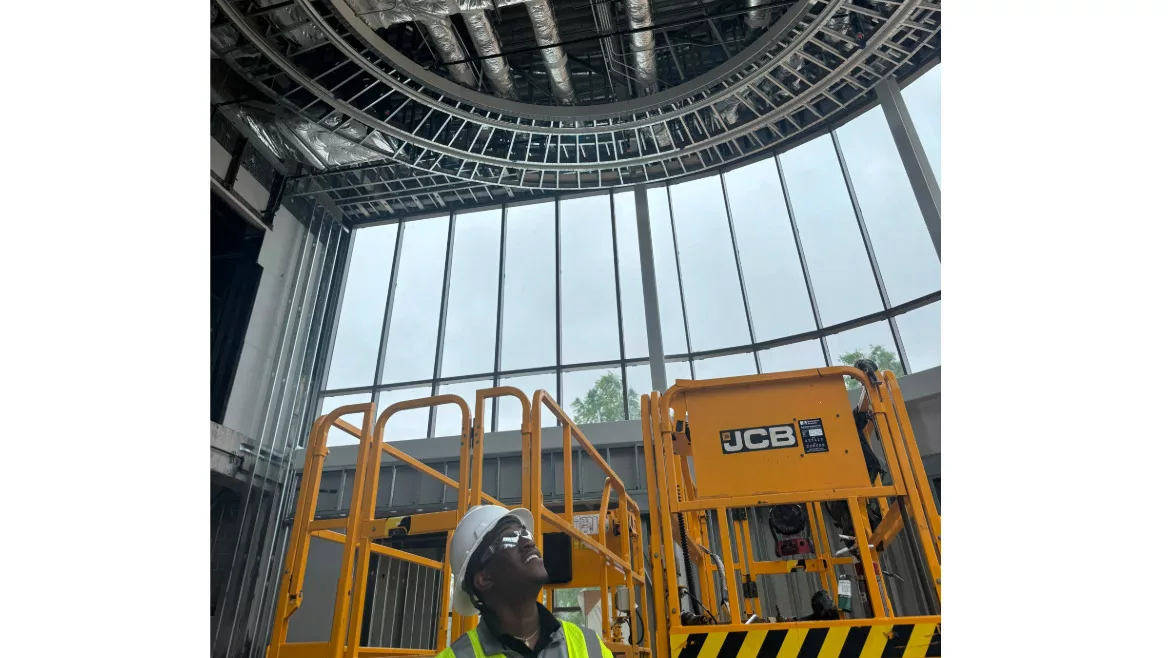
Insulating pipework can require dexterity and demands safety. The Borlaug Center’s lofty exterior rotunda is home to piping that channels water off the roof. When insulating piping, workers maneuvered a 26-foot lift to weave insulation in and out of the fur downs and grill registers. Navigating this part with a scissor lift was a challenge that underscored the importance of jobsite safety. Hot temperatures were another safety factor. Contractors working in Texas understand the stress that summer heat presents on a job. The contractor maintained hydration logs for workers to record their water breaks – important when working in high temperatures and direct sunlight.

Jobsite Safety: Installing insulation in the Borlaug Center’s rotunda required careful maneuvering and a close focus on safety and heat protocols. (Courtesy of Owens Corning)
Compare thermal performance and compressive strength
Comparing the anticipated energy costs associated with fabricated pipe and tank insulation and the flexible insulation wrap helped inform the material decision. Differences in manufacturing processes can affect both thermal performance and compressive strength of an insulating material. Production processes used to make flexible wrap give this material a slight thermal advantage compared to the fabricated pipe and tank wrap. The compressive strength of the flexible pipe and tank wrap is more than sufficient to support the weight of jacketing installed on the insulation.
This difference is because the flexible wrap insulation fibers are “crimped” during production which causes fibers to be oriented between horizontal and vertical. This improves compressive strength and maintains thermal performance. The fabricated pipe and tank wrap have the fibers in the direction of heat flow, allowing the heat to escape more easily. This results in lower thermal performance.

Material Choice: Mastic is applied to seal and protect insulation, helping ensure long-term durability and performance in the facility’s mechanical spaces. (Courtesy of Owens Corning)
Calculate and compare project cost
Two truths apply to virtually every project. First, every project is different. Second, a project always comes with a budget. Owens Corning conducted calculations to compare the cost of flexible wrap to pipe and tank wrap, and found in this incidence that the flexible wrap could save about 12.5% over the installed cost of fabricated pipe and tank.
By selecting mechanical system materials that could be efficiently sourced, that delivered optimal thermal performance and contributed to a “clean and pristine” appearance, the Borlaug Center’s mechanical room and systems respect its namesake’s enduring impact on global agriculture.
Looking for a reprint of this article?
From high-res PDFs to custom plaques, order your copy today!