What’s Tops in Rooftops
Heat pumps, greater energy efficiency, and IAQ features are among the major RTU trends
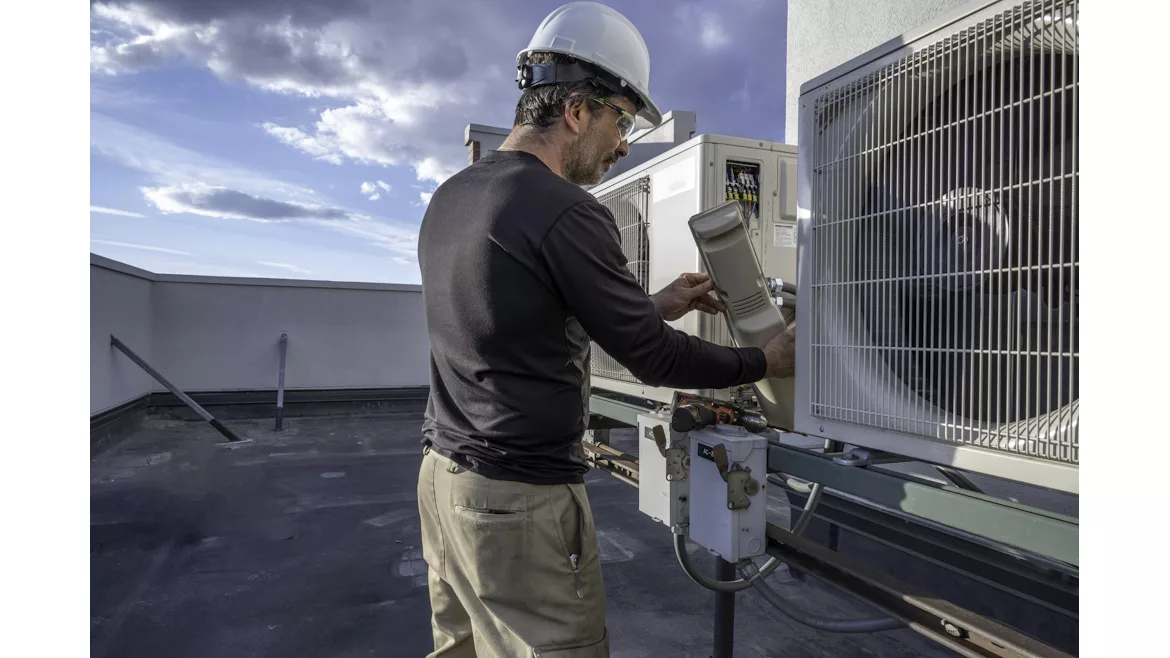
MORE IN LESS SPACE: Modern RTUs can include air-source heat pumps for both heating and cooling, or dual-fuel systems that combine a heat pump with a gas furnace. (Courtesy of Getty Images / spates)
Improved energy efficiency, along with the incorporation of more heat pumps and IAQ features, are among the trends shaping the modern rooftop unit.
Advanced controls, the use of inverter technology in fans and compressors — which contribute to greater energy efficiency — and even artificial intelligence (AI) in rooftops are also on manufacturing experts’ trends lists.
Rooftop units (RTUs) for large commercial and public buildings today are often much more than packaged furnace-a/c combinations. They can include air-source heat pumps for both heating and cooling, or dual-fuel systems that combine a heat pump with a gas furnace. They can also have dedicated outdoor air systems (DOAS), for improved IAQ, that are loaded with energy-saving technology, plus controls that can optimize conditions, allow for remote monitoring, and make servicing easier.
The Heat Pump Factor
Air-source heat pumps are increasingly used in RTUs because of their improved performance and reliability in cold climates, according to Brent Stockton, director of engineering at Aaon Inc., and Spencer Nord, applied rooftop manager at Daikin Applied. In many areas of the country, older heat pumps weren’t up to the task when ambient temperatures got low, Stockton said.
“The introduction of extended-range air-source heat pumps increases the unit’s capacity in low ambient conditions, allowing the equipment to operate through the winter and eliminate or minimize other forms of heat,” Stockton said.
“By improving low-ambient heat pump capacity and adding supplemental heating options, we ensure reliable heating performance across a wide range of climates and significantly reduce the need to burn fossil fuels,” said Nord.
Ryan Merritt, a product manager at Aaon, said the dual-fuel RTU — a heat pump combined with a natural gas or propane furnace — is also becoming more common, and helps account for the increased use of heat pumps in rooftops.
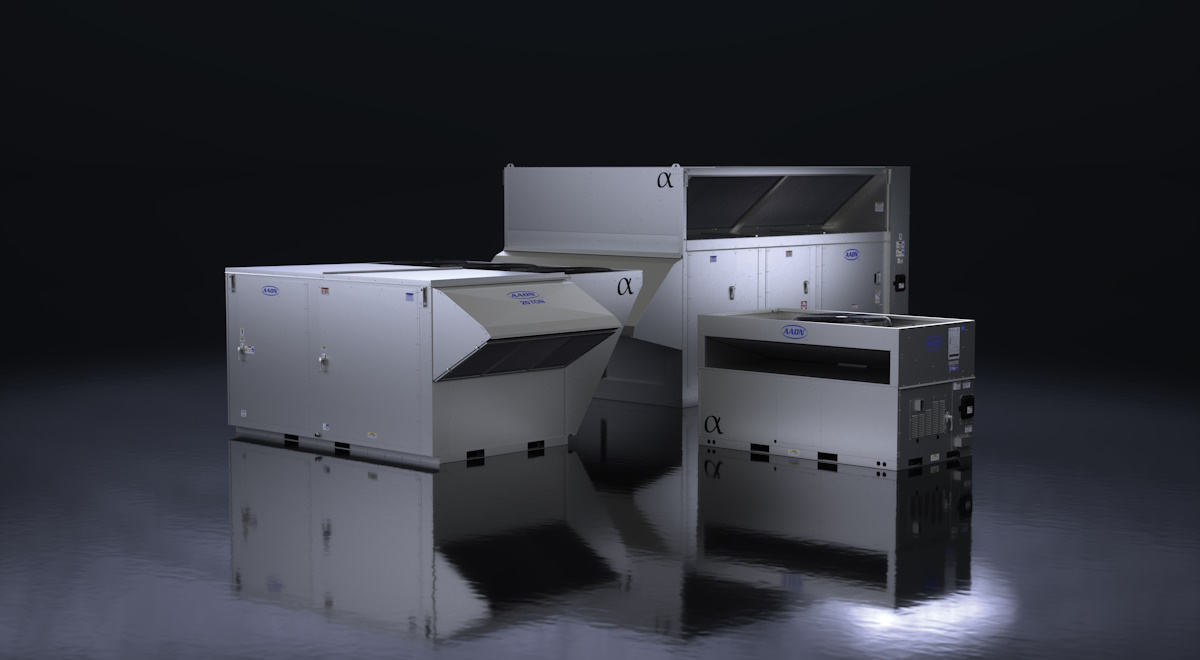
ALPHA CLASS: Three Aaon Alpha Class air-source heat pump rooftop units. Alpha RTUs are available in capacities of between 2 tons and 70 tons. (Courtesy of Aaon Inc.)
“This greatly reduces the usage of fossil fuel needed for heating when the air-source heat pump is still able to operate but cannot meet the building’s heating demand,” Merritt said.
Stingy on Energy
RTUs are also undergoing an efficiency revolution, said Melissa Schumann, who leads the large packaged rooftop portfolio at Trane Technologies. There’s been an increase of up to 30% in the U.S. Department of Energy’s minimum RTU efficiency standards over the last decade, and efficiency tiers higher than the minimum have become the norm, she said
“These higher-efficiency units provide great payback on new and replacement installations,” Schumann said.
Advanced controls are helping make RTUs more efficient, Schumann said, as well as extending their lifespans by maintaining equipment at optimal operating conditions, plus allowing for remote monitoring and diagnostics, which help to minimize downtime.
Inverter compressors are also contributing to the energy efficiency of RTUs, said Nord.
“Inverter compressors are a foundational energy-saving technology and central to the industry’s efforts to decarbonize buildings,” he said. “Inverter compressors dynamically adjust their speed to meet demand, significantly reducing energy consumption during part-load operation and extending equipment lifespan by minimizing wear. This results in superior temperature and humidity control while providing significant cost and energy savings.”
“There is a big shift away from fossil fuel heating and towards adoption of air-source heat pumps for primary heating,” said Merritt. “To meet performance and efficiency goals, and reduce overall energy consumption, variable-speed fans and compressors are required.”
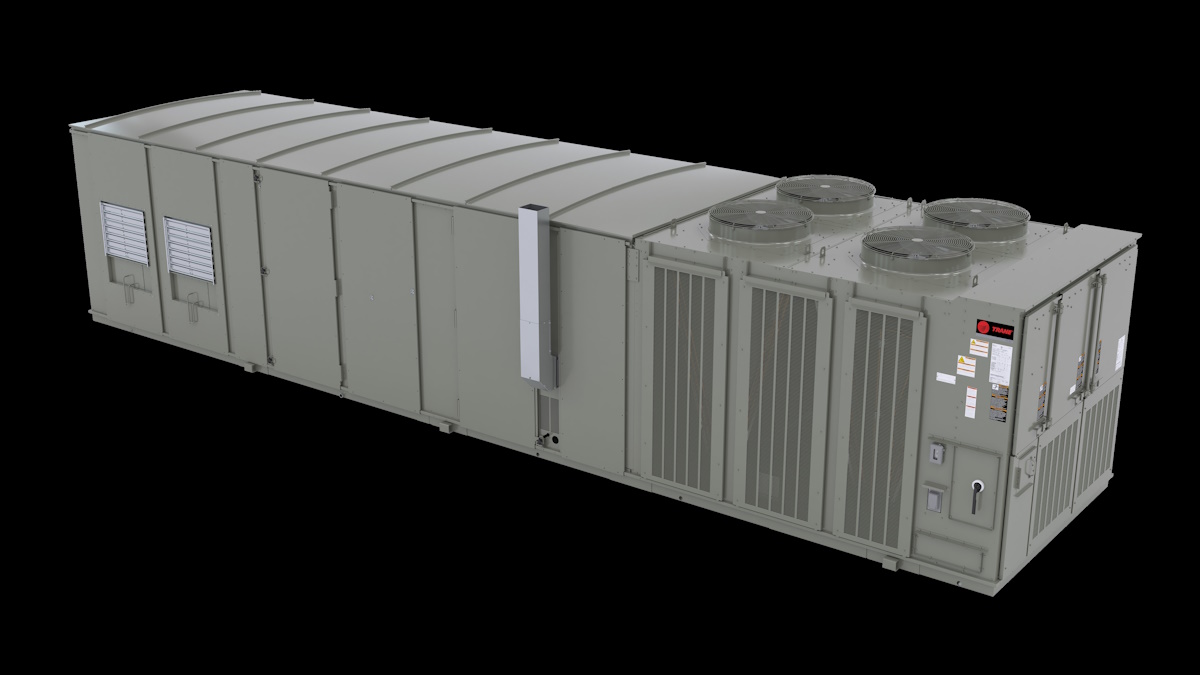
INTELLIPAK: The Trane Intellipak rooftop units are available in capacities ranging from 20 tons to 150 tons and include Symbio 800 controls. (Courtesy of Trane Technologies)
Better IAQ and More
An emphasis on IAQ “continues to play a primary role in the evolution of RTUs,” Nord added. And IAQ features in RTUs are becoming more energy efficient themselves, said Nord and Stockton.
Stockton said variable-speed supply, condenser, exhaust fans, and variable-speed compressors, in DOAS equipment contribute to greater energy efficiency, as do features like modulating hot gas reheat and energy recovery wheels, making DOAS less energy-intensive than previously, thus making better IAQ more affordable.
“Variable-speed fans, variable-speed compressors, and modulating hot gas reheat allow the equipment to meet the load across a wide range of conditions so that the supply air temperature and humidity remain constant,” Stockton said. “Energy recovery wheels greatly reduce the equipment load by recovering energy from the exhaust air stream and transferring it to the indoor air stream.”
Nord said that sorbent ventilation technology (SVT) in RTUs, which removes C02, volatile organic compounds (VOCs), and other contaminants, is also reducing the energy consumption of IAQ features.
“Using air-cleaning technology to reduce the amount of outdoor air can not only trim energy consumption and utility bills, but it can reduce capital costs by decreasing the size of unit required for the served space,” Nord said.
Nord said that artificial intelligence (AI) has the potential to “revolutionize RTU performance.” That might occur, he said, through the use of real-time data analysis and also through AI-ordered adjustments that would maximize efficiency and comfort.
“Though AI-driven RTUs are not yet mainstream, their ability to enhance performance and efficiency could make them essential in sustainable building management,” Nord said.
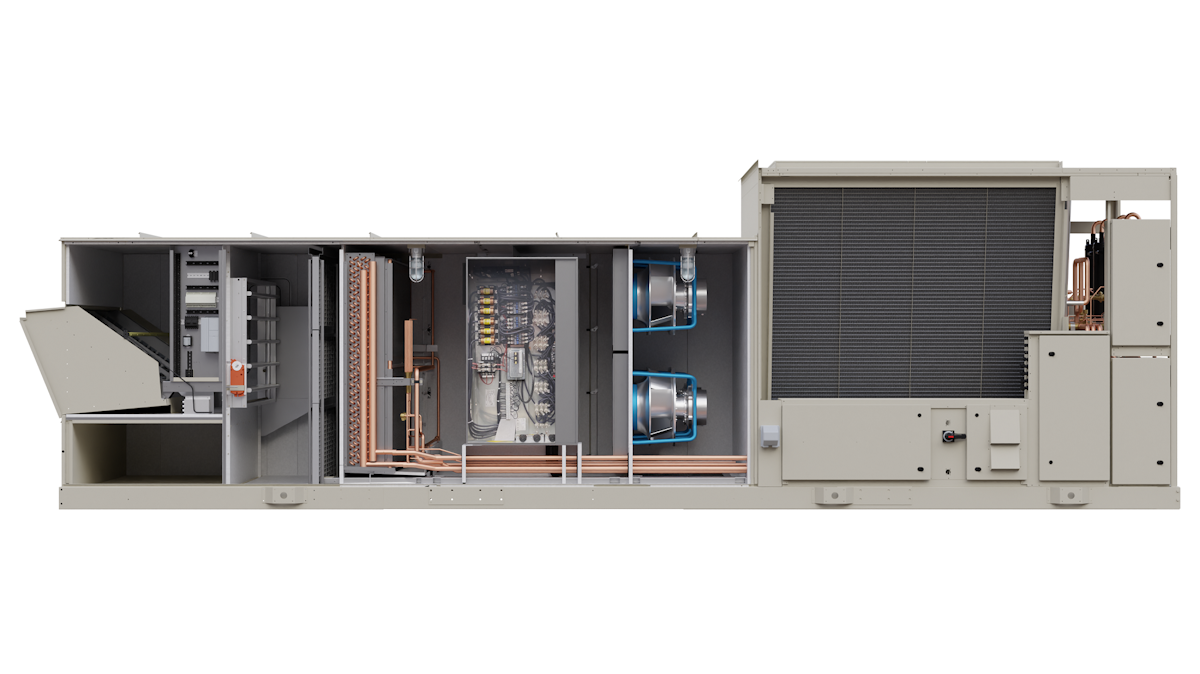
REBEL APPLIED: A cutaway of a Rebel Applied rooftop unit from Daikin Applied. The model is available in capacities that range from 20 tons to 120 tons. (Courtesy of Daikin Applied)
Up on the Roof
AI aside, the OEMs have RTU models that incorporate many of the many of the current trends.
Trane offers the Precedent RTU, in capacities ranging from 3 tons to 25 tons. It’s available with a/c equipment only, with gas heating or with a heat pump, and also with a hybrid gas-heat pump system, Schumann said. The Precedent includes Trane’s Symbio 700 control system for operation, monitoring, and servicing, and there are options for hot-gas reheat and multiple-zone variable air volume (VAV) features. The Precedent’s highest-efficiency model has an integrated energy efficiency ratio (IEER) of up to 25.4.
Recommended applications for the Precedent, Schumann said, include office buildings, stores, restaurants, schools, and warehouses.
Trane also has the Intellipak RTU model, in capacities from 20 tons to 150 tons. It’s available with a/c only, with gas heating (two-stage, modulating, and ultra-modulating), and also hot water or steam heating. The Intellipak features Symbio 800 controls, several flexible features that make it suitable for a range of applications, and a high-efficiency model with an IEER of up to 19.3. Recommended applications include multi-story office buildings, medical facilities, schools, and factories, Schumann said.
Daikin Applied offers the Rebel Applied air-source heat pump RTU, in capacities of between 20 tons and 120 tons. The Rebel Applied has electric heat pumps with inverter compressors that give it an IEER rating of up to 20, Nord said. IAQ options include SVT air-cleansing, HEPA filtration, and humidity control. The model is a good choice for schools, healthcare facilities, and office buildings, Nord said.
At Aaon, the Alpha Class heat pump RTU, available in capacities of between 2 tons and 70 tons, has an IEER rating of up to 21.5. Alphas have variable-speed compressors, can be either all-electric or electric-gas hybrids, and have DOAS capabilities when combined with Aaon’s Delta Class products.
Looking for a reprint of this article?
From high-res PDFs to custom plaques, order your copy today!