Troubleshooting Water Pumps Using Pump Basics and Old Fashion Experience
For a start, look at the existing conditions of the pump discharge and troubleshoot
The opportunities for consultants to make troubleshooting a niche business can be very beneficial when the economy slows down and, in turn, design engineering for construction projects slows down. When the economy drops off, building owners and their facility managers look to reduce utility costs through energy conservation measures. Hindsight is 20-20 when troubleshooting and poor pump performance is one of the best places to start to recommend improvements that will have a reasonable return-on-investment and/or correct an operation problem.
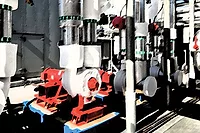
A simple walk-around in an equipment room at the HVAC pumps can identify some, if not all of the following:
- Improvement in performance on the discharge side of the pump
- Improvement in performance on the suction side of the pump
- Improvements leading to an energy retrofit
- New pump selection
- Reduced motor horsepower
- Applying variable speed drives (VSD) correctly
Starting with troubleshooting exiting conditions on the pump discharge:
- Seeing a discharge balancing valve closed more than 10% is analogous to having one foot on the gas and the other foot on the brake. The reason the testing, adjusting, and balancing (TAB) technician set this balancing valve at a specific percentage open was to meet the design engineer’s design intent for pump head (the calculated resistance the pump has to overcome to move the required gallons per minute flow). When the design engineered resistance is over estimated, which is usually the case, the TAB technician needs to introduce more resistance into the water system to achieve design intent.
Results: Added resistance equates to waste of pump motor horsepower.
Solution: If the added resistance is excessive, e.g., 25% or more closure of the balancing valve, consider replacement of the pump with a more efficient pump that will result in less motor horsepower.
If the added resistance is not excessive, consideration is to add a VSD to the system and have the TAB technician open the balancing valve 100%, and then manually reduce the motor speed until the GPM (gallons per minute) flow is reduced to the design intent for the existing pump.
- Improvement in performance on the suction side of the pump can be achieved when the system is an open system, e.g., condenser water system serving an open cooling tower and the available net positive suction head (NPSH) is less than the required pump manufacturer’s NPSH requirement per the selected condenser water pump curve. Note: closed water systems will not have an inadequate NPSH requirement because the entire system is pressurized.
Results: When NPSH criteria is not met, the pump suction pressure will either be inadequate inlet pressure or the inlet pressure will be in a vacuum state (results can be cavitation, noise, reduction in flow, and/or damage to the pump itself) that can impact the design intent, e.g., change the performance curve to something not calculated on the manufacture’s pump curve.
Solution: Adequate NPSH can be solved usually with one of two results:
- The cooling tower’s open sump reservoir is not located high enough above the condenser open-water system pump and the cooling tower will be required to be elevated to achieve adequate NPSH upstream of the pump. Resolution #1 is to raise the tower but, quite often, this issue is found after the installation has been completed and raising the tower may not be physically and/or financially possible. A second resolution to this dilemma is to build out a sump pit below the pump discharge piping and replace this condenser pump with a sump pump constructed where NPSH is not an issue.
- When the cooling tower has been installed correctly to meet the condenser water pump NPSH compliance, a reduction in this inlet head pressure can be when the pump’s water strainer becomes dirty to the extent that it restricts water flow and eventually into a vacuum operating condition. Note: The strainer is always installed just upstream of the pump to collect dirt, leaves, etc. that initially landed in the cooling tower’s open sump. This situation is not a problem if the design intent was based on a closed-loop cooling tower.
Results: As noted above, when NPSH criteria is not met, the pump suction pressure will either be inadequate inlet pressure, or the inlet pressure will be in a vacuum state. As a rule, the design engineer will require a pressure gage at the pump casing inlet and at the discharge of the pump. With a facility operation attitude, the design engineer may require a third gage installed at the water strainer inlet that allows the maintenance technician to take in and out readings across the strainer to determine whether the strainer should be blown out, discharging sediment in the screen.
Solution: There are three useful solutions to monitoring, managing, and maintaining clean condenser water strainers. The first step is to use one pressure gage in lieu of 3-individual gages. Each of the three locations, upstream of strainer, downstream of strainer/at pump inlet, and at pump discharge are manifolded and each gage has a pet cock to read one gage at a time, e.g., close pump inlet and pump discharge gages to obtain a reading at the strainer inlet. Then take a reading at the pump inlet with the other two pet cocks closed and then finally, take a reading at the pump discharge. It is seldom, if ever the three gages would be consistently in calibration with each other. Using one gage eliminated the potential for inaccurate readings.
The second step to the solution is that any gage installed upstream of the pump should be a compound gage that provides both positive and negative pressure readings. On the discharge of the pump the compound gage will provide a standard zero to 30, 40, etc. positive pressure per square inch gage (PSIG) reading. This compound gage will provide “inches vacuum” reading capability. With this configuration, the maintenance technician will have the information needed to determine when the strainer will be required to be cleaned.
The third step to the solution is to replace the inlet strained with a duplex basket strainer that allows the maintenance technician to switch the flow from one strainer basket that is dirty, to the clean basket strainer without shutting down the condenser water system while maintenance is being performed on cleaning the dirty strainer screen.
Looking for a reprint of this article?
From high-res PDFs to custom plaques, order your copy today!