Poor IAQ makes it challenging for our skin to ‘breathe’
Monitor your IAQ management plan to avoid unintended health consequences
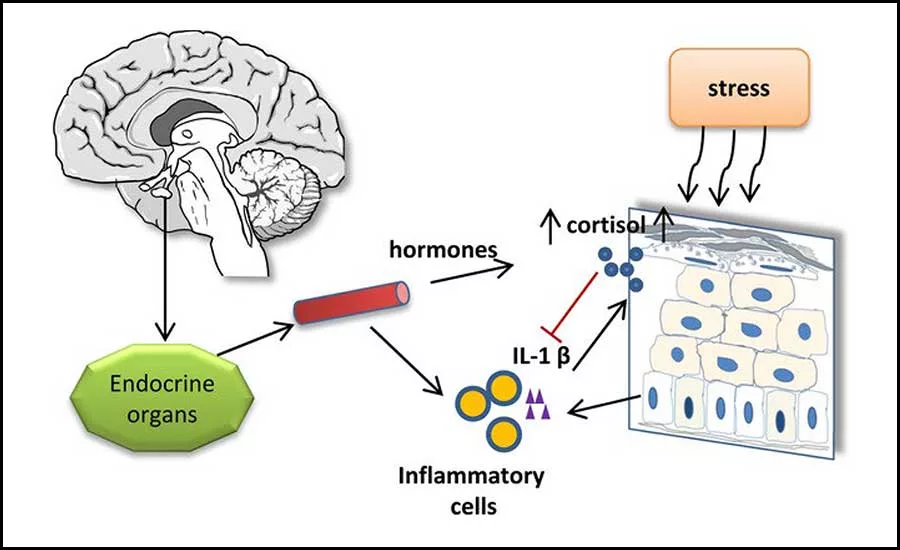
Low environmental humidity stimulates skin cell production of cortisol, an immuno-suppressant.
Image courtesy of Experimental Dermatology, Volume: 23, Issue: 1, 30 October 2013, DOI (10.1111/exd.12275)
When studying the relationship between IAQ and health, we tend to focus on exposure to contaminants through breathing. This is understandable, given the recent and very disruptive pandemic due to the SARS-CoV-2 virus that is primarily transmitted through the air. Even before COVID-19, we knew that airways provide key entry points for all sorts of contaminants, both infectious and noninfectious, potentially leading to diseases in systems beyond the lungs, such as the heart, brain, blood, and more.
Limiting the exposure of our respiratory system to poor IAQ is clearly important; however, we’ve neglected managing the impact of IAQ on our largest organ: our skin. Strategically located between the outside world and our inner physiology, skin has the challenging task of preserving carefully tuned internal conditions, while the external conditions can fluctuate widely. Skin cells sense, categorize, and respond to environmental signals, which range from pleasurable to life-threatening. It also plays a key role in maintaining a tightly controlled core temperature through evaporation of sweat and regulating blood circulation close to our body surface. The fundamental functions of detecting and responding to changes in external environments involve the production of hormones, neurohormones, and neurotransmitters that act both locally and at the systemic levels.
Skin consists of several layers that include the surface epidermis, underlying dermis, and deeper subcutaneous tissues. For the most part, these dermal layers protect our inner physiology. But, studies in the last decade have revealed that unhealthy air quality stresses skin, causing responses that actually increase our vulnerability to infections and other diseases. We want to avoid this!
Stressed skin
During our daily lives, our skin can be harmed by many factors, including ultraviolet light, visible light, infrared radiation, gases and particles from pollutants, and dry air (see Figure 1).
When encountering these extrinsic stresses, the skin responds by altering protective surface microbes (the skin microbiome), stimulating immune responses, and locally synthesizing chemicals. These local skin reactions can activate systemic immune, neural, and hormone production; systems that advance skin aging; and inflammation in addition to increasing vulnerability to cancer (see Figure 2). While previous studies have focused on the roles of inflammation and allergic reactions, recent findings show that skin can also function as an independent cortisol-generating organ when stressed. For example, when skin is exposed to dry air or to penetrating UV light, dermal cells increase the local production and release of cortisol, an immunospppressing hormone.
While we manage IAQ to decrease exposure to airborne pathogens, such as SARS-CoV-2, we need to be extremely careful to avoid IAQ management that has the unintended consequence of suppressing our immune system, making us more vulnerable to infections, inflammatory diseases, and cancer.
Looking for a reprint of this article?
From high-res PDFs to custom plaques, order your copy today!