Science enabling heat and air conditioning for long-term space habitats is almost fully available
Experiment on International Space Station aims to investigate how reduced gravity affects condensation
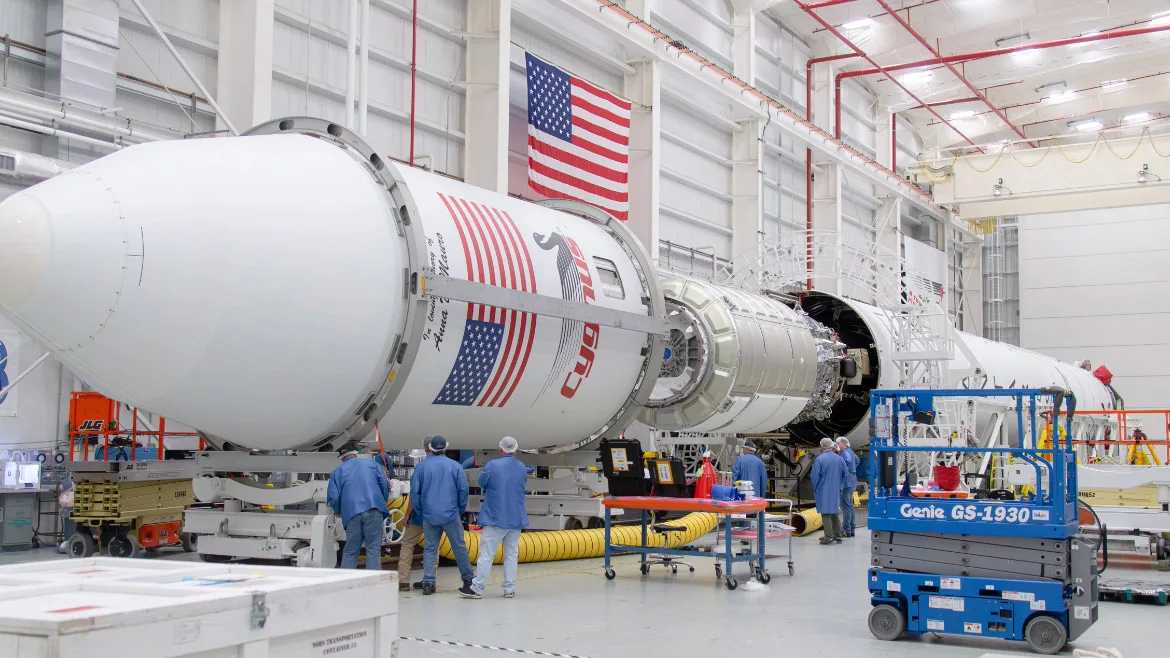
A Purdue University experiment aiming to find out how condensation works in reduced gravity is onboard Northrop Grumman’s 19th commercial resupply services mission (NG-19) to the International Space Station for NASA. Photo courtesy of NASA/Danielle Johnson
WEST LAFAYETTE, Ind. – To live on the moon or Mars, humans will need heat and air conditioning that can operate long term in reduced gravity and temperatures hundreds of degrees above or below what we experience on Earth.
Building these systems requires knowing how reduced gravity affects boiling and condensation, which all heating, ventilation and air conditioning systems use to operate in Earth’s gravity.
A Purdue University experiment that arrived Aug. 4 to the International Space Station aims to collect data scientists need to answer decades-old questions about how boiling and condensation work in reduced gravity.
Purdue professor Issam Mudawar started this project in response to a 2011 survey by the National Academies that guides NASA, the White House and Congress on areas of research to prioritize for funding. In the survey, which publishes every 10 years, numerous scientists recommended that a priority for space exploration should be studying the relationship between gravity and fluids.
The 2023 decadal survey also includes recommendations for future fluid physics research in space based on the progress of the experiments Mudawar has been conducting on the space station and the expertise he provided as a member of the survey’s panel on physical sciences.
“We have developed over a hundred years’ worth of understanding of how heat and cooling systems work in Earth’s gravity, but we haven’t known how they work in weightlessness,” said Mudawar, Purdue’s Betty Ruth and Milton B. Hollander Family Professor of Mechanical Engineering.
The experiment was transported via Northrop Grumman’s 19th commercial resupply services mission (NG-19) to the space station for NASA. The NG-19 spacecraft launched Aug. 1 from the Mid-Atlantic Regional Spaceport at NASA’s Wallops flight Facility in Virginia.
The mission carried a module for conducting the second experiment of a Purdue-designed facility called the Flow Boiling and Condensation Experiment (FBCE), which has been collecting data on the space station since August 2021.
Last July, Mudawar and his students finished their first experiment gathering data from a module of FBCE on the space station that measures the effects of reduced gravity on boiling. Using the facility’s additional components that arrived with the NG-19 spacecraft, the researchers will be able to conduct the second experiment, which will investigate how condensation works in a reduced-gravity environment.
Both experiments’ modules for FBCE will remain in orbit through 2025, allowing the fluid physics community at large to take advantage of this hardware.
“We are ready to literally close the book on the whole science of flow and boiling in reduced gravity,” Mudawar said.
To develop FBCE, Mudawar’s lab worked with NASA’s Glenn Research Center in Cleveland, which engineered and built the flight hardware funded by the agency’s Biological and Physical Sciences Division at NASA Headquarters. The team spent 11 years developing FBCE hardware to fit into the Fluids Integrated Rack on the orbiting laboratory.
FBCE’s answers on boiling and condensation will not only support exploration on the moon or Mars but also help spacecraft to travel longer distances. The farther missions are from Earth, the more likely that the spacecraft for those missions will need innovative power and propulsion systems, such as ones that are nuclear thermal or electric. Compared to other types of processes that enable heating and cooling in space, boiling and condensation would be much more effective at transferring heat for spacecraft with these systems.
In addition, FBCE data could help enable spacecraft to refuel in orbit by providing scientific understanding of how reduced gravity affects the flow boiling behavior of the cryogenic liquids spacecraft use as propellant.
FBCE is among NASA’s largest and most complex experiments for fluid physics research. Mudawar’s team is preparing a series of research papers unpacking data the FBCE has collected on the space station, adding to more than 60 papers they have published on reduced gravity and fluid flow since the project’s inception.
“The papers we have published over the duration of this project are really almost like a textbook for how to use boiling and condensation in space,” Mudawar said.
With more than 30,000 citations, Mudawar is one of the most highly cited researchers in the field of heat transfer. Google Scholar ranks him No. 1 in flow boiling, spray cooling, microchannels, and microgravity boiling. He also is the most cited author in the International Journal of Heat and Mass Transfer.
For more than a decade, Mudawar and his students have been developing three sets of predictive tools to be validated using FBCE data. One set of tools puts the data into the form of equations that engineers can use to design space systems. Another set identifies fundamental information about fluid physics from the data, and the third set is computational models of the fluid dynamics.
All together, these models would make it possible to predict which equipment designs could operate in lunar and Martian gravity.
“The amount of data coming out of the FBCE is just absolutely enormous, and that’s exactly what we want,” Mudawar said.
About Purdue University
Purdue University is a public research institution with excellence at scale. Ranked among top 10 public universities and with two colleges in the top 4 in the United States, Purdue discovers and disseminates knowledge with a quality and at a scale second to none. More than 105,000 students study at Purdue across modalities and locations, with 50,000 in person on the West Lafayette campus. Committed to affordability and accessibility, Purdue’s main campus has frozen tuition 12 years in a row. See how Purdue never stops in the persistent pursuit of the next giant leap, including its first comprehensive urban campus in Indianapolis, the new Mitchell E. Daniels, Jr. School of Business, and Purdue Computes, at https://www.purdue.edu/president/strategic-initiatives.
Looking for a reprint of this article?
From high-res PDFs to custom plaques, order your copy today!