TODAY’S BOILER | JANUARY 2023
Bigger Is Better: Rental Boiler Edition
A look back at rental boiler innovations over the past 55 years, and a look toward the industry’s future.

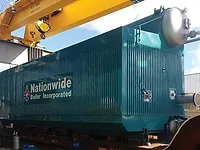
FIGURE 1. Two trailer-mounted boilers — 40,000 pound per hour (front) and 70,000 pound per hour (back) — pictured side-by-side for size comparison. Images courtesy of Nationwide Boiler Inc.
In 60 A.D., a Greek inventor in Egypt named Hero developed a machine called the “Aeolpile,” which loosely translates to “rotary steam engine.” Historians refer to it as “Hero’s Engine,” and it is believed that no one could think of a practical use for the machine upon inception. It took more than 1,700 years before the first patent on a steam engine was received by Thomas Savery. Then, in 1698, an English inventor by the name of Thomas Newcomen adapted many of Hero’s original concepts into a steam-driven pump to remove water from coal and tin mines. Half a century later, James Watt improved on Newcomen’s design by building the first modern steam engine. Not by coincidence, this signaled the start of the Industrial Revolution.
The first boilers providing steam to Watt’s engines were crude, inefficient, unsafe, and unreliable. While neither fast nor easy, enormous changes in boiler design and construction have taken place since then. This includes higher efficiency, cleaner burning, greater capacity in the same footprint, and the versatility to handle a variety of fuels. Fast forward to 1950 and the introduction of package boilers. This brought a very significant change to industrial boiler design, but it eventually became the standard.
While the history of the steam boiler is well-known and concrete, it’s hard to establish exactly when the first rental boiler was put into service. However, we do know that almost 200 years after James Watt patented his boiler design, the first reliable and efficient source of temporary steam became available: the trailer-mounted boiler, developed by Nationwide Boiler Inc. in 1967.
The very first trailer-mounted package watertube boiler was a mere 20,000 pound-per-hour (pph) unit, installed on a dedicated, highway-legal trailer. Prior to that time, “renting a boiler” consisted primarily of leasing either a steam locomotive from a railroad or renting a makeshift temporary boiler, often put together under emergency conditions to meet an immediate need. None of these early systems offered an easy way to deliver equipment to the job site. The older, jury-rigged boilers typically had to be loaded by a crane onto special low-bed trailers, and locomotives required a railroad spur, something that was often hard to come by. In addition, locomotives had extremely low capacities for their size, operating pressures were limited, and reliability was low.


Virtually every stationary steam and hot water plant has potential for using a temporary boiler. From planned maintenance to unexpected repair to increased steam demand, there are many scenarios in which a rental boiler provides a solution. With the uprising of purpose-built mobile boilers, facilities now had a reliable, temporary option that eliminated the need for special cranes to load and off-load and also cut response time from weeks to as little as 24 hours from dispatch to operation. The concept of trailer-mounted, mobile boilers signaled the start of the rental boiler industry as we know it today.
After the first two 20,000-pph, trailer-mounted boilers were built and in operation, the need for more rental units like it became very apparent. In 1972, a 24,000-pph, saturated steam boiler was mounted on a dedicated trailer. Although today this increase in size from the first trailer-mounted boiler may seem insignificant, it did represent a substantial 20% increase in capacity over the earlier units.
Capacities continued to increase throughout the years, up to 52,000 pounds per hour in 1981, and then 60,000 pph in 1985.
Then, another nearly 20% increase in capacity, up to 70,000 pph, became the standard saturated steam, trailer-mounted boiler for many years. This was until the 82,500-pph, trailer-mounted boiler was introduced in 2004. Designed for use with an economizer and flue gas recirculation (FGR), this size of boiler was able to meet an input of 99.9 MMBtu per hour and more stringent air emissions limits.
In 1993, Nationwide Boiler introduced a 120,000-pph, 400-psig, trailer-mounted boiler. At the time, it was coined as “the world’s largest mobile boiler.” As large as it was, it provided the same flexibility as the first trailer-mounted boiler, only one-sixth its capacity, which was introduced more than 25 years earlier. The current “world’s largest” mobile, saturated steam boiler, introduced in 2016, produces 125,000 pph of steam with a higher design pressure of 750 psig to support a wider range of operating pressures.
While saturated steam is more commonly utilized and preferred for heating applications, superheated steam is used in power generation and turbines, and there was an obvious need in the market for a temporary superheated steam option. Therefore, in 1998, the first high-pressure, 75,000-pph, trailer-mounted, superheated steam rental boilers were introduced. Also featuring economizers and FGR, these boilers were built with a design pressure of 750 psig to produce 750°F superheated steam.
The 75,000-pph, trailer-mounted rental boiler is still the standard today in terms of temporary, mobile options for superheated steam supply. However, another “world’s largest” trailer-mounted boiler for superheat steam applications was introduced in 2015 by Nationwide Boiler. Weighing 220,000 pounds and mounted on a trailer nearly 100 feet long, the boiler can supply up to 110,000 pph of superheated steam and is most commonly rented within the petrochemical and refining industries.


Another trailer-mounted rental boiler solution is the mobile boiler room, originally introduced to market around 1989. In the early days of the mobile boiler room, systems available included firetube boilers ranging in size from about 20-350 hp. Built with a feedwater system, water softener, chemical feed system, and blowdown separator, these units were available as complete steam plants requiring only consumables for sustained operation.
In 1998, the first 650-hp mobile boiler rooms were introduced using X-ID tube technology. X-ID tubes offered 85% higher capacity in the same footprint, allowing for a larger firetube boiler to be included in the complete temporary steam plant system. It wasn’t until 2016 that the current largest mobile boiler room became available, offering a steam capacity of up to 1,000 hp. Like the 82,500-pph, trailer-mounted boilers, these units were built to fire under 40 MMBtu per hour and facilitate air-permitting requirements in Texas.

Looking forward, we continue to see advancements in the boiler capacities offered for rental. While the current “world’s largest” saturated steam, trailer-mounted boiler is 125,000 pph, Nationwide Boiler is pushing the limit again with an even larger trailer-mounted boiler now in production: 150,000 pph. This increase in capacity is achievable with Superior Boiler’s new DFW watertube boiler design, offering a higher steam capacity in the same overall footprint. Along those same lines, DFW technology has allowed an increase from 75,000-pph, superheated steam boilers to 85,000- and 82,500-pph, saturated steam boilers to 100,000 pph. And with more than half a dozen 100,000-pph, trailer-mounted boilers already on the market for rent, these may well become the new market standard for large, saturated steam demands in a single boiler package.
Looking back at the innovations in the rental industry these past 55 years, there is one obvious commonality: bigger is better. From 20,000 to 150,000 pph, the steam capacity of a single, trailer-mounted boiler package has increased by a whopping 650% since the first unit ever built. Only time will tell what’s in store next for the rental boiler industry, but, if the trend continues, it’s likely to include bigger, better boilers.
Chelsey Ryker is marketing manager for Nationwide Boiler Inc.
Looking for a reprint of this article?
From high-res PDFs to custom plaques, order your copy today!