Data Centers Are a Hot Market — Don’t Waste the Heat!
Data centers and high-performance computing centers always require cooling and constantly reject heat. When built as stand-alone facilities, this heat is rejected, and any opportunity to recover it is lost.
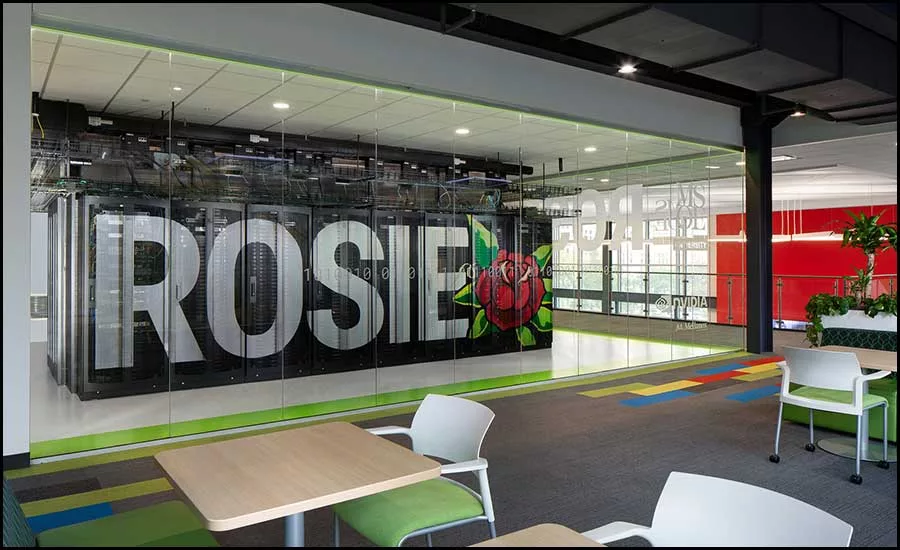
Located in the heart of campus on Milwaukee Street, the new Dwight and Dian Diercks Computational Science Hall at the Milwaukee School of Engineering (MSOE) is the academic home for the university’s first computer science degree. The building encourages truly transformative cross-departmental collaboration via its technologically advanced spaces. Artificial Intelligence (AI) is also employed to enhance the curricula of existing degree programs at the University, most notably the engineering disciplines, business, and nursing.
Since data centers require continuous cooling (expelling waste heat throughout the year), mixed-use buildings or campus settings provide opportunities to employ waste heat recovery from the data center and reduce overall energy consumption.
Data centers and high-performance computing centers always require cooling and constantly reject heat. When built as stand-alone facilities, this heat is rejected, and any opportunity to recover it is lost. SmithGroup has successfully implemented ways to integrate data centers in mixed-use sites, utilizing waste heat to optimize the energy demands of the buildings.

Combining Offices, Laboratories, and High-Performance Computing Environments for Maximum Energy Savings
Laboratories condition large amounts of outside air that must be heated. In winter, offices require heating as well. At the U.S. Department of Energy’s (DOE) National Renewable Energy Laboratory (NREL) campus in Golden, Colorado, SmithGroup’s design challenge was to align the heat rejection of the high-performance data center with the heating demands of laboratories and offices to improve the energy efficiency of the facility and campus.
Within the building are three major hydronic systems that support cooling, heating, and energy recovery, with the heating system split into both low and high-temperature loops. The role of the energy recovery system is to extract the waste heat from the liquid-cooled data center and transfer it to the building and campus (in summer) as the first stage of heating. The balance of waste heat not reused is then efficiently rejected to the environment.
This approach provides for campus and building heating in summer and low-temperature building heating year-round. Low-temperature heating supports offices, conferencing, and radiant-floor systems. The high-temperature system, supplemented by the campus in winter months, is dedicated to the laboratories. To maximize recovery even with supplemental heating, the hottest water is directed to the high-bay laboratories, then is used a second time to temper outside air. This generates a large temperature differential that allows data center waste heat recovery to continue throughout the winter months.

This award-winning LEED Platinum-certified project has one of the most efficient data centers in the world and a net-zero energy-capable office. It demonstrates the ability of data centers to supply heating for the diverse demands of laboratories, offices, and campuses.
Integrating Artificial Intelligence Computing Within a Higher Education Facility
In the heart of campus at the Milwaukee School of Engineering (MSOE), the new Dwight and Dian Diercks Computational Science Hall is the academic home for the university’s first computer science degree. The facility encourages transformative cross-departmental collaboration via its technologically advanced spaces. Artificial intelligence (AI) enhances the curricula of existing degree programs at the University, notably the engineering disciplines, business, and nursing.

Funded primarily by a $34 million donation from MSOE alumnus and Dwight Diercks, senior vice president, NVIDIA, and his wife, Dian, the focal point of the building is an air-cooled supercomputer powered by state-of-the-art NVIDIA graphics processing units (GPU). The supercomputer, affectionately known as “Rosie,” pays homage to the pioneering 1940s women who worked as human computers calculating ballistic weapons trajectories, some of whom went on to program the early electronic numerical integrator and computer (ENIAC).
While the supercomputer occupies only a fraction of the 65,000-square-foot new computer science facility, it consumes over 60% of the building’s energy. While the data center needs cooling year-round (rejecting waste heat), the academic and office buildings fluctuate between cooling and heating over the year. SmithGroup recognized the opportunity to improve the building and data center energy efficiency by looking at the different energy needs by season, occupancy, and space use.
For summer cooling and dehumidification, the HVAC system delivers chilled water at colder temperatures than the data center needs. Instead of designing the data center around the colder chilled water temperatures, the data center was instead designed to utilize the building’s warmer chilled water return as primary cooling, which includes waste heat from educational and office spaces. This approach raises the temperature of the chilled water return, increasing the energy efficiency of the entire building.
During winter months, when the base building does not need cooling, the data center switches to dedicated rooftop condensers which make use of the “free cooling” of the cold Milwaukee winters to reduce energy demand. As the data center is designed around warmer chilled water return temperatures, this transition to free cooling occurs sooner.
This flexible approach to data center cooling allows for increased energy efficiency and economization under normal conditions but can react quickly to meet the increased demands of the supercomputer during peak usage.
Campus Energy Master Planning with Waste Heat from Next Generation Supercomputing

SmithGroup was retained by the DOE’s Argonne National Laboratory (ANL) to conduct studies and master planning for energy recovery on their campus outside of Chicago. ANL is in the process of preparing for the next generation of exascale high-performance computing, which is more powerful than the previous generation’s top 100 supercomputers combined.
When the supercomputer comes online, it will be the largest consumer of energy at the ANL campus. The new supercomputer will use over 20 megawatts of power and generate waste heat year-round in the form of 95°F water. While the supercomputer waste heat exceeds all the heating demands of the adjacent laboratories, its lower water temperature limits its application for laboratory heating.
Heat recovery studies evaluated the application of heat recovery chillers to cool these data center “process” loads while simultaneously providing a higher quality of heating water currently generated by campus steam. There is also an opportunity to utilize the low-grade waste heat directly to assist in the heating of outside air.
ANL has undertaken these studies as part of a larger initiative to improve campus energy efficiency, lower its carbon footprint, and reduce water consumption on campus. The approach reduces utility costs while also improving systems resilience and sustainability in alignment with ANL’s long-term infrastructure goals.
With increasing energy demands and costs, co-locating data centers in mixed-use sites creates excellent opportunities to improve energy performance. SmithGroup’s integrated approach and energy recovery expertise have successfully delivered solutions for these critical environments.
This article first appeared on SmithGroup’s Perspectives website. See the original article in its entirety here: https://www.smithgroup.com/perspectives/2022/data-centers-are-a-hot-market-dont-waste-the-heat.
Looking for a reprint of this article?
From high-res PDFs to custom plaques, order your copy today!